
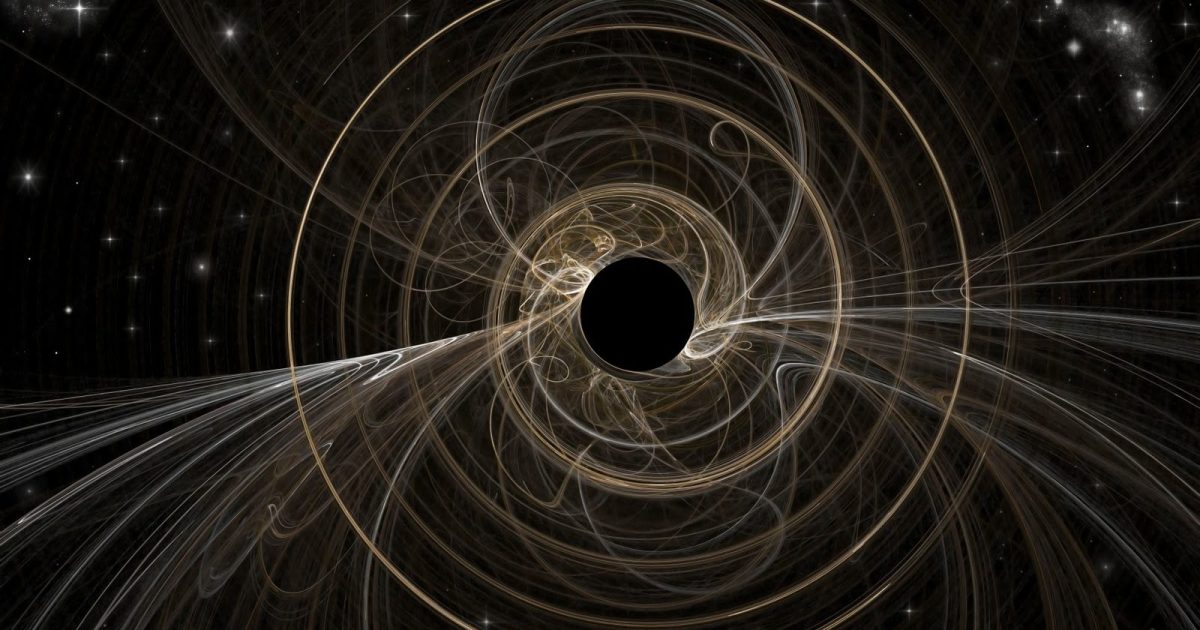
Here in our Universe, there’s a big puzzle at the heart of every black hole. According to Einstein’s general relativity, for every black hole that exists within the Universe, there are only three properties that go into it that matter in any way:
the black hole’s total mass,
the black hole’s net electric charge,
and the black hole’s intrinsic angular momentum,
and that’s it. It doesn’t matter what type of matter (or antimatter, or dark matter) went into the black hole in order to form it; all that matters is its mass, charge, and angular momentum.
But in addition to a Universe governed by Einstein’s general relativity, we also live in an inherently quantum Universe. Quantum mechanically, there are all sorts of bizarre phenomena that cannot be avoided, from uncertainty to entanglement. It’s that latter property, entanglement, that led to this week’s big question, coming from Patreon supporter Jeff Bonwick, who wants to know:
“If two particles are entangled, and one of them crosses a black hole’s event horizon, does that break the entanglement? Or can we measure the particle that’s outside the black hole and thereby glean information about its interior?”
This brings us to the intersection of two very important concepts at the frontiers of physics: black hole information and the nature of quantum entanglement. Let’s take them on individually, and then afterward, try to bring them together to ultimately answer the question.

A wine glass, when vibrated at the right frequency, will shatter. This is a process that dramatically increases the entropy of the system and is thermodynamically favorable. The reverse process, of shards of glass reassembling themselves into a whole, uncracked glass, is so unlikely that it never occurs spontaneously in practice. However, if the motion of the individual shards, as they fly apart, were exactly reversed, they would indeed fly back together and, at least for an instant, successfully reassemble the wine glass. Time reversal symmetry is exact in Newtonian physics, but it is not obeyed in thermodynamics.
Credit: BBC Worldwide/GIPHY
Black hole information
In our regular, everyday Universe, one of the most important rules you can count on is the second law of thermodynamics. As time goes on, entropy increases, and that means many things all at once.
It means that systems spontaneously tend toward equilibrium.
It means that, over time, less energy can be extracted from a system to perform work.
It means that systems “lose their memory” of their initial conditions over time, and become more like a thermal bath.
And, because information and entropy are very closely linked, it means that the information encoded in quantum particles cannot be fundamentally destroyed.
That last part is very important for us when it comes to black holes, because that seems like it doesn’t match up with what Einstein teaches us about black holes. If you were to take a book and burn it, the information that was written in the book will still survive. The combusted material from the book cover, the pages, and the ink will still physically exist, even if they’re converted into ash. If you could track and gather up all of those particles, you could, in principle, still reconstruct the information that was written in the book. It may get converted into a difficult-to-reconstruct form, but the information that was in that book doesn’t get destroyed.
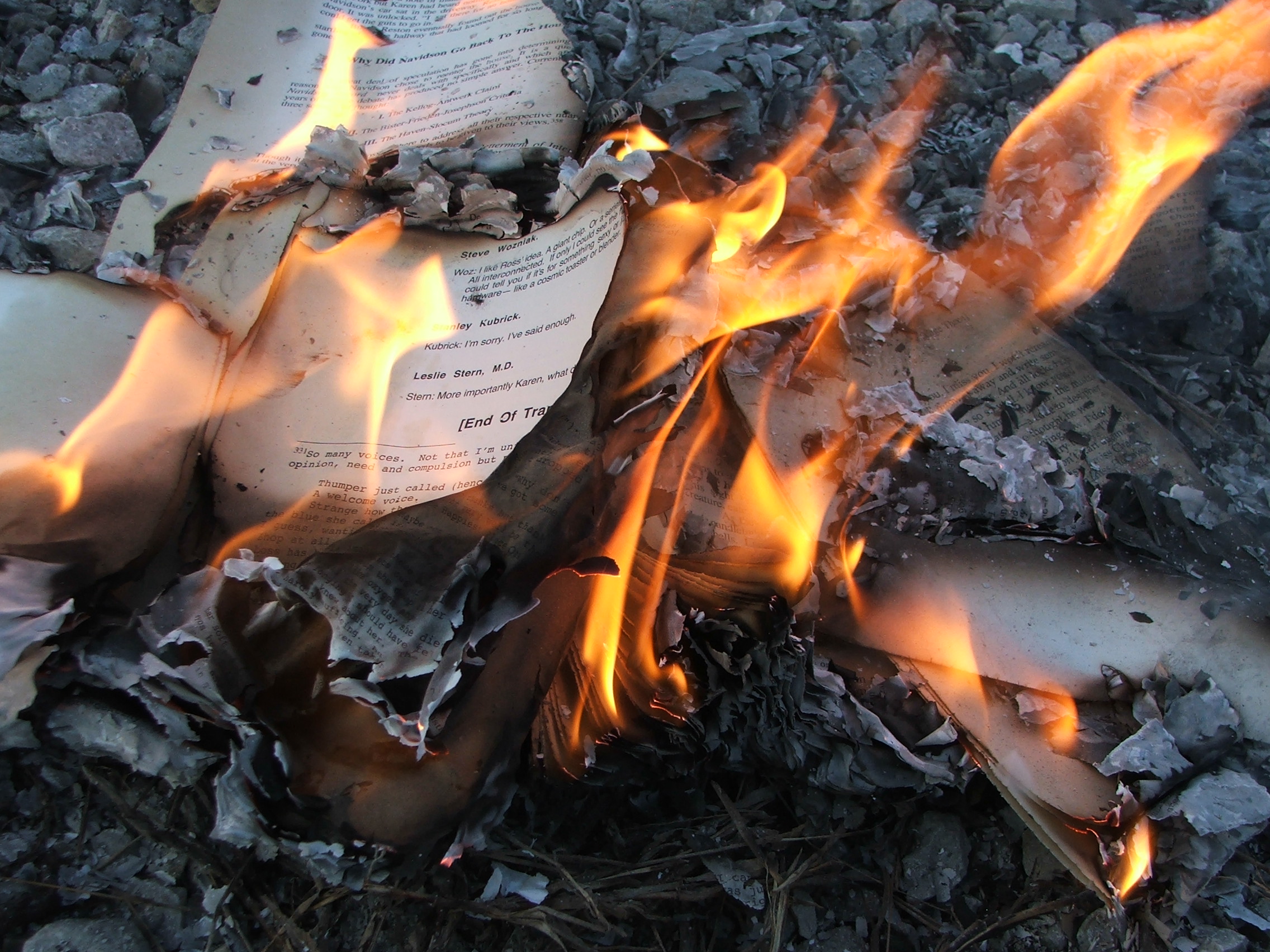
This photograph from the burning of an actual book might lead one to believe that the information within the book is completely destroyed by the process of combustion, but in reality the particles that made up the book, including the ink and the paper, still exist. In principle, that information could be reconstructed from the burned ashes, smoke, and other particles that were once a part of that book that still persist.
Credit: LearningLark/Wikimedia Commons
But if you toss that book into a black hole, it doesn’t matter what the cover, pages, or ink was. All that matters are those three parameters: mass, charge, and angular momentum. It would seem to imply that when you throw a book into a black hole — or any information-containing system, for that matter — the information really does get destroyed.
It was by thinking about that problem, back in the 1970s, that led scientists like Jacob Bekenstein and Stephen Hawking to develop a deeper understanding of how entropy and black holes work together. What their work uncovered is that, while general relativity only cares about mass, charge, and angular momentum for fully describing the spacetime of a black hole, thermodynamics requires a bit more than that.
What they were able to show is that the entropy of a black hole, which is a measure of its information content, isn’t zero, which is what it would be in the context of general relativity alone. Instead, the information of a black hole is proportional to the black hole event horizon’s surface area, which itself is determined by those three Einsteinian parameters: mass, charge, and angular momentum.
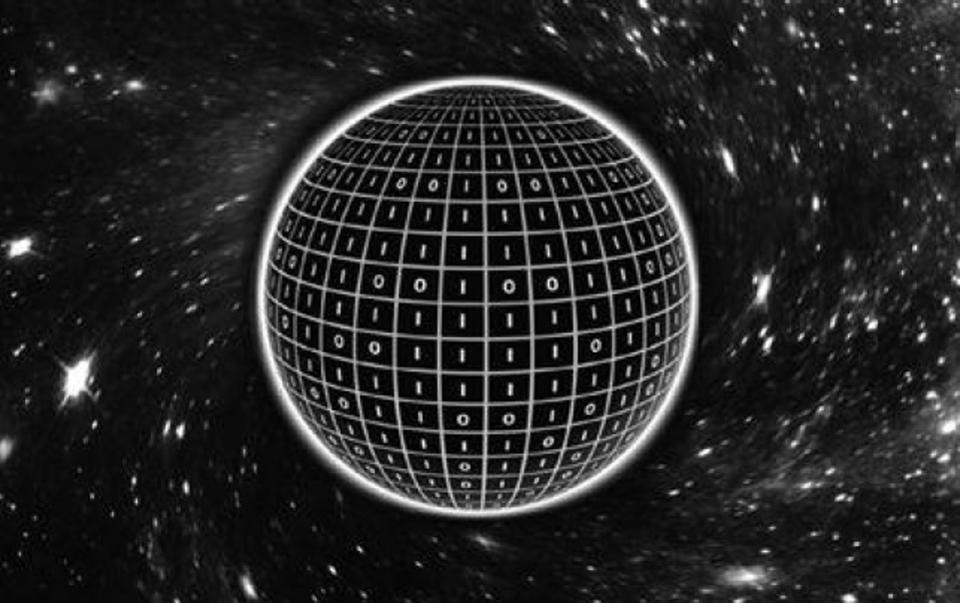
Encoded on the surface of the black hole can be bits (or quantum bits, i.e., qubits) of information, proportional to the event horizon’s surface area. When the black hole decays, it decays to a state of thermal radiation. As matter and radiation fall into the black hole, the surface area grows, enabling that information to be successfully encoded. When the black hole decays, entropy will not decrease, but rather will remain constant, as Hawking radiation is an entropy-conserving (adiabatic) process. How or if that information is encoded into the outgoing radiation is not yet determined.
Credit: T.B. Bakker/Dr. J.P. van der Schaar, Universiteit van Amsterdam
The larger in mass your black hole is — and, to a lesser degree, the greater its charge and/or angular momentum — the greater the surface area of the event horizon is. The amount of “room” it takes to encode one bit of information on the event horizon surface is one Planck area: the Planck length (about 10-35 m) in width multiplied by the Planck length in height. The idea is that whenever a quantum of any type crosses over the event horizon, from the outside to the inside, the black hole grows slightly, and the information from the infalling particle gets imprinted onto the additional area of the event horizon. Instead of zero entropy, the entropy of black holes is enormous.
This means that, going back to the example of the book, if you tossed a book into a black hole and it crossed over the event horizon, the information contained in that book would somehow be imprinted onto the event horizon’s surface. However, because black holes evaporate via Hawking radiation over long enough cosmic timescales, those surfaces eventually disappear. Is that information somehow encoded in the outgoing radiation, even though the physics we know simply predicts a thermal blackbody spectrum for Hawking radiation? And if so, how? This problem is still unsolved, and is known as the black hole information paradox.
All of this provides the background we need on black hole information to move onto the next part.
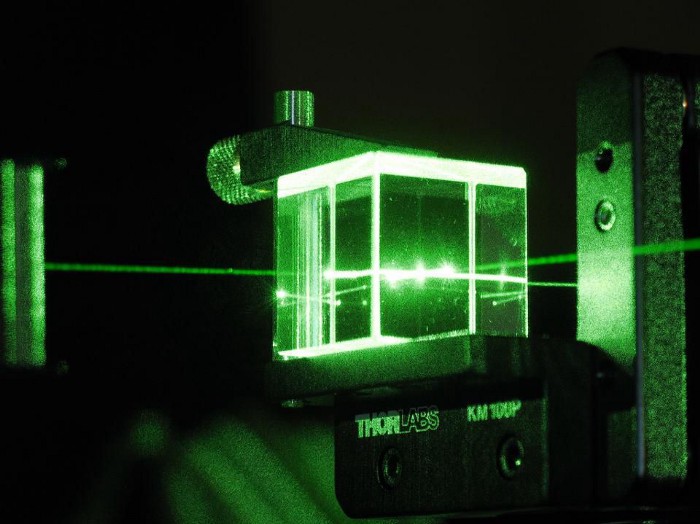
By creating two entangled photons from a pre-existing system and separating them by great distances, we can ‘teleport’ information about the state of one by measuring the state of the other, even from extraordinarily different locations. Interpretations of quantum physics that demand both locality and realism cannot account for a myriad of observations, but multiple interpretations all appear to be equally good.
(Credit: Melissa Meister/ThorLabs)
Quantum entanglement
Now we come to the idea of quantum entanglement. Entanglement is a relatively straightforward concept, but it’s often misinterpreted in popular explanations. The “straightforward” part is to imagine that you have a quantum particle, such as a photon, and that by having this particle interact with another physical system of particles, like a crystal, then two quantum particles will emerge with properties that are linked, or entangled, with one another. The misinterpreted part usually goes something like this:
we knew some information about the quantum state of the original particle,
and we can measure information about either member of the two particles that emerge from the system,
and once we measure information about the first member, we instantaneously know the quantum state of the other member.
That’s not quite right, even though that’s how it’s often presented. In reality, the information you get from measuring the first quantum particle allows you to know more information about the second quantum particle than random guessing would provide, probabilistically, but not to know its exact quantum state. In reality, you need to actually measure both particles and then bring the results together to know the states of both particles.
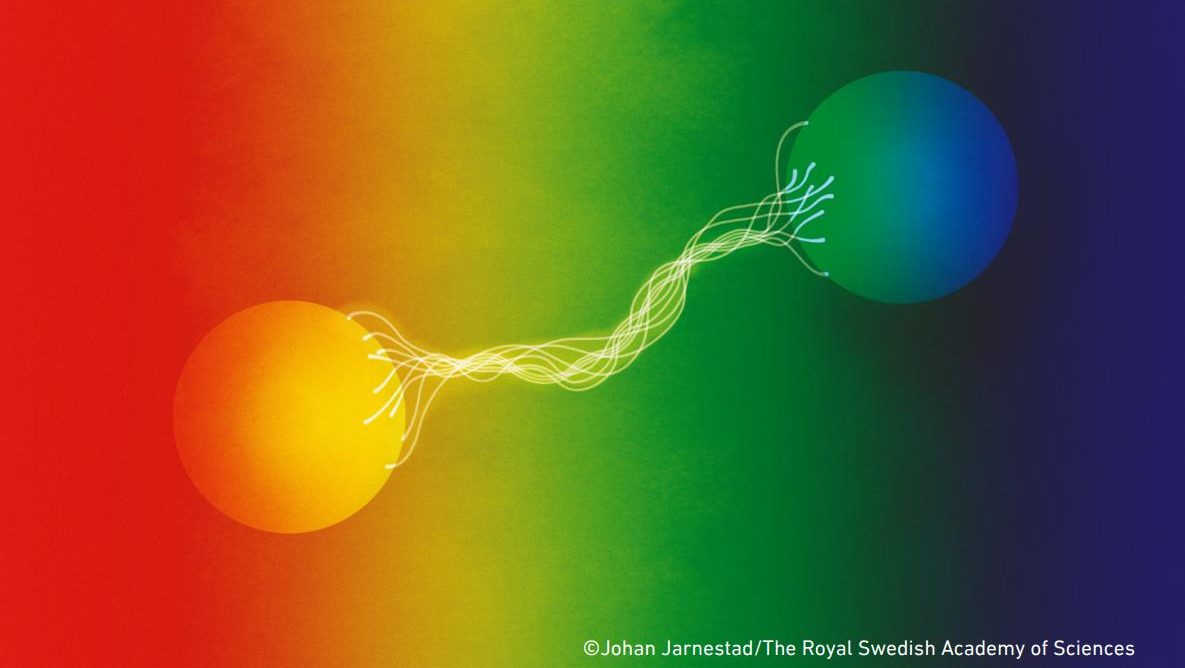
Illustration of two entangled particles, separated in space and each with indeterminate properties until they are measured. It has been experimentally determined that neither member of the entangled pair exists in a particular state until the critical moment at which a measurement occurs: the key aspect which enables many modern quantum technologies. Whether there’s an actual “connection” between these entangled particles, in any sense, remains to be determined.
Credit: Johan Jamestad/The Royal Swedish Academy of Sciences
Only in a statistical sense, by preparing these quantum states over and over again and taking the results of many independent trials, can you see how the knowledge of one particle’s quantum state allows you to do better than random guessing in determining the state of the second particle. There is no faster-than-light communication, and there are no hidden variables causing an instantaneous transmission of information. Instead, there’s just the bizarre and counterintuitive laws of quantum physics, linking the quantum states of these particles in a non-trivial and subtle way, but in a way that we can predict and measure the effects of this entanglement once we have information about both members.
It’s also important to recognize that entanglement, where the quantum state of two (or more) quanta are related to one another, is very difficult to maintain. Here on Earth, the reason for that is because there are so many other quanta around no matter what we do. Even in the most pristine vacuum we can create in a laboratory setting, there are still photons, neutrinos, and charged particles zipping through it. Whenever you have an energetic enough interaction with another quantum particle, you can alter your original particle’s quantum state. Entanglement is only maintained if there are no quantum interactions that either determine, “pick out,” or measure your particle’s state. If you “force” the particle into a certain state, that also destroys entanglement.
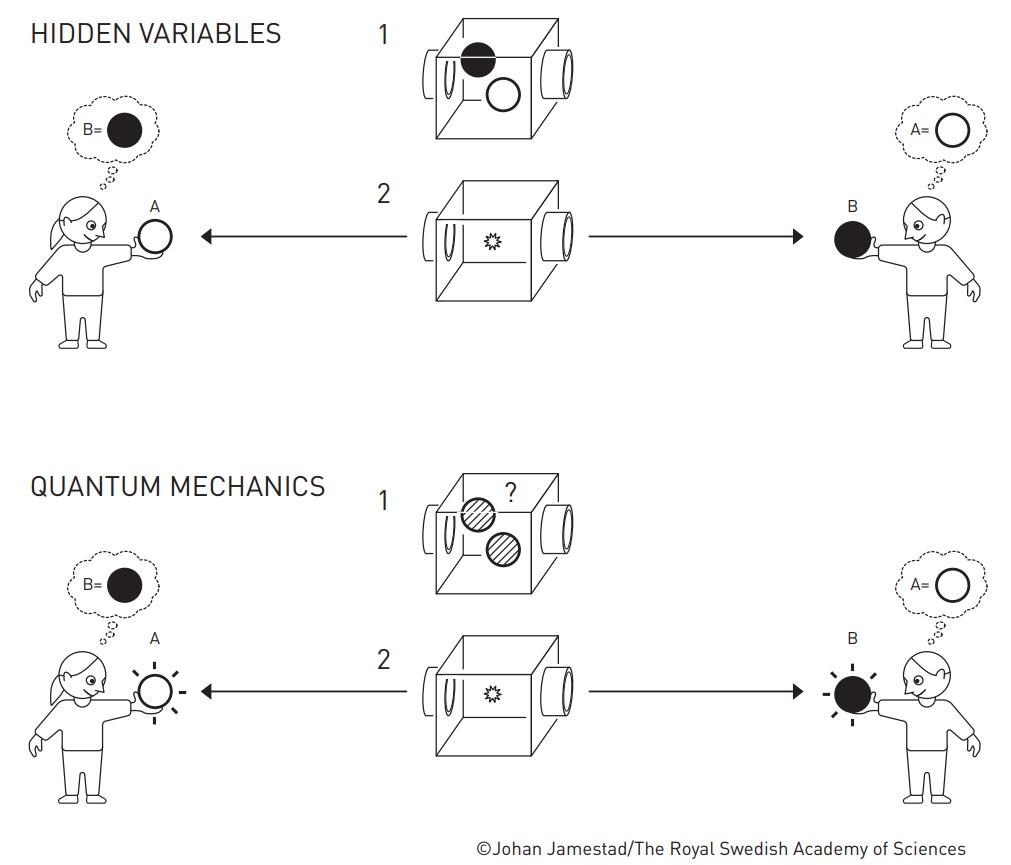
Quantum mechanics’ entangled pairs can be compared to a machine that throws out balls of opposite colors in opposite directions. When Bob catches a ball and sees that it is black, he immediately knows that Alice has caught a white one. In a theory that uses hidden variables, the balls had always contained hidden information about what color to show. However, quantum mechanics says that the balls were gray, or a combination of black and white, until someone looked at them, when one randomly turned white and the other black. Bell inequalities show that there are experiments that can differentiate between these cases. Such experiments have proven that quantum mechanics’ description is correct, and the balls have an indeterminate color until the measurement is made.
Credit: Johan Jamestad/The Royal Swedish Academy of Sciences
But remember: entanglement doesn’t say that “if you measure the quantum state of one member of your entangled pair, you immediately know what the quantum state of the other particle is.” That’s not only untrue, it’s probably the most common misconception associated with entanglement. As long as entanglement is maintained, then if you measure the quantum state of one member of an entangled pair, you can predict the quantum state of the other member to greater than 50% accuracy, but to less than 100% accuracy, always. In fact, it was the demonstration of this fact of nature that led to the 2022 Nobel Prize in Physics.
We know that many scenarios where hidden variables underlie these correlations have been falsified, and there are many theorems that place further constraints on what unseen dynamics could possibly be governing these systems. To the best of our current knowledge, the indeterminism inherent in quantum systems — even in entangled quantum systems — is not a limit of our human ability to “know” the underlying true state, but rather is a limit of nature, where the state itself is not determined until it is measured. As soon as the state of one particle is measured, picked out, determined, or forced into a certain state, the entanglement is now broken. But until you measure the state of the other member of the entangled pair, you can’t know what its quantum state actually was.
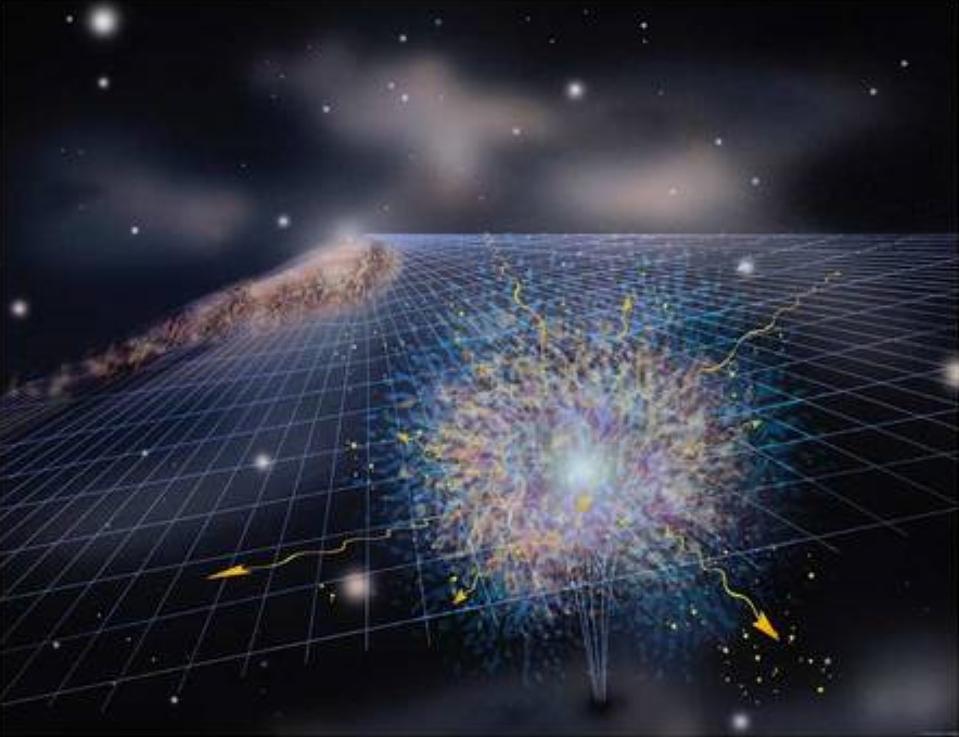
It’s generally assumed that at some level, gravity will be quantum, just like the other forces. While the semi-classical approximation for computing the decay of black holes involves performing quantum calculations in the classical background of Einstein’s curved space, that approach might not be valid for capturing the full suite of physical behavior that the outgoing radiation possesses, particularly as far as information is concerned. When black holes evaporate, we don’t know whether, or how, information from what went into creating that black hole is encoded into that outgoing radiation.
Credit: Aurore Simmonet
Entanglement across a black hole’s event horizon
Now that we’ve covered some background on black holes, and in particular on black hole information, as well as the background on quantum entanglement, we come to the big question: what happens when you have an entangled pair of particles, and one of them falls into the black hole, while the other escapes?
All we’ll ever practically have access to, from outside the black hole, is the escaping member of the entangled pair. We can measure one of its properties, if we like, that’s very sensitive to entanglement: something like its spin in one particular direction. If the spin is positive (spin up), then we can know — again, to greater than 50% accuracy but less than 100% accuracy — what the spin of the entangled member that fell into the black hole must have been. If the spin is negative (spin down), it’s the same story: greater than 50% knowledge, but less than 100% knowledge, of the other member of the entangled pair.
But now, we come to the problem of knowledge: in order to know whether the entanglement persists (where we have greater than 50% knowledge) or is broken (where the second particle’s spin is independent of the first, and so we only have 50/50 knowledge), we actually have to go and measure or determine the second particle’s quantum state. And we can’t, because it’s now behind a black hole’s event horizon!
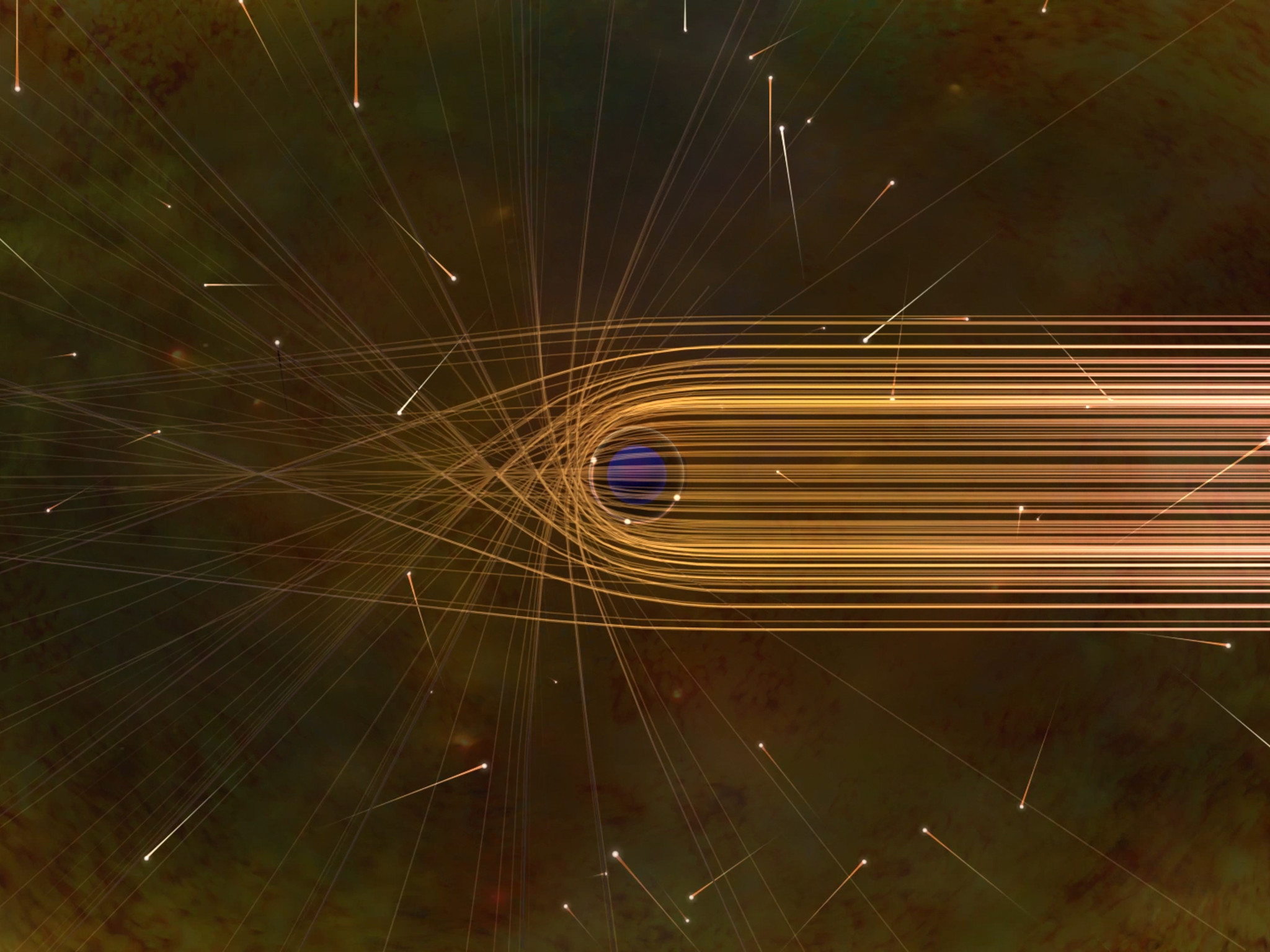
This illustration shows how photons are bent around a black hole by its gravity. The size of the shadow of a black hole is different from the size of the event horizon, which are both different than the size of the central singularity, which are different still from the path traced out by particles in a stable orbit around the black hole. Related, but independent, is the notion of a firewall around the event horizon of every black hole: a hotly debated contention here in the 21st century.
Credit: Nicolle R. Fuller/NSF
It seems like we can’t know whether entanglement persists or is broken. And there are some reasons to think that it might be broken, as there is a controversial suggestion that at or near the event horizon of every black hole, there is a firewall of high-energy quanta flying around it. If that’s true, then at least one of those quanta will almost certainly encounter the infalling member of the entangled pair, and in doing so, will cause an energetic-enough interaction to fully determine and/or measure that particle’s quantum state. If that occurs, then when you measure the escaping member of the pair’s quantum state, it will no longer be correlated with the infalling member’s state; the entanglement has already been broken, and you’ll only have 50/50 knowledge of the other state.
However, the notion of the AMPS firewall relies on several assumptions being true:
the equivalence principle (where all objects in free-fall are indistinguishable from free-floating objects),
unitarity (where the probabilistic sum of all possible outcomes adds up to one),
quantum field theory (that our current formulation is correct even at the extreme conditions in and around a black hole),
and locality (that any signal or event can only affect things within their past and future light-cones).
In many formulations of quantum gravity, locality is not strictly true, and so the existence of the firewall is not necessarily a certainty. If it’s absent, and if there are no other interactions that destroy the entanglement, then it must persist even across the black hole’s event horizon.

When a black hole either forms with a very low mass, or evaporates sufficiently so that only a small amount of mass remains, quantum effects arising from the curved spacetime near the event horizon will cause the black hole to rapidly decay via Hawking radiation. The lower the mass of the black hole, the more rapid the decay is, until the evaporation completes in one last “burst” of energetic radiation. The longest-lived black holes will be the most massive, with decay timescales exceeding 10^100 years.
Credit: ortega-pictures/Pixabay
But there’s a big difference between having theoretical predictions that some phenomenon “must” exist and having experimental or observational confirmation that the predicted phenomenon is borne out by reality. We can make all the predictions that we like, and have all the expectations one would have as a downstream consequence of our existing theories, but without evidence to validate those predictions, we can’t draw any meaningful conclusions.
The only way to make such measurements, at least in principle, is so difficult that it’s maddening. You’d have to:
perform the experiment where you create two entangled particles,
allow one particle to fall past a black hole’s event horizon while the other escapes,
measure the quantum state of the escaping particle,
and then determine how the information contained within the infalling particle imprints itself onto the black hole’s surface,
and how that information is then encoded in the outgoing radiation emitted as part of the Hawking evaporation process,
and then stick around for long enough to measure and reconstruct that information,
and to do that so many times that you can determine whether the quantum state of the infalling member of the entangled pair was predicted to better than 50/50 odds, or whether it’s completely random.
The first three steps are easy, sure, but we have absolutely no idea how to do any of the steps after that. This is made more difficult by the fact that the timescale for the Hawking evaporation process is on the order of 1067 years for a black hole that’s merely the mass of the Sun, with all known realistic black holes being more massive than that and having even longer evaporation timescales. We might be able to test this in a lab by leveraging black hole analogues, but whether the analogy to black holes still holds won’t be established until we perform the key experiment directly. While many, including myself, fully expect that information really is conserved and is somehow encoded into the outgoing radiation, we have no idea how. All we can do, at present, is map out the rough path toward a better understanding of nature. Sometimes, even when you do that, the destination still seems immensely far away.
Send in your Ask Ethan questions to startswithabang at gmail dot com!