
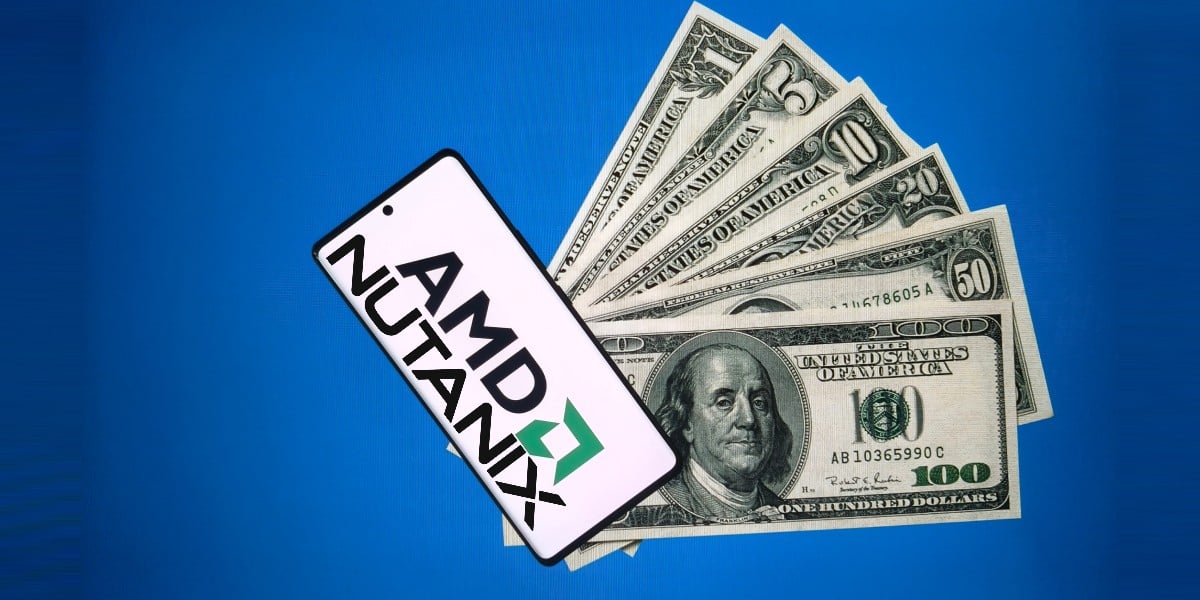
AMD has struck another chips ‘n’ stock deal, this time with software-defined datacenter player Nutanix.
The deal means AMD will acquire $150 million worth of Nutanix stock and also fund up to $100 million of joint engineering work and go-to-market efforts for a new “full-stack AI infrastructure platform” that will use Nutanix’s stack to allow agentic and inferencing applications to run in the many on-prem, cloudy, and edge environments it supports.
Nutanix currently supports only Nvidia GPUs. This new deal means it will support AMD accelerators, too, making this a bet by AMD that Nutanix can generate more demand for its hardware.
“Our goal is to provide customer choice,” Nutanix CEO Rajiv Ramaswami told The Register. “Nvidia has been the market leader and AMD is the other big platform company.”
Ramaswami said agentic AI adoption is still at a “very early stage” within enterprises, but said Nutanix hopes to speed things up a bit by tuning its stack so it can host this class of applications wherever customers want to run them.
Nutanix revealed its new ties to AMD after first announcing its Q2 results, which saw revenue grow ten percent year-over-year to reach $723 million. The company has long preferred to use annual recurring revenue as its top-line indicator, to demonstrate the strength of its subscription business, and that grew 16 percent to $2.36 billion.
Ramaswami said the company signed 1,000 new customers in the quarter, and that most intend to migrate away from VMware.
“We see a lot of that happening now,” he said. “People do not necessarily see Broadcom as a long-term partner.”
IBM used its earnings announcement to reveal that Red Hat has signed $500 million worth of deals for its virtualization portfolio in the last two years. Ramaswami said Nutanix believes Red Hat is definitely a competitor, but that as its virtualization platform relies on Kubernetes that makes migrations more complex than moving from VMware to Nutanix.
“We have not seen many successful migrations from VMware to Red Hat,” he said.
Ramaswami offered investors a new take on component shortages by saying the availability of CPUs, not memory, has been Nutanix’s biggest concern.
“This is driving higher prices and lengthening lead times for servers,” he told investors. “Thus far, longer lead times largely driven by lack of CPU availability have been a significantly bigger challenge for us than pricing.”
Memory shortages are now starting to bite.
“Through the latter half of Q2, we began to see that the challenging supply environment for CPUs, memory, storage and other components is delaying our customers’ ability to procure servers from our hardware partners in order to run our software,” the CEO said. “We did not see this as a meaningful driver of our results in our fiscal Q1… later in Q2, we did start to see it become more pronounced to a greater extent than anticipated, and expect it to continue through the rest of the fiscal year.”
That’s a problem for Nutanix because the company can’t recognize some revenue for software sales until customers’ hardware arrives. The company therefore reduced its revenue guidance for the full year from between $2.82 billion and $2.86 billion to between $2.80 billion and $2.84 billion.
Investors clearly liked something about either Nutanix’s results or the AMD tie-up because they sent the company’s shares up by almost 20 percent in after-hours trading. ®