
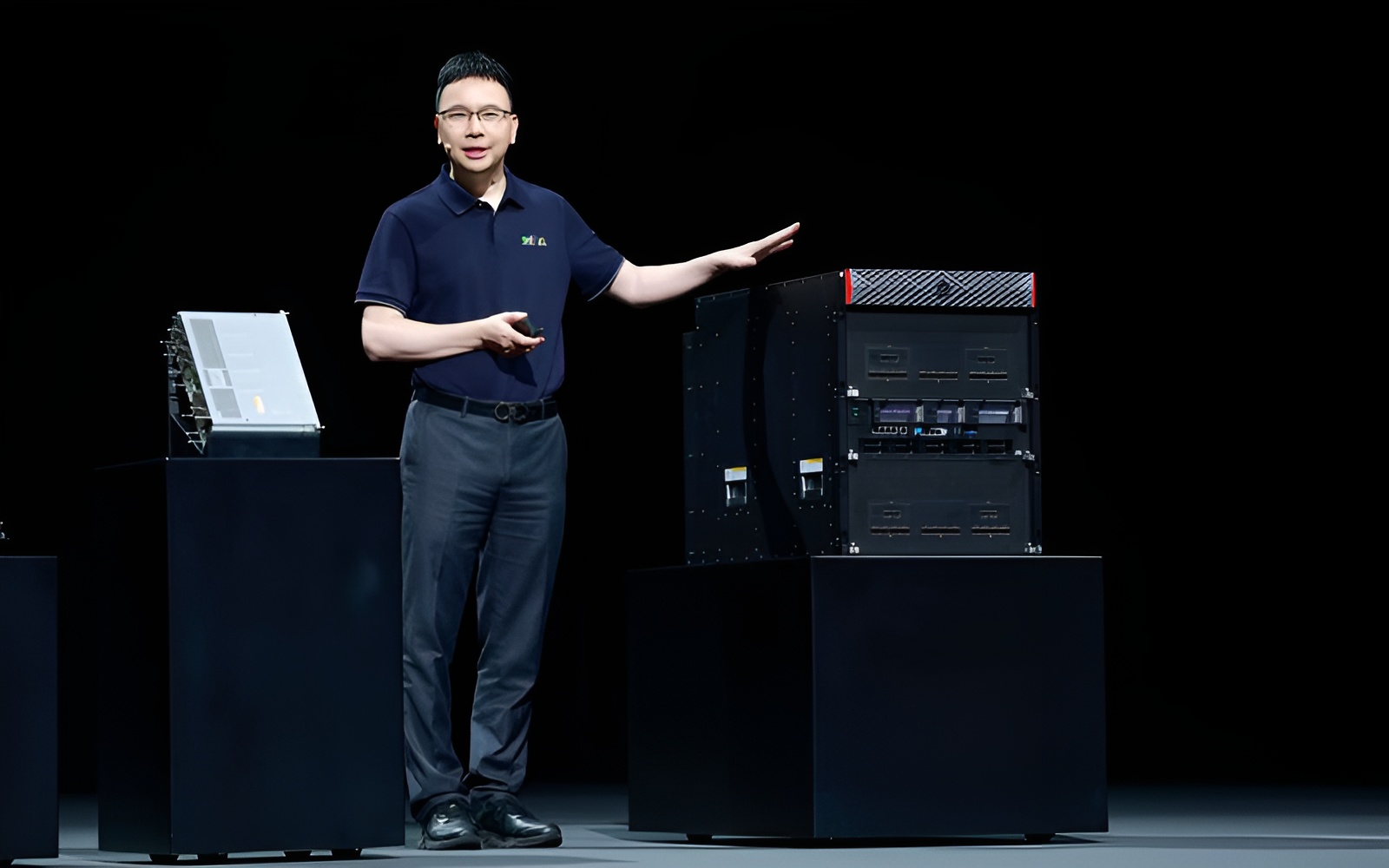
Huawei plans to showcase its most powerful AI cluster, the Atlas SuperPoD 950, at this year’s MWC, marking its first public appearance.
Huawei’s Atlas SuperPoD 950 Has a ‘Huge’ Lead Over Vera Rubin AI Racks, But Only In Official Disclosures
The infrastructure race in China has become much more aggressive since Beijing decided to double down on preventing the influence of American technology on Chinese developers. Advancements from the likes of Huawei, Biren, Cambricon, and Moore Threads have made headlines in the past few months, mainly due to the nation’s ambition to achieve sustainability in the AI computing race. In a report by Nikkei Asia, Huawei now plans to showcase a key compute technology to the world, in particular, the Atlas 950 SuperPoD AI cluster at MWC, which is touted as an alternative to NVIDIA’s Vera Rubin.
The decision to showcase the supercomputer in Europe underscores Huawei’s ambitions of taking on global leader Nvidia even outside its home market, and instill confidence that China can produce more advanced chips.
– Nikkei Asia
In an earlier report, we discussed what the Atlas 950 SuperPoD holds: Huawei plans to mount 8,192 of the Ascend 950 AI chips, bringing a cumulative performance of 8 EFLOPS FP8 and 16 EFLOPS FP16, with a total interconnect bandwidth of a whopping 16.3 PB/s. Since memory capacity has become an essential factor in today’s AI workloads, the Atlas 950 offers 1,152 TB of capacity. According to Huawei’s official disclosures, here is how the above statistics compare with Vera Rubin (NVL144 and NVL576).

The Atlas 950 SuperPoD will feature Huawei’s new interconnect technology, called the UnifiedBus, which is claimed to be an alternative to NVIDIA’s NVLink. While we are yet to see whether Atlas 950 actually delivers on the above performance figures, it is important to note that Huawei does rely on aggressively ramping up power/thermal limits to achieve compute figures that appear ‘impressive’ on paper. You can judge this by how a single rack holds 8,192 of the Ascend 950 AI chips. And interestingly, a single Atlas 950 rack is claimed to span up to 1,000 square meters.

The showcase of the Atlas 950 SuperPoD at this year’s MWC clearly indicates that Huawei plans to take the compute race with much greater aggressiveness; however, when it comes to customer adoption, the Chinese giant is constrained by industry realities. While solutions like the CloudMatrix 384 have emerged as viable alternatives, the real question is whether Huawei can satisfy customer demand as it scales up.
Follow Wccftech on Google to get more of our news coverage in your feeds.