

“Are your men hormones getting the better of you? It might be low testosterone.” So reads a poster by the health company Voy that is plastered across London’s Underground network. The controversial advertising campaign has gone viral — and prompted a few eyebrow-raises from women familiar with being labelled “hormonal”— for seeming to suggest that poor male behaviour might not be the fault of the individual. “It’s not him, it’s his hormones,” reads another poster in the same campaign. “Feeling irritable? It might be low testosterone.”
The ads have highlighted the number of companies such as Voy — which also deals in GLP-1s and menopause treatments — that are offering at-home blood test kits for men to determine whether they have a testosterone deficiency.
They tend to follow a pattern: an initial test to determine testosterone count (which costs £33.95 with Voy), a second to double check, followed by a medical consultation and subscription to testosterone replacement therapy (TRT). Other companies offering a similar service include Numan, Optimale, Balance My Hormones, Alphagenix and Urban TRT.
Men of a certain age are being “spammed” with such adverts and according to Dr Rob Stevens, who has run The Men’s Health Clinic in Dorset for a decade, which specialises in treating men with testosterone deficiencies, “the rate of testosterone blood testing has massively risen with this aggressive marketing’’. The research firm Future Market Insights says the global testosterone industry was worth $114.3 million in 2025, with blood tests the leading segment in the market.
So who actually needs to test and what do they need to know about TRT?
Testosterone is central to so much in the male body, controlling hair and muscle growth, bone density, fat distribution, mood, red blood cell production and sexual development. Women produce it too, albeit in much lower levels. It generally decreases with age: by 40, an estimated 10 to 30 per cent of men have experienced a decline, according to Professor Suks Minhas, a consultant urologist and andrologist at Imperial College London.
• Trust me, taking testosterone as a woman is about more than sex
That doesn’t mean you’ll hit an unhealthy low, Stevens says. “We have 5,000 patients attending our clinic, aged 18 to 90, and a disturbing number have admitted to feeling so low as to be suicidal, so testosterone deficiency is a very serious condition,” he emphasises. “But we also screen lots of men in their fifties and sixties who have super-healthy testosterone levels.”
He lists the four most common symptoms of testosterone deficiency as low mood, brain fog, fatigue and low libido, and recommends that men get tested if they’re experiencing one of these. Others include increased fat around your waist, erectile dysfunction and loss of muscle mass. But, he adds, “the symptoms are quite vague and there are 100 reasons you might be fatigued, from bad sleep to cancer”.
That, the experts tell me, is a major concern about online companies. Many only offer basic blood tests that don’t give a full picture of a person’s health — important, since low testosterone is also linked to type 2 diabetes and metabolic syndrome, which carries an increased risk of cardiovascular disease.
“Testing testosterone in isolation provides little or no useful information other than to sell TRT if it’s ‘low’,” Stevens says. “It also feeds into health anxieties as it provides no specific information. There’s a massive element of confirmation bias.”
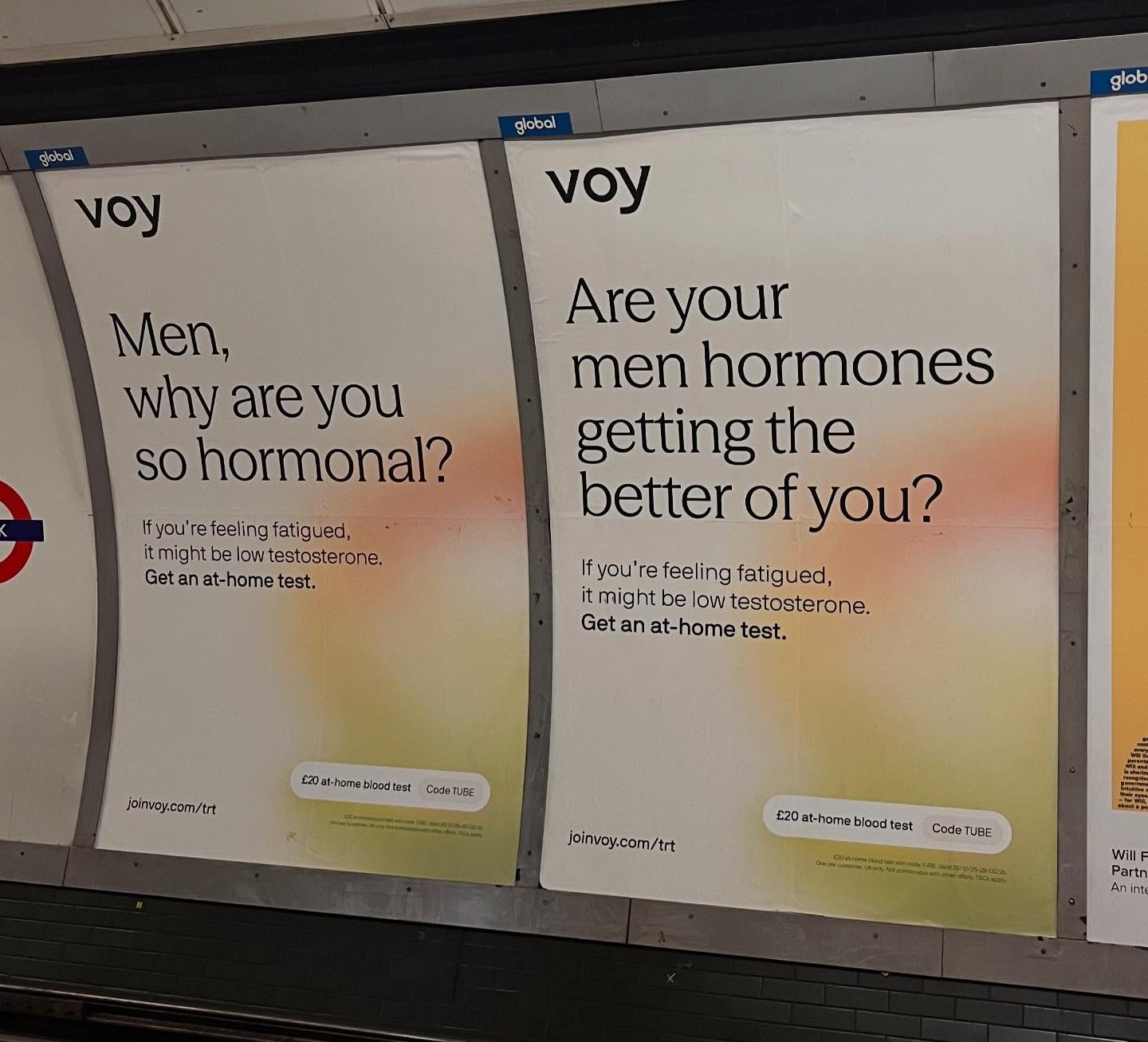
A poster by the health company Voy on London’s Underground network
His advice? Seek out a registered healthcare professional who will conduct a comprehensive blood screening — looking at everything from your kidney function to thyroid, vitamin D and zinc, which are involved in testosterone production — and work with you to make health and lifestyle changes, which can reverse low testosterone, before even considering TRT.
“I’ve just spent two hours telling most of my patients they don’t need TRT, they need to go away and address their stress levels, sleep, nutrition and exercise,” Stevens says. “The idea is to see what they can do to not need TRT at all.”
• Joe Rogan and the ‘manosphere’ glorify testosterone. What are the dangers?
Another problem, Minhas says, “is that you have to do testosterone as a morning sample, before 10am, when it’s at its highest level. I’ve had patients come to me who’ve been on these sites, done the tests at the wrong time of day because they weren’t told otherwise, and been diagnosed as having abnormal testosterone when it’s normal.
“The testing needs to be done according to evidence-based guidelines and we need to make sure we’re not over-prescribing this, because it has negative impacts too. TRT isn’t wrong but it needs to be done the right way. Not every single man needs testosterone, not every single man with low testosterone needs TRT.”
TRT — which is injected — works by shutting down the natural production of testosterone in the testicles and, once started, is generally a lifelong commitment with continued health risks that need regular monitoring, such as raised blood pressure and cholesterol.
“It’s a controlled medicine for a reason,” Stevens says. “Prescribing it unnecessarily without adequate doctor supervision can cause potential long-term harm.”
• Read more expert advice on healthy living, fitness and wellbeing
That includes fertility. Stevens prescribes his patients daily microdoses of TRT to mimic the body’s own production, along with hCG (human chorionic gonadotropin), a hormone produced by the placenta to maintain pregnancy but which in men stimulates sperm production.
It’s also expensive, generally costing upwards of £100 a month on subscription. So why not seek help on the NHS? “The NHS can’t really support the treatment because it requires follow-up and there are other priorities,” Minhas says. “It also means crossover between specialities. Who do you see if you’ve got low testosterone? We have gynaecologists, urologists, cardiologists, endocrinologists, but we don’t have a men’s health specialist.”
Stevens says the condition is still misunderstood, partly because testosterone deficiency isn’t taught in medical school, while TRT still has an image problem, being associated with macho bodybuilders, meaning that some medics don’t take it seriously and some men find it an emasculating diagnosis. Many of his patients have been to see their GP and been sent away with antidepressants (also the experience of vast numbers of menopausal women who aren’t offered HRT).
The one positive of companies like Voy, he says, is an increased awareness around the importance of testosterone in men’s health. “There shouldn’t be any stigma,” he says. “After all, it’s just a hormone.”