
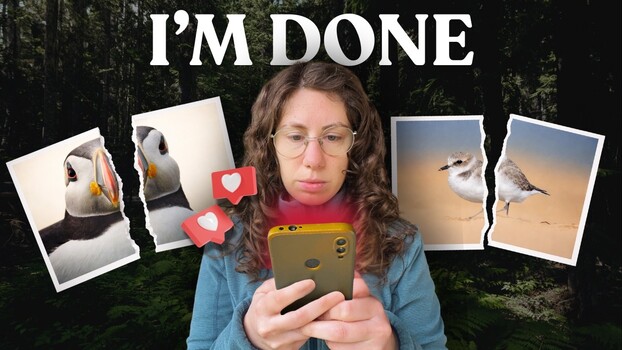
Instagram has reshaped wildlife photography in ways you might not notice at first glance.
Coming to you from Chiara Talia – Wildlife Photography, this candid video takes a hard look at how Instagram’s algorithm rewards a narrow type of image. It is the tight close-up of a charismatic animal, perfectly sharp, smooth background, instant impact. That kind of frame stops the scroll. Slower images do not. Wider environmental scenes, softer light, storytelling moments—these often disappear in a feed built around speed. You start to notice how that pressure pushes people, especially beginners, toward one look, one formula, one idea of what “good” should be.
Talia also points to editing. Scroll long enough and images begin to blur together. The same tones. The same color grading. The same presets passed around and copied. When every fox glows with identical contrast and every kingfisher pops with the same teal and orange treatment, authorship fades. You can admire the technical finish, yet struggle to tell who made the picture. Talia’s approach to teaching editing is different. She focuses on tools and control, not on imposing a signature look. That stance matters when the platform quietly nudges you toward whatever is trending.
Travel is another fault line. Open the app and it seems like everyone is on safari, in the Arctic, or standing in front of a polar bear. Constant movement becomes the baseline. Exotic species start to feel like the minimum requirement. That illusion carries weight. Not everyone can fund repeated international trips. When remote locations go viral, crowds follow. Fragile habitats fill with tripods chasing the same shot. You begin to question whether the goal is connection with wildlife or public proof of access.
Then there is transparency. The algorithm cannot tell how an image was made. Ethical and unethical practices look identical on a phone screen. Was a bird baited? Was playback used to draw it out? How much artificial intelligence shaped the final file? Talia highlights the example of kingfishers photographed with live bait placed in tanks. Those images circulate widely. Viewers see a flawless catch and assume patience alone produced it. That gap between reality and perception sets up frustration and distorted standards.
There is also the performance layer. Short-form videos often center the person more than the subject. Full camouflage. A massive lens. Slow motion sequences lifting the camera to the eye. The message is clear: this is what a “real” wildlife shooter looks like. Talia pushes back. She does not use camouflage for her subjects. She chooses compact, lightweight gear instead of a 600 mm f/4. Her style is focused but joyful. There is more than one way to do this work.
Beyond gear and image style sits the psychological cost. Feeds show curated success. Big trips. Huge engagement numbers. Viral reels. When you compare your quiet local project to that stream, doubt creeps in. Talia shares that many in her community have stopped posting because they feel their images are not good enough. The platform was built to keep attention, not to nurture confidence.
Talia explains why she is shifting energy toward long-form video and a newsletter, and how she now uses Instagram in a limited way. She also lays out practical reminders: value local wildlife, develop your own voice, choose platforms that match your values, accept the slowness that real wildlife work requires. Check out the video above for the full rundown from Talia.