
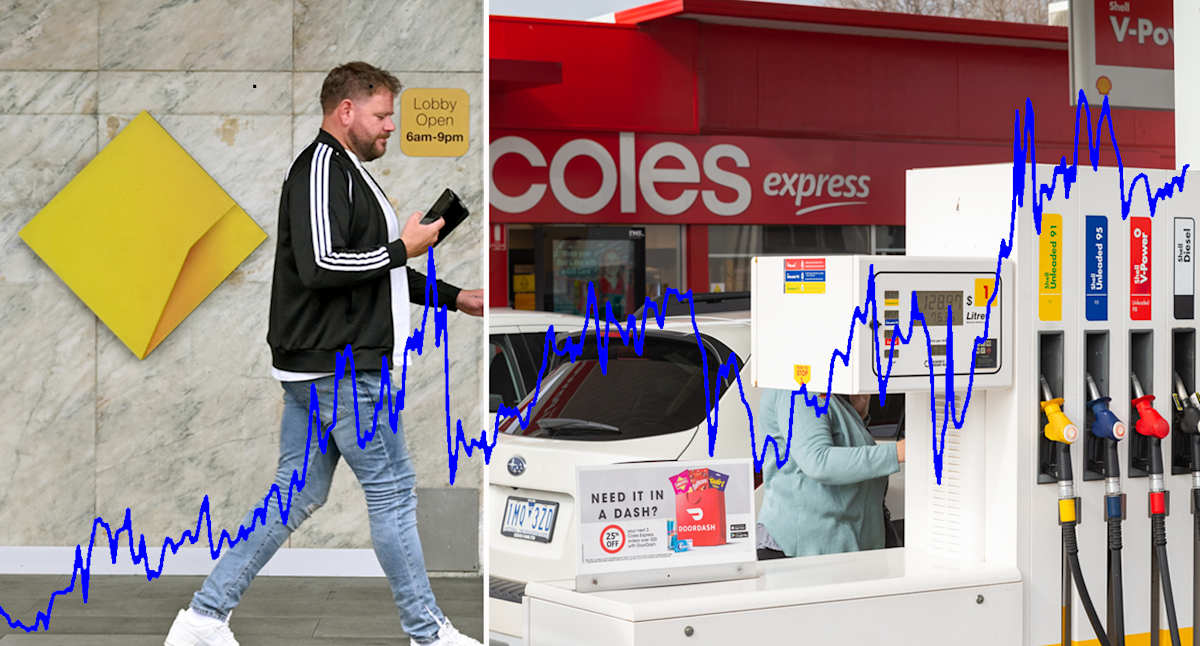
 The conflict could put pressure on Aussie households and the RBA to raise rates sooner. (Source: Getty)
Renewed conflict in the Middle East is expected to put upward pressure on inflation as petrol prices could rise as much as 40 cents at the bowser for Australian drivers. It’s a scenario that makes the current job of the Reserve Bank more complicated as heavily indebted mortgage holders around the country brace for more interest rate hikes.
The US and Israeli war with Iran could last for four to five more weeks, Donald Trump said overnight, promising a “big wave” of military action still to come. The Commonwealth Bank is warning that “escalation remains the base case with substantial geopolitical and economic consequences”.
The conflict poses the risk of “significant disruption to global economic growth” given the likelihood of oil tankers being disrupted, particularly through the Strait of Hormuz,
“A $US40 a barrel spike in oil prices could add 40 cents a litre to petrol prices with a threat to growth and inflation,” AMP economist Shane Oliver warned in a note on Monday night.
That would amount to a “tax on spending”, he said. So while it would make the inflation numbers appear even worse, he urged the RBA to “look through it” when it meets on Monday week to decide the official cash rate.
RELATED
The price of oil hit $US120 a barrel after the Russian invasion of Ukraine in 2022, but has more recently fallen to less than half that, hitting a low of $US56 in January this year.
The Iran conflict has seen it spike to over US$72 on Tuesday, but Oliver and other analysts see potential for it to move much higher as the Iranian government fights for its survival.
Oliver said his base case is that Trump tries to extricate the US from the war in the weeks ahead and declare victory, putting the likelihood of that scenario at 60 per cent.
But he ascribed a 40 per cent chance to a more “high-risk” version of future events, which would likely rattle international markets.
“Trump may lose the gamble with Iran fighting on for longer forcing the US to say involved longer. Iran could descend into chaos as occurred in Iraq and Afghanistan necessitating US troops on the ground,” he said.
“There are few examples of successful regime change from US interventions in recent decades. This could mean a bigger and much longer disruption to oil supplies, conceivably resulting in a doubling in oil prices to around $US150/barrel, which could drive a sharp fall in shares.”
Story continues
The main impact for everyday Aussies would be at the petrol pump, he said.
 Aussie households could be about to get another hit. (Source: AMP)
“Roughly speaking each $US1 a barrel rise in oil prices adds around a cent a litre to petrol prices.
“So, a $US40 a barrel rise in world oil prices taking them above $US100 a barrel would add around 40 cents a litre with a 7-10 day lag if sustained.”
Commonwealth Bank’s senior Geo-Economics Analyst Madison Cartwright also warned in a note to investors on Monday afternoon that the ongoing conflict is set to deliver a global energy shock and make the job of central banks in Europe and Asia more difficult in the face of returning inflation.
About a fifth of global oil and LNG shipments pass through the Strait of Hormuz, but traffic through the critical “chokepoint” just off the Iranian coast has now plummeted.
“Shipping through the Strait of Hormuz has collapsed, Red Sea risks have re‑emerged, and air travel is curtailed,” he wrote
“Diplomatic off‑ramps remain limited, and escalation remains the base case with substantial geopolitical and economic consequences.”
In a speech on Tuesday, RBA governor Michele Bullock said the bank was keeping a close eye on the situation in Iran and the impact it will have in Australia when it comes to prices.
“The staff will take some time to make sense of what it could mean for inflation here. A supply shock could, for example, add to inflation pressures. And the potential implications for inflation expectations are something we are very alert to,” she said.
However Bullock said it was “not obvious” how the turmoil would impact overall inflation, as dampening economic conditions could also result from the instability.
“But at the same time, a prolonged impact on energy markets could have adverse effects on global economic activity and result in downward pressure on inflation,” she said.
Energy Minister Chris Bowen on Monday downplayed concerns around Australia’s chronically low fuel reserves amid fears the conflict could worsen.
As a party to the International Energy Agency, Australia is required to have minimum 90 day stocks of oil and refined fuels, such as petrol and diesel.
Asked about stocks during question time on Monday, Mr Bowen said they sat at “34 days in relation to diesel, 32 days in relation to jet fuel and 36 days in relation to petrol”.
Get the latest Yahoo Finance news – follow us on Facebook, LinkedIn and Instagram.