
Closing post
Time to wrap up….
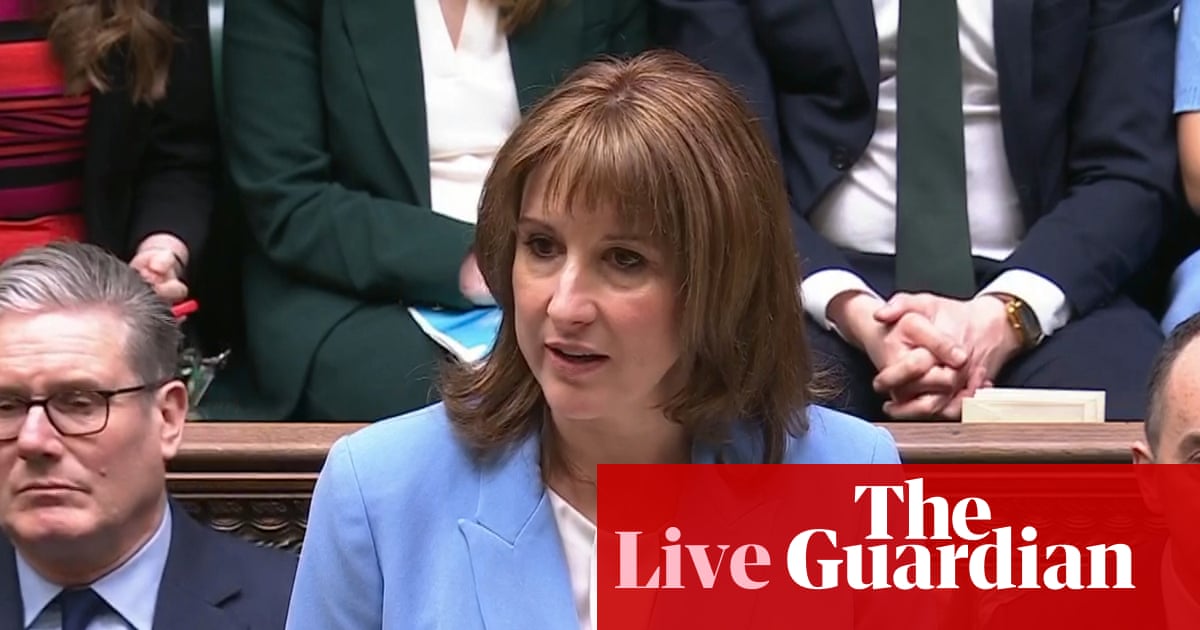
Rachel Reeves insisted Labour has “the right economic plan” for a world that has become “yet more uncertain” as she delivered a spring forecast that downgraded growth for this year.
The chancellor was addressing MPs against the backdrop of surging energy prices, as investors fret about the impact of the war in the Middle East.
Reeves said she was in close touch with the Bank of England governor, Andrew Bailey, as they monitored the situation and would meet representatives of the North Sea energy industry on Wednesday.
New forecasts from the independent Office for Budget Responsibility (OBR), published alongside her statement, showed that as Reeves said, “inflation is down, borrowing is down, living standards are up and the economy is growing”.
“This government has restored economic stability,” she said, in a deliberately low-key statement that, as expected, contained no substantive policy announcements.
Reeves conceded that GDP growth was now expected to be “slightly slower” this year, however, down to 1.1% from the previous forecast of 1.4%, after weaker than expected data in the final quarter of 2025 – but stronger in future years, at 1.6% in 2027 and 2028, and unchanged at 1.5% in 2029 and 2020.
The OBR itself warned that:
double quotation markConflict in the Middle East, which escalated as we were finalising this document, could have very significant impacts on the global and UK economies.
OBR’s latest forecasts also show:
Economists warned, though, that that extra headroom could be wiped out by the jump in energy prices called by the Middle East crisis.
Oil prices have continued to climb today; Brent crude is up 6.2% at $82.55 a barrel.
UK month-ahead gas prices have jumped 21% today, hitting a three-year high this morning.
Stock markets have fallen across the world, again, with heavy losses in Asia-Pacific bourses, across Europe and in the US today – where the Dow Jones Industrial Average is currently down 550 points or 1.1%.
In London, the FTSE 100 share index lost 2.75%, its biggest one-day fall in 11 months.
Key events
Show key events only
Please turn on JavaScript to use this feature
 Mark Sweney
An investor-led “AI panic” saw the share price of the owner of the Mirror, Express and Star newspapers plunge over 12%, after the publisher said that traffic to its titles from Google has almost halved.
Reach, which also owns scores of regional titles including the Manchester Evening News, the Birmingham Mail and the Liverpool Echo, reported that digital revenues crucial to its future declined by 0.9% to £128.9m in the year to 3 March.
The publisher said that overall digital page views fell 8% year-on-year, primarily due to a 46% year-on-year decline in traffic from Google in the second half of its financial year.
Investor jitters were further fuelled by the company saying that it is taking a “cautious approach” to digital performance this year, and does not expect to provide hard numbers on expectations until potentially its half-year results.
The impact of features including Google’s AI Mode and AI Overviews, which sit at the top of the results page and summarise responses and often negate the need to follow links to source content, have prompted fears of a “Google zero” future where traffic referrals dry up.
Piers North, the chief executive of Reach, said that most of the traffic decline has come from Google Discover, which feeds users articles and videos tailored to them based on their past online activity, and has replaced search as the main source of click-throughs to content.
“The traffic referral headwinds we have seen have continued into January and February, there are a lot of unknowns,” he said, speaking to the Guardian. “What underpins that, is that related to AI, we can speculate. We have to be careful making sweeping statements one way or the other on such a changeable eco-system. Clearly AI at a macro level is changing the internet as we know it.”
Earlier this week, Roger Lynch, the chief executive of Vogue and New Yorker publisher Condé Nast, said that Google’s introduction of AI summaries was “another sort of death bow” in search traffic.
Overall, Reach beat market expectations on adjusted profits of £104.7m, which was helped by boosting the level of cuts to its operating costs to 5.2%, ahead of the 4% to 5% targeted.
The publisher, which in September made more than 300 redundancies, said it is targeting 5% to 6% of cuts this year.
Reach made an overall pre-tax loss of £165.9m after taking a non-cash impairment charge of £222.8m.
Total print revenues fell 4.6% year-on-year to £388m. Newspaper sales revenue fell 3.4% to £288m, while print advertising revenue dropped 14.8% to £55.8m.
Analysts at Panmure Liberum referred the current valuation of Reach reflected the “current AI panic” in the market.
North, who joined Reach in 2014 and was promoted to chief executive last March, said that Reach is in a strong position for the future as hefty annual payments to its pension plan end in 2028 and its nascent subscription strategy gathers momentum.
A believer in a primarily advertising funded future, Reach launched its first premium subscription service for the Manchester Evening News in November.
The company now has subscription offerings across six major titles, including the Express, with a total of 15,000 subscribers to date and a target of 75,000 by the end of this financial year.
“Clearly to have a robust and solidly performing business in media is no mean feat,” said North. “This is a defining year for the industry, from a macroeconomic and global perspective, there is huge change. We know the market is changing. Continual change is the norm and it is going to get quicker and faster.”
ShareLosses narrow at GB NewsMark Sweney
Losses at GB News have hit almost £130m over the past four years, as the right-leaning TV broadcaster continues to struggle to make its business model work.
GB News, which is funded by investors including Spectator-owner Sir Paul Marshall and Dubai-based Legatum Ventures, reported a pre-tax loss of £22m in the year to 31 May 2025.
However, the broadcaster, which launched in June 2021 and has presenters including Nigel Farage and Eamonn Holmes, managed to significantly reduce its loss from the £32.7m recorded the previous year.
Overall, pre-tax losses since it began setting up ahead of its 2021 launch now total £127.9m.
GB News has continued to increase total revenues, which increased almost 60% year-on-year to £26.2m, with advertising income climbing 48% to £14.2m.
The commercial performance has been underpinned by audience growth with the company claiming an 18% year-on-year increase in the average monthly reach of viewers watching at least 3 minutes of GB News to 3.7m, according to figures from TV research body Barb.
GB News said that it still holds an ambition to become the “UK’s largest news channel by 2028”.
During the year GB News cut staff numbers from 311 to 263, trimming annual staff costs from £22m to £19.7m.
GB News remains dependent on funding from its parent company All Perspectives, in which Marshall controls more than a third and Legatum also has a large stake.
GB News received funding of £17.7m from All Perspectives last year, taking the total balance due to its parent company to £141m.
“The parent company has a strong positive net asset position and has confirmed its ongoing commitment to funding the operations of GB News Limited,” said GB News in its filing to Companies House. “After the year end, the investors have confirmed they will provide funding which the directors believe will be sufficient to cover any expected deficit.”
ShareClosing post
Time to wrap up….
Rachel Reeves insisted Labour has “the right economic plan” for a world that has become “yet more uncertain” as she delivered a spring forecast that downgraded growth for this year.
The chancellor was addressing MPs against the backdrop of surging energy prices, as investors fret about the impact of the war in the Middle East.
Reeves said she was in close touch with the Bank of England governor, Andrew Bailey, as they monitored the situation and would meet representatives of the North Sea energy industry on Wednesday.
New forecasts from the independent Office for Budget Responsibility (OBR), published alongside her statement, showed that as Reeves said, “inflation is down, borrowing is down, living standards are up and the economy is growing”.
“This government has restored economic stability,” she said, in a deliberately low-key statement that, as expected, contained no substantive policy announcements.
Reeves conceded that GDP growth was now expected to be “slightly slower” this year, however, down to 1.1% from the previous forecast of 1.4%, after weaker than expected data in the final quarter of 2025 – but stronger in future years, at 1.6% in 2027 and 2028, and unchanged at 1.5% in 2029 and 2020.
The OBR itself warned that:
double quotation markConflict in the Middle East, which escalated as we were finalising this document, could have very significant impacts on the global and UK economies.
OBR’s latest forecasts also show:
Economists warned, though, that that extra headroom could be wiped out by the jump in energy prices called by the Middle East crisis.
Oil prices have continued to climb today; Brent crude is up 6.2% at $82.55 a barrel.
UK month-ahead gas prices have jumped 21% today, hitting a three-year high this morning.
Stock markets have fallen across the world, again, with heavy losses in Asia-Pacific bourses, across Europe and in the US today – where the Dow Jones Industrial Average is currently down 550 points or 1.1%.
In London, the FTSE 100 share index lost 2.75%, its biggest one-day fall in 11 months.
ShareShareAnalysis: Reeves’s talk of stability may be misplaced Heather Stewart
“This government has restored economic stability,” Rachel Reeves told the House of Commons on Tuesday.
Yet the chancellor was speaking just moments after MPs had been hearing from the foreign secretary, Yvette Cooper, about plans to evacuate British nationals from the escalating conflagration in the Middle East.
Should the violence that has sent energy prices soaring abate, the impact on inflation and economic growth will be short-lived, in which case Reeves’s bold claim about economic stability may just about stand.
But if the conflict is prolonged, then the Office for Budget Responsibility’s (OBR) forecasts will look hopelessly out of date within weeks.
The oil price was continuing to climb as she spoke and financial markets have pushed up government borrowing costs, as they bet that central banks will be unable to cut interest rates much more in the face of rising inflation.
Today’s OBR forecasts were out of date before they were published, says consultancy Oxford Economics.
Their chief UK economist Andrew Goodwin says:
double quotation mark“The surge in oil and gas prices means GDP growth is likely to be weaker, and inflation higher, than the OBR forecasts this year.
“Although the OBR took on board the recent lower inward migration data and cut its medium-term forecast, its assumptions still look too high.
We expect it will have to cut its growth forecasts and raise its borrowing projections over time.”
Green Party MP Dr Ellie Chowns is calling for the government to ditch its fiscal rules, saying:
double quotation mark“Hannah Spencer’s decisive by-election victory last week shows it is action to tackle the cost-of-living crisis that voters desperately want to see. But the truth is the Labour Party has failed to properly get to grips with this crisis and today was no different.
“When bills are still sky-high, rents are extortionate, and millions of children remain in poverty, it is incredibly disappointing that this government continues to tie itself in knots with its self-imposed fiscal rules, which even the IFS are now calling dysfunctional.
“The Green Party is laser-focused on making our country affordable again, because we knows it is inequality, not immigration, that is to blame for the state we are in. That is why we are again calling on the government to scrap their failing fiscal rules and double down on tackling the cost-of-living crisis, starting with scrapping the household benefit cap, bringing water into public ownership, and introducing rent controls.”
There are two fiscal rules:
that day to day spending is matched by tax revenues, so the Government is only borrowing to invest.
that the national debt should be falling as a share of the economy
These are designed to reassure bond investors that ministers won’t go off on a wild borrowing spree.
Today, Rachel Reeves said these rules have allowed the government to “increase public investment and protect our public finances”.
ShareReeves’s extra headroom “may soon be wiped out” by Middle East crisis
Rachel Reeves seemed keen today to flag that her buffer – or “headroom” – to keep within the fiscal rules had increased in today’s projections, to £23.6bn from £21.7bn at the time of the November budget.
However, Capital Economics believe that headroom could soon be “wiped out” by the market turmoil caused by the Middle East crisis, which has sent government borrowing costs soaring.
They say:
double quotation markThe Chancellor didn’t announce any major new policies in her fiscal statement and, on the face of it, has a bit more money to play with come the Budget in the autumn. But that could be swamped by events in the Middle East. The economics could therefore point to more tax hikes. But political pressures point to more government spending in the near term and a bigger tightening in fiscal policy later on.
Updated at 12.06 EST
FTSE 100 records biggest daily fall in 11 months
After a day of heavy losses, the UK’s stock market has recorded its worst day in 11 months.
The FTSE 100 share index has closed down 2.75%, or 296 points, at 10,484 points, a two-week low.
That’s the biggest one-day drop for the Footsie since 9 April 2025, when markets were sliding after Donald Trump announced sweeping tariffs (which were overturned last month).
Every sector of the London stock market fell today, with financials (banks) and basic materials (miners) among those worst hit.
However, the City got off relatively lightly! Germany’s DAX has lost 3.6%, France’s CAC 40 is down 3.5% and Italy’s FTSE MIB shed 3.9%.
George Buckley of Japanese bank Nomura has dubbed today’s spring forecast “a low-key affair”, adding:
Key points from today’s statement included revisions to the Office for Budget Responsibility’s macro forecasts (cyclically weaker growth forecasts this year), the outlook for the fiscal rules (slightly lower borrowing and slightly higher headroom vs. the rules), and perhaps most importantly the coming year’s gilt issuance plans (£252bn, which was £5bn higher than we thought but only because of fewer t-bills).
Last November’s Budget had the effect of reducing the Bank of England’s inflation forecasts by 0.5pp in the spring, with pre-existing base effects also pushing inflation down. Developments in the Middle East could offset some of that fall should the rise in energy prices persist or even accelerate (as seems to be the case as we write this).
There’s a broad consensus today that the spring statement was a little light on news, and overtaken by events in the Middle East.
Credit ratings agency Moody’s suggest today’s fiscal update “may already be old news”.
Andrew Hunter, associate director and senior economist at Moody’s, says:
double quotation markThe U.K. chancellor’s spring statement pointed to a little-changed near-term fiscal outlook, but that was before the conflict in the Middle East started driving up energy prices and U.K. government bond yields.
Concerns over potential disruption to energy supply have caused prices for crude oil and, in particular, natural gas to jump which could put renewed upward pressure on consumer price inflation. The U.K. 10-year gilt yield has surged back above 4.5% in recent days, from a low of close to 4.2% last week, on the expectation that further policy rate cuts by the Bank of England may now be delayed. This leaves long-term yields marginally higher than their level in late November.
Although there is plenty of uncertainty over how the conflict will evolve and whether the jump in energy prices will be sustained, this provides yet another illustration of the U.K. economy’s vulnerability to external shocks and underscores that concerns over the public finances and the government’s ability to stick to its fiscal targets will persist.”
Robert Salter, a director at Blick Rothenberg, is blunter, saying “it is questionable whether there was any meaningful value for either businesses or the general public from today’s speech”.
But on the other hand… there had been calls for the government to “de-emphasise” the Spring Statement, points out Simon French of City firm Panmure Gordon, rather than destabilising the economy with two fiscal statements a year. Rachel Reeves has certainly avoided that today…
I know that the Treasury get frustrated when business asks for something, it then gets delivered, and there is silence. So as someone who very vociferously called for de-emphasising the Spring Statement (to enhance stability/reduce policy speculation) well done to HMT for…
— Simon French (@Frencheconomics) March 3, 2026