
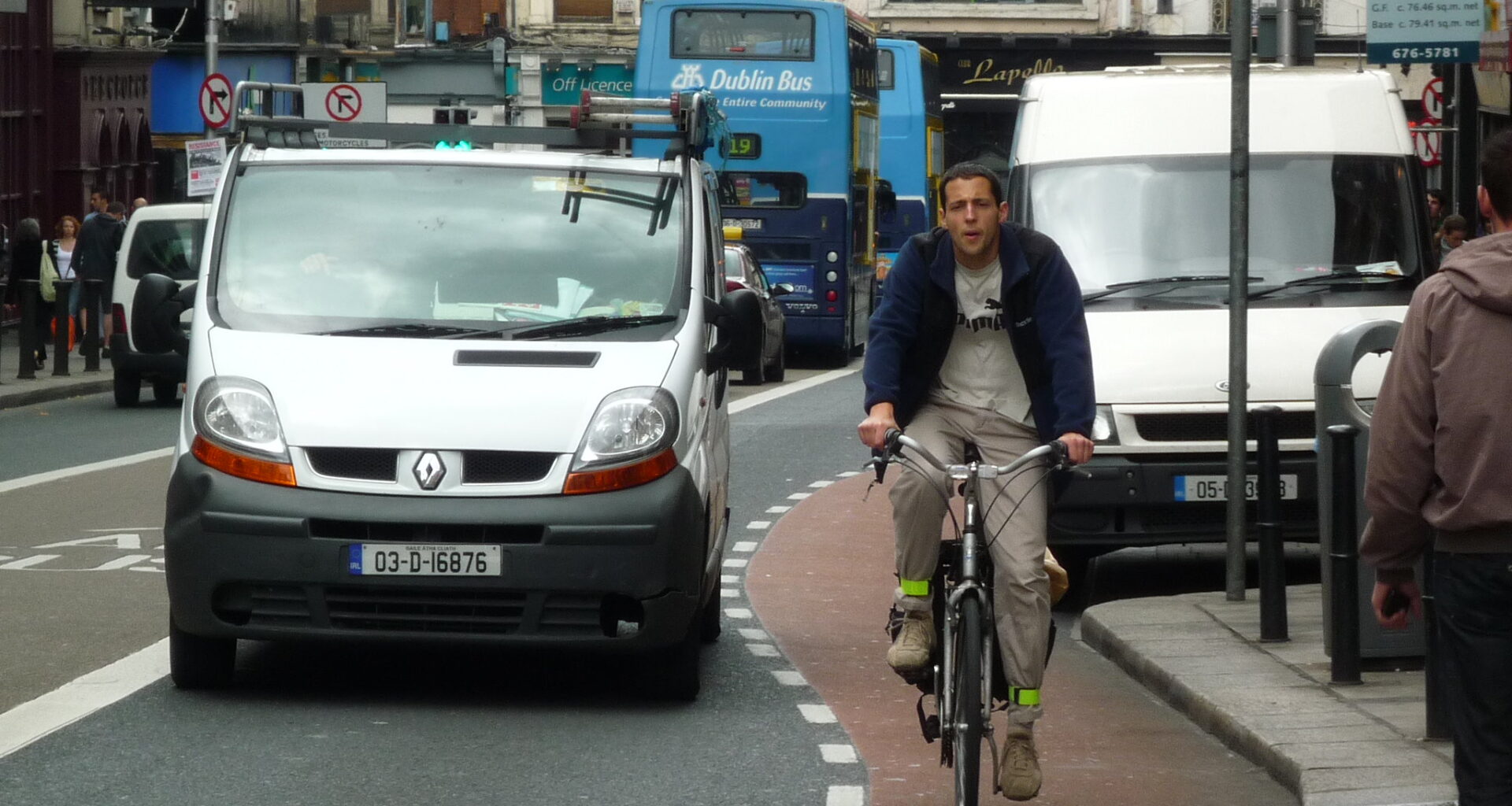
Latest figures from Ireland have revealed cycling trips are up 50 per cent in Dublin in two years, the stats showing while much of the recent political and media attention around cycling in the country has focused on controversial measures such as mandatory hi-vis clothing and helmets, in the background there is consistent active travel take-up.
The National Transport Authority’s 2025 Walking and Cycling Index found that active travel journeys in Dublin, Cork, Galway, Limerick and Waterford had resulted in 660,000 fewer daily car journeys, a figure The Journal suggests is equivalent to 120,000 tonnes of greenhouse gas emissions annually.
Of that two-thirds of a million number, around 510,000 walking an cycling journeys came in Dublin, where the proportion of adults cycling five or more days a week has increased from eight per cent in 2023 to 12 per cent in 2025.
Notably, the number of school journeys cycled is almost double the 2023 figure and commuting journeys were up around a third from 23.2 million in 2023 to 30 million in 2025.
Campaigners and pro-cycling politicians will point to the numbers as proof investment in active travel infrastructure, such as protected cycle lanes, is working and enabling more people to access cycled journeys.
However, while the figures show cycling’s growth over the past few years, recent media attention in Ireland has focused on controversial proposals, such as introducing mandatory hi-vis for cyclists.
Last month, Ireland’s Department for Transport confirmed its plan to fine all cyclists not wearing helmets or hi-vis, only for the proposal to be unceremoniously scrapped following a backlash 24 hours later.
Then, more recently, Ireland’s National Bus and Rail Union also called for hi-vis jackets to be made mandatory for people on bikes, a move the union said would “make the roads a safer place”.
The year also began with a media storm following a judge’s remarkable court comments claiming that cyclists in Dublin have become “a nightmare”.
The case saw the judge reported to the judicial standards body and attracted criticism from Ireland’s transport minister and prime minister.
While a rise in the number of people cycling in Ireland is undoubtedly a positive for the environment and public health, recent road safety figures did find that 14 cyclist fatalities were recorded in the Republic of Ireland in 2025, the fourth highest number this century and double the number recorded in 2022.
The casualty figures, published in January, prompted road safety groups to call for a “whole-of-government response” to better protect vulnerable road users and “reverse this tragic increase in road deaths”.
Today’s publication of the Walking and Cycling Index also highlighted concerns about cycling safety, even if participation numbers are on the rise.
Of those surveyed, 59 per cent said they feel it is safe to cycle in their area, this number significantly lower than the 87 per cent and 90 per cent who said it is safe to walk or drive.
There was broad support for 30km/h (18.6mph) speed limits in urban areas and 71 per cent of Dubliners expressed support for segregated cycling infrastructure.
“The vast majority of residents across the State’s five main cities want increased investment in cycling infrastructure, even when that results in less road space for cars, the NTA’s 2025 Walking and Cycling Index has found.” @darraghobrientd.bsky.social
www.irishtimes.com/ireland/dubl…
— Irish Cycling Campaign (@irishcyclingcmpn.bsky.social) 3 March 2026 at 08:02
“It is really encouraging to see such strong levels of support for more investment in walking, wheeling and cycling,” Anne Shaw, the National Transport Authority’s CEO said.
“We will use this data to guide our work as we continue to deliver high quality walking and cycling infrastructure, more safer routes to school, and active travel networks that connect people’s homes with their work, school and local amenities.”