
Your support helps us to tell the story
From reproductive rights to climate change to Big Tech, The Independent is on the ground when the story is developing. Whether it’s investigating the financials of Elon Musk’s pro-Trump PAC or producing our latest documentary, ‘The A Word’, which shines a light on the American women fighting for reproductive rights, we know how important it is to parse out the facts from the messaging.
At such a critical moment in US history, we need reporters on the ground. Your donation allows us to keep sending journalists to speak to both sides of the story.
The Independent is trusted by Americans across the entire political spectrum. And unlike many other quality news outlets, we choose not to lock Americans out of our reporting and analysis with paywalls. We believe quality journalism should be available to everyone, paid for by those who can afford it.
Your support makes all the difference.Read more
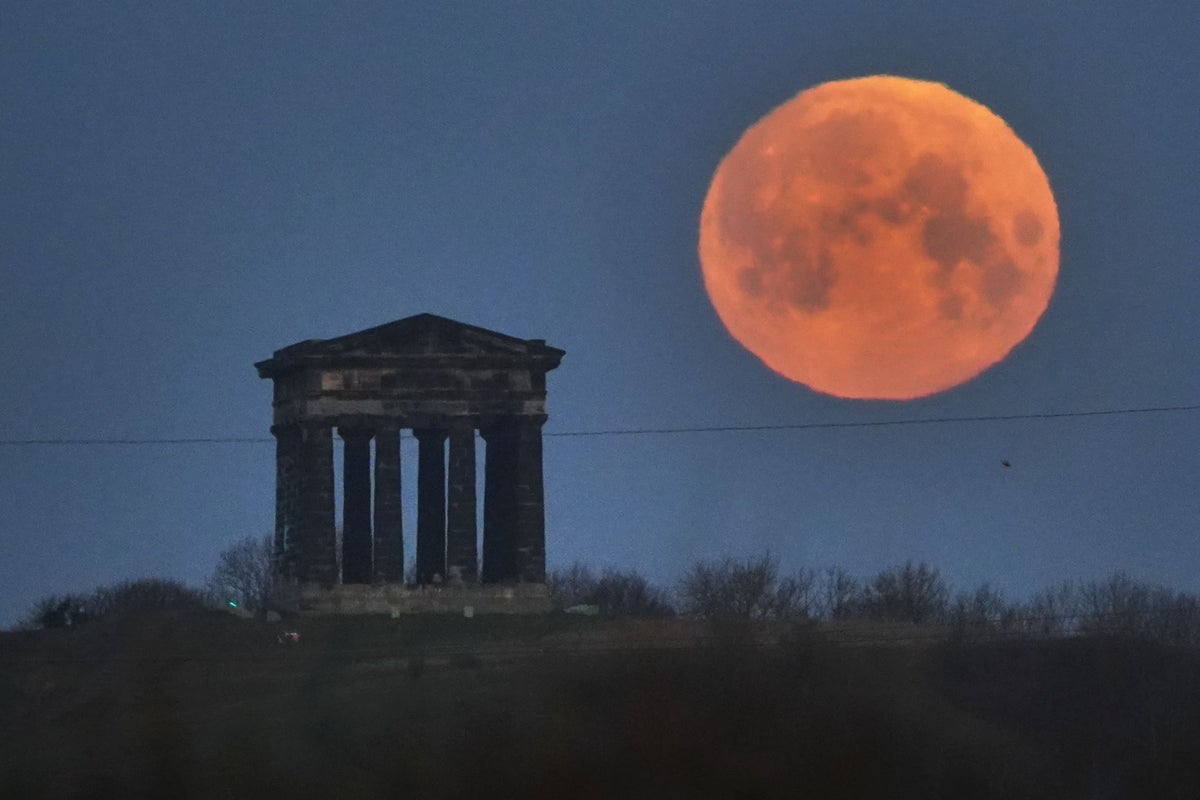
The second full moon of the year will delight skygazers across large parts of the UK on Tuesday evening.
The first full moon of spring, known as the worm moon, will be most visible from Scotland, Northern Ireland and northern England, with cloudier conditions expected in the south.
The Moon appeared red in parts of Asia, Australia, North America and South America earlier on Tuesday as it coincided with a full lunar eclipse – also known as a blood moon.
But the worm moon will lose the distinctive colouring as it comes into view across the UK as the eclipse reached totality at around 11.30am on Tuesday.
Dr Ed Bloomer, senior astronomer at the Royal Observatory Greenwich, said: “In the UK, we don’t get to see the eclipse portion.
“It’s below the horizon for us. You get to see the Moon tonight, but you miss the bit where it reddens.”
The worm moon is thought to take its name from worms who escape from the soil to mate during the spring, he said.
The blood moon appears red as the Moon lines up with Earth and the sun.
Light escapes the eclipse and is scattered through Earth’s atmosphere, causing the reddening effect.
Dr Bloomer said: “The Earth acts a little bit like a prism. Most light gets blocked out, but some light gets through, but it’s been refracted.”
Dan Suri, chief operational meteorologist at the Met Office, said: “This evening, skies will be clearest across Scotland, Northern Ireland and northern England.
“There will be some, albeit less extensive and less reliable, clear skies over parts of southern England.
“Inbetween, conditions will be cloudier, with some of this cloud spreading into Northern Ireland, northern England and southern and western Scotland during the early hours of Wednesday.”