
For Angelo Candalepas, a building’s impact on the human experience is more important than its outward appearance. It’s less about a building’s silhouette and more about its soul.
This guiding philosophy – the idea that a building’s true value lies in how it engages the spirit – has enabled the Sydney architect to pivot seamlessly from the high-end luxury market to the grit of community-focused projects.
And now two such projects have earned Candalepas Associates two places on the shortlist of the Royal Institute of British Architects International awards for excellence.
The list, announced on Thursday, features 52 projects from 18 countries, with five Australian projects making the shortlist.
Candalepas’s achievement marks a rare double-shortlisting for two projects that are as starkly different in their design as they are in their function.
The Porter House hotel, located in the heart of Sydney, is a creative blend of heritage and modernity. A 10-storey base wraps around the original historic building, while a cantilevered 27-storey apartment tower sits gracefully above it.
The Porter House hotel on Castlereagh Street in Sydney’s CBD, designed by Candalepas Associates. Photograph: Rory Gardiner
Inside, the hotel trades corporate vibes for the cosy, private feel of a luxury apartment. As Candalepas’s team began excavating the Castlereagh Street site, relics from the original building – old gloves, glasses, pots and teacups – were uncovered, which are now on display in the foyer to give guests a connection to Sydney’s past.
Less than 20km south-west of the CBD sits Hurstville’s new Church of the Living God, designed as a sanctuary for both a linguistically diverse Pentecostal community and women fleeing domestic violence.
The Church of the Living God in Hurstville, Sydney, designed by Candalepas Associates. Photograph: Rory Gardiner
The big architectural challenge, said Candalepas, was making the building feel like a fortress without looking like a prison.
“The building is one which accommodates a kind of monastic life for those women who are seeking refuge away from the misfortunes of their lives,” he said.
“But at the same time, there’s an investment of an entire congregation with many, many languages … so the building has to be this kind of refuge, but in the truest meaning of the word, where people actually feel safe inside … a protective harbour and a welcoming place of worship.”
Candalepas said the core task for both projects was the same.
“For me, architecture is an understanding of certain things that exist in the world that are common to all humans,” he said. “The size of the project is not the primary consideration … it’s how one applies oneself to a task which engages with humans.”
The Australian projects shortlisted in the awards represent a broad spectrum of design, from high-end residential to local community infrastructure.
Although now more than two years old, fjcstudio’s Darlington public school in Sydney continues to collect international plaudits, shortlisted alongside five other education projects across China and the Indian subcontinent.
Darlington public school in Sydney, designed by fjcstudio. Photograph: Anthony Fretwell
In 2024 it was crowned world building of the year at the World Architecture festival in Singapore.
The design of Darlington public school centres on a “connecting with country” framework, a strategy that earned it top honours at the 2024 NSW Architecture awards and the Indé awards. The architects integrated native landscaping and preserved historic Aboriginal murals, recreating those that could not be saved to maintain the school’s cultural identity.
By using the entire campus as a “living classroom”, the project has been praised for balancing modern educational requirements with a respect for its Indigenous history.
Two Australian architect firms also made it on to the shortlist in the highly competitive residential category.
Gold Creek house in Brookfield, Brisbane – a collaboration between Pritzker prize-winning architect Glenn Murcutt and Brian Steendijk – is a finalist in the residential category.
Gold Creek in Brookfield, Brisbane, designed by Brian Steendijk and Glenn Murcutt. Photograph: Christopher Frederick Jones
Tucked into a ridgeline on the semi-rural outskirts of Brisbane, Gold Creek is a twin-pavilion residence sitting within the natural environment. The 100 sq m home has dramatic, zigzagging roofs of rust-red Corten steel. The concertina structures serve as a functional and aesthetic purpose, providing an ember-resistant shield for a site prone to bushfires.
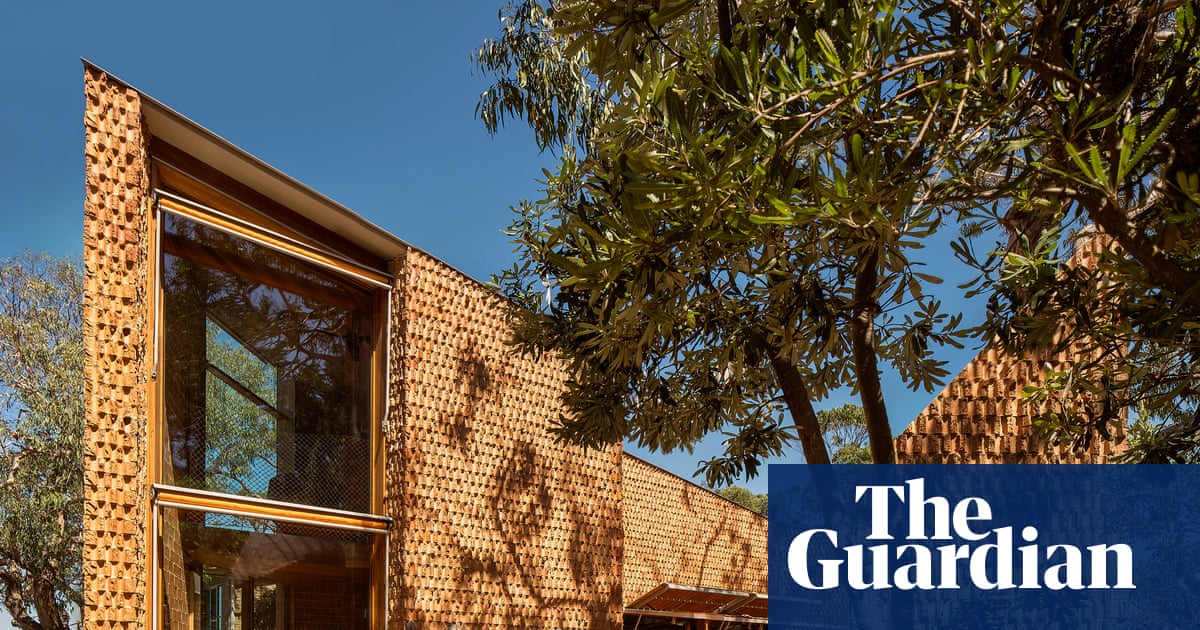
Meanwhile, Wardle’s Burnt Earth Beach House in Victoria’s Anglesea, also the recipient of multiple previous national and state architecture awards, anchors itself to the dramatic cliffs of the Great Ocean Road.
Burnt Earth Beach House in Anglesea, Victoria, designed by Wardle. Photograph: Willem Dirk du Toit
Designed by John Wardle as his own family retreat, the house is primarily built from terracotta. The exterior features hand-torn bricks to match the texture and ochre tones of nearby cliffs, and provides a fire-resistant shell for the home’s high-risk bushfire location.
The house is organised around an X-shaped plan that centres on the kitchen, with living areas branching out to track the sun and frame views of the Southern Ocean.
Over coming months, the 52 shortlisted projects will be visited by a global jury. The winners of the Royal Institute of British Architects International awards for excellence will be announced on 11 June 2026.