
Hello Subscribers,
It’s World Book Day on March 8, and to coincide with the event, we’re sharing extracts from some of the best cycling books around. All the extracts are free, so there’s no paywall, and the aim is to run one per day.
Follow me on: Twitter 🟢 — Instagram 🔴 — Bluesky 🔵
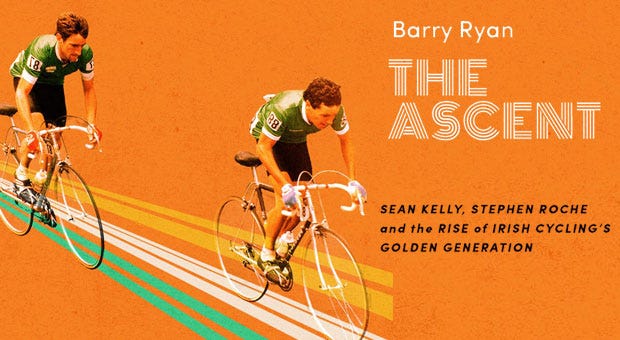
Today, we have Barry Ryan’s ‘The Ascent: Sean Kelly, Stephen Roche and the Rise of Irish Cycling’s Golden Generation.’
I hope you enjoy it!
Daniel 🫶
Stephen Hero
Jacques Goddet never hid his admiration for Sean Kelly, and ahead of the 1987 Tour de France, his final edition as director after almost a half a century at the helm, he was all but willing the Irishman to win it. The Tour peloton was setting out from the Grand Départ in West Berlin without the retired Bernard Hinault and the injured Greg LeMond, but in an interview with L’Équipe on the eve of the race, Goddet preferred to focus on the presence of a man who had missed the previous year’s race. “For the first time, Sean Kelly is coming to the Tour de France aiming to win it, and that is a very remarkable event,” Goddet said. In the same newspaper, the five-time Tour winner Jacques Anquetil picked Kelly as his favourite for overall honours in the first instalment of a daily column in which he answered a mailbag of readers’ questions.
For his part, Kelly must have been wondering what he had done to merit such a tag after a trying spring, though no one among the wide slate of contenders held unimpeachable credentials. Laurent Fignon had struggled with injury in the three years since his 1984 triumph. Pedro Delgado was deemed too inconsistent. Jean-François Bernard was too callow. Luis Herrera was penalised by his time trialling. Stephen Roche had won the Giro, true, but the field there was weak. Besides, the Giro-Tour double had only ever been achieved by Fausto Coppi, Eddy Merckx, Anquetil and Hinault, and nobody truly believed Roche belonged amid that august company.
Kelly, still world number one, was as safe a bet as any, and he was certainly due an upturn in his fortunes by the time July rolled around. His year had begun tragically, when Jean de Gribaldy was killed in a car crash near Besançon on the night of January 3. Among De Gribaldy’s foibles was a penchant for reckless driving, as well as a tendency to drive through the night when he felt the occasion demanded it. He was a man perpetually in a hurry. The police report suggested that he fell asleep at the wheel. At the age of 64, Le Vicomte was gone.
Kelly and the Kas team were at a skiing camp in Combloux in the Alps at the time, and they travelled to Besançon together for the funeral three days later. “Above all, De Gribaldy gave me freedom,” Kelly told Vélo Magazine later in the spring. Though his influence remained, De Gribaldy’s role had altered slightly when Kas took over sponsorship at the beginning of 1986, and the team already had a readymade replacement as manager in the form of Ramon Mendiburu. The Basque was, Kelly wrote in Hunger, “the perfect character to fill the void” because, like De Gribaldy, he rarely felt the need to raise his voice.
The opening weeks of the season delivered the usual yield, as Kelly won Paris-Nice and the Critérium International, beating Roche into second place both times, but he fell short in the classics. After another second-place finish at the Tour of Flanders, Kelly snapped his handlebars on the cobbles at Ennelevin during Paris-Roubaix, where Vanderaerden’s victory only compounded his distress. Worse was the follow at the Vuelta a España, where Kelly led the race with four days to go to the finish in Madrid, only to be forced out by a painful cyst on his perineum that prevented him from sitting on the saddle. Instead of feting Ireland’s first Grand Tour winner, the Vuelta had its maiden Colombian champion, as Luis Herrera took the spoils.
Kelly’s injury had healed by the time he arrived in Berlin for the start of the Tour, but though he evinced confidence in public, he privately harboured doubts about his form. “If I can find the little something I’m still missing, I can still win the Tour,” Kelly said after the team time trial in Berlin, though the admission that he needed to lose a kilogram of excess weight during the opening week of the race was an ill portent. He proceeded to lose rather more than he had bargained for in the first long individual time trial at Futuroscope, conceding more than five minutes to Roche. All prospects of winning the Tour evaporated there, and worse was to follow.
The early kilometres of stage 12 saw the first détente of the 1987 Tour, with the peloton content to amble along at a leisurely pace. When the rider in front of him braked abruptly, Kelly rode into the back of him, and his left shoulder bore the full brunt of his fall. Kelly knew that his collarbone was broken, but he jumped back on his bike regardless. He lasted a minute before the pain proved too much to bear, and he wheeled to a halt. Race doctor Gerard Porte administered a painkilling injection, while directeur sportif Christian Rumeau gave an on-the-hoof update to L’Équipe’s Jean-Marie Leblanc, who was sitting beside Goddet in the race director’s car. “We’ll let him ride for a couple of kilometres and see,” he said.
Kelly set off again uneasily, and was initially pushed along by his Kas teammates Inaki Gaston, and Gilles Sanders, until Goddet reluctantly admonished them from atop the sunroof of the director’s car. “Gentlemen, you can’t do that, unfortunately. I’m deeply sorry,” Goddet said sadly. Roche, Fignon, Kimmage, Earley and Claude Criquielion were among those to drop back to sympathise as word spread of his plight. Kelly was unable to use his left arm to brake or change gear. A platoon of photographers’ bikes plagued him like mosquitoes, waiting for the moment. After 75 kilometres, on an almost imperceptible rise, Kelly brought his Tour to a halt, sobbing openly as Rumeau draped a long-sleeve jersey across his shoulders.
As the photographers stepped in to capture the moment, Goddet emerged from his car to shake Kelly’s hand and whisper words of consolation. After taking his seat once again, he took the radio mouth-piece and made a special, gravely-intoned address to the Tour caravan, as Leblanc put it, “to salute Sean Kelly.”
***
On the final day of the Tour, while Roche was being feted in yellow on the Champs-Élysées, Kelly sat in a lifeless studio in Brussels, his arm still in a sling from his crash a fortnight earlier. At the behest of RTÉ, he spoke via a live link-up to give his thoughts on this most historic day for Irish cycling. His words for Roche were generous, but his disappointment at his own fate was obvious. It was a trying afternoon.
“I went into one of the TV stations in Brussels and I was talking with Jimmy Magee on the radio or something,” Kelly says. “From one side, I think yeah, you’re happy to see it. But there’s another side where you’re disappointed you’re not in there, in the event and getting onto the Champs-Élysées. And when you see Roche winning it, I suppose you say to yourself, ‘Shit, if he can win it, I should be able to win it.’ So there’s a lot of things that go through your head at that time, in those three weeks, and especially at the very end, on the final day.”
Kelly being Kelly, he is reticent even now to expand greatly on the conflicting feelings conjured up by the occasion. Paul Kimmage, who was in Paris that evening, but only as a spectator following his abandon on the road to La Plagne, can hazard a guess. “Kelly would have been fucking gutted when Roche won the Tour,” he says. “Up until then, he was the man, but when Roche won the Tour, it altered the terms of his legacy. It meant that what Roche had achieved would always be greater than what he did. Do people think about who was world number one at the time? No, winning the Tour de France is your place in history. Kelly understood that more than anybody when Roche won the Tour. That would have been really fucking tough.”
I have established a WhatsApp Community Group for Substack founding members. I post interview recordings and breaking transfer news.
To sign up, subscribe or upgrade to Founding Member status. Once you’ve signed up, I’ll ask for your mobile number and add you to the group. This group is not for mainstream cycling press, full-time staff on cycling teams, team owners, or CEOs at cycling brands. Sorry. It’s just for the fans. Join today!