
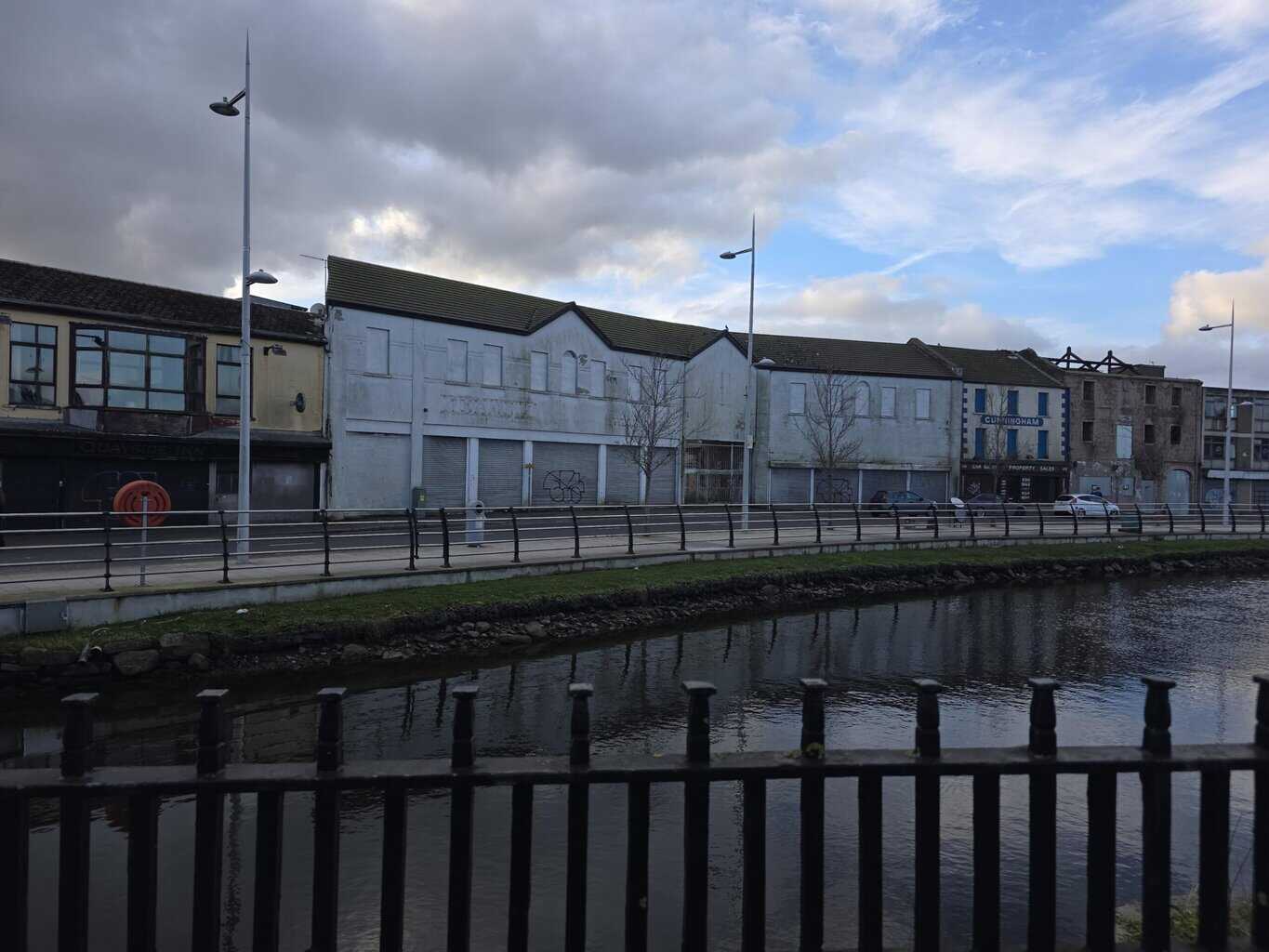
Walk down most high streets in Northern Ireland — Lisburn, Ballymena, Newry, Newtownards, and the secondary streets of Belfast — and you will see town and city centres in distress. Empty shop units sit alongside an over-proliferation of charity shops, vaping stores, barbers and nail bars which, to an outsider, would suggest that Northern Ireland people spend their lives searching for second hand bargains, have the best-kept hair and nails in the UK and every citizen carries a vape wherever they go. It is, in short, not the picture of a thriving retail economy.
Now drive to any NI industrial estate. Different picture entirely. The estates are vibrant, busy, and expanding.
Northern Ireland’s manufacturing sector is, by any measure, booming. The NISRA Index of Production shows NI’s production sector is now 7.2% above pre-pandemic levels, while the UK as a whole remains 8.2% below its pre-pandemic level. Manufacturing employment grew from 88,100 in 2019 to nearly 97,000 by 2023. The number of production businesses grew by 2.5% in 2025 alone — the fastest of any sector in Northern Ireland. These are not the statistics of a sector in distress. These are the statistics of a sector that has, frankly, never had it better.
So here’s the question that Stormont and Land & Property Services need to answer: why are we still giving that sector a 70% discount on its rates bills, while doing almost nothing for a high street that is visibly struggling?
Industrial derating — the mechanism that slashes the rates liability of qualifying manufacturing premises by 70% — costs the Northern Ireland Executive an estimated £58 million a year in foregone revenue, supporting around 4,400 ratepayers. It is unique to Northern Ireland; England and Wales abolished the equivalent relief in 1963, Scotland phased it out by 1995. We have held onto it, initially with good reason, but the economic logic that once justified it has long since evaporated.
The relief was designed for a sector under siege. The original legislation dates to 1929, when manufacturing faced intense international competition and needed a lifeline. Northern Ireland’s manufacturing sector in 2026 does not need a lifeline. It needs, at most, a friendly nod.
What makes this worse — and frankly farcical — is that the legislative definition of who qualifies for the relief is rooted in the Factories Act (Northern Ireland) 1965, itself largely a restatement of laws going back to the 1920s. The Act’s definition of a “factory” is so broadly drawn that it encompasses premises where people are employed in “sorting any articles,” “packing articles,” “washing or filling bottles or containers,” and the “breaking up” of any article. In plain English, that means certain modern distribution warehouses — where workers break down pallets, sort goods into smaller lots, and pick and pack orders for onward dispatch — could, with the right technical arguments, qualify for the same 70% rates discount as a food manufacturer or an engineering firm. Not every warehouse operation will be doing this, and many businesses in this space are perfectly legitimate claimants of whatever reliefs they are entitled to. But the legislative loophole exists, it has been acknowledged by the NI Assembly’s own committee, and there is no evidence it has ever been properly closed or policed.
What should give Stormont pause is the nature of some of the businesses that could potentially benefit from this ambiguity. Some of those distribution operations are the engine rooms of online retail — the fulfilment and despatch infrastructure that has systematically stripped footfall from our town centres and driven a wrecking ball through the high street businesses our politicians claim they are desperate to save.
It is at least worth asking whether public money, in the form of a 70% rates subsidy rooted in 1920s legislation, is flowing to some of the very operations that are hollowing out the high street. Stormont MLAs can make all the speeches they like about saving our town centres, host all the regeneration summits they want, and commission all the high street recovery strategies money can buy — but if the rating system is simultaneously subsidising distribution infrastructure that competes directly with the retailers doing the struggling, they are not saving the high street. They are, however inadvertently, helping to fund its decline. It is, even by the standards of devolved government in Northern Ireland, a quite remarkable piece of institutional irony.
Meanwhile, the sector that genuinely is under siege gets next to nothing. Smaller retail properties do qualify for the Small Business Rate Relief scheme, which offers a 20% reduction for properties with a Net Annual Value between £5,001 and £15,000. That is welcome as far as it goes, but it is capped at the smallest end of the market and does nothing for the vast majority of town centre retailers who sit above that threshold and face the full rates burden with no structural relief.
Town centre retail vacancy rates across Northern Ireland ran at 14% before the pandemic — already well above the UK average of 9.6%. The pandemic made things worse. High street stalwarts like Woolworths, Debenhams and Laura Ashley disappeared. The departures since have been long and familiar. Connswater Shopping Centre in East Belfast closed in 2025, with unaffordable business rates cited as a key factor in its demise. The Northern Ireland Retail Consortium went to Stormont in January 2026 asking simply for a rates freeze, describing conditions on the high street as “very challenging.” England and Wales have introduced extended retail relief schemes. Scotland has its own hospitality and retail relief. Northern Ireland has done nothing.
There is a further, less visible dimension to this failure. When retail businesses collapse — and they are collapsing — LPS is left holding rate bills that will never be paid. According to figures presented to the Stormont Finance Committee in December 2024, LPS carries a collection target of 93% against gross collectible rates of nearly £2 billion, meaning that even in a strong collection year, over £130 million goes uncollected across all ratepayers. In 2023/24 alone, £16.9 million of rates debt was formally written off. Retail — the sector facing the highest insolvency pressure without any structural relief — contributes a disproportionate share of that bad debt. A rates bill issued to a shop that subsequently closes due to insolvency is not a contribution to public finances. It is a number on a spreadsheet that LPS will spend years trying to recover, and will largely never see. The current system is not merely unfair to retail. It is trying to generate revenue from a sector it is simultaneously squeezing to death.
The result is a rating system that, whether by design or drift, subsidises success while taxing struggle.
The fix is not complicated, and crucially it can be done in a way that is broadly revenue neutral to Stormont. Reduce industrial derating from 70% to 25%, phased over three years to give manufacturers time to adjust, and redirect the released resource — approximately £37 million per year — into a 50% rates relief for qualifying town centre retail occupiers.
Not all retail needs the support. Supermarkets, convenience multiples — your Supervalu’s, Centras, and Nisas — and out-of-town retail parks are performing strongly and can stand on their own feet. The relief should be targeted at the independent shops, the high street chains, the cafés, boutiques, and service retailers that animate our town centres. These are the businesses whose closure leaves behind something harder to fix than a balance sheet — a hollowed-out town centre that takes a minimum of generation to recover, or perhaps never recovering.
The revenue arithmetic works. At 70%, industrial derating costs around £58 million per year. At 25%, that falls to approximately £21 million, releasing around £37 million that could fund meaningful relief across the NI retail sector.
Some will argue that manufacturing needs certainty and that reducing derating sends the wrong signal. That argument might have carried weight when the sector was fragile. It carries very little weight when manufacturing employment is at a 20-year high and production output is at record levels. A 25% rates discount remains a meaningful competitive advantage. It is not abandonment — it is a recalibration to reflect reality.
Others will point to the complexities of the rating system, the legislative requirements, the need for consultation. All true. But “complicated to fix” is not the same as “wrong to raise.” And this is wrong. A policy designed for 1929 economic conditions, operating through a definition of manufacturing so outdated that a warehouse worker breaking down pallets might qualify for the same relief as a factory floor engineer, should not be costing £58 million a year while the high street dies on its feet.
Northern Ireland’s Executive has limited fiscal levers. Non-domestic rates is one of them. The question is whether Stormont chooses to use that lever to reflect economic reality, or continues to reward the thriving and ignore the struggling.

Patrick Murdock is a dual qualified Chartered Surveyor and qualified Tax Advisor original from and currently in based Newry. An independent free thinking liberal at heart, prior to establishing his own specialist consultancy, Patrick has built a twenty year career working for a number of global advisory firms and continues to work across markets in the construction, property and final services industries and has considerable experience and practical knowledge of working day today in the UK, Northern Ireland and ROI markets.
He is also Cofounder and operator – The Hub, Newry.
Discover more from Slugger O’Toole
Subscribe to get the latest posts sent to your email.