
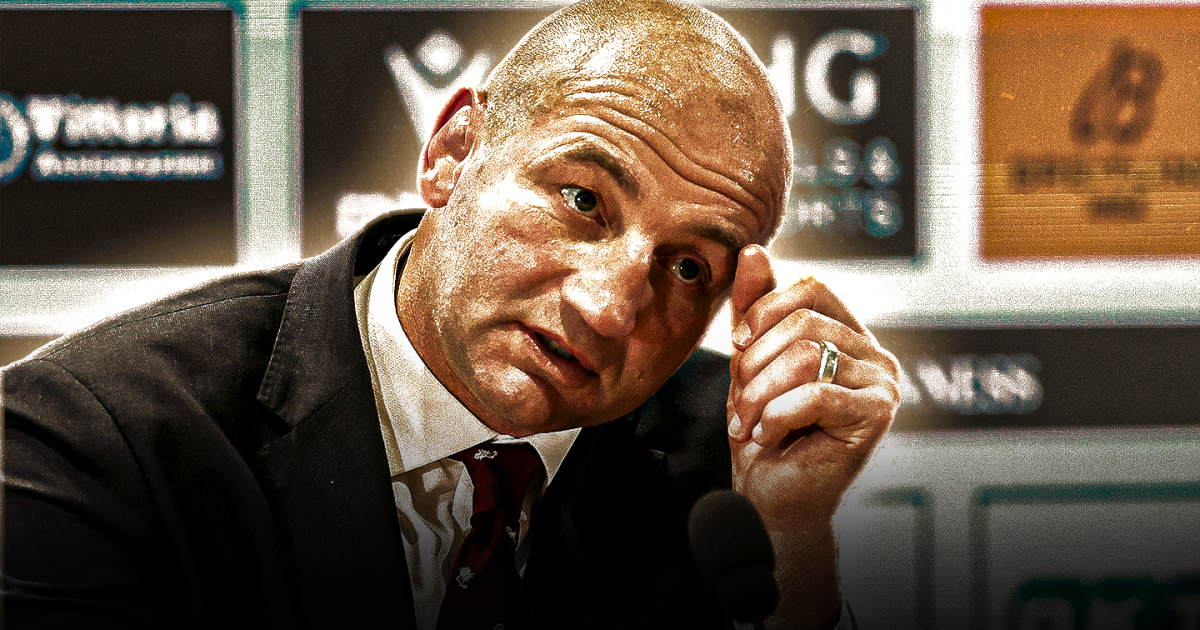
After England’s historic first-ever loss to Italy on Saturday afternoon at the Stadio Olimpico in Rome, there have been the usual calls for mass decapitations at the top of the game in England. Nothing much seems to have changed in the country since the era of Henry VIII. Heads must roll when things do not go to plan, and there has been no change in thinking from medieval to modern. Spare a thought for soccer, where the reflex has become automatic, and epidemic.
The name at the top of the list for the axe is that of head coach Steve Borthwick, and right now the proud Cumbrian must be wondering whether he did right to accept the poisoned chalice after Eddie Jones’ sudden sacking before the 2023 World Cup. What goes around, comes around, as the saying goes.
In the age of the limited attention span and the 280-character post, results need to be now and past successes are too easily forgotten. As the enigmatic Aussie discovered, a 73 per cent win rate, the best among all England coaches, can be wiped out only 11 months before a World Cup; as Borthwick is finding out, a 12-match winning run can evaporate into thin air with just three consecutive losses.
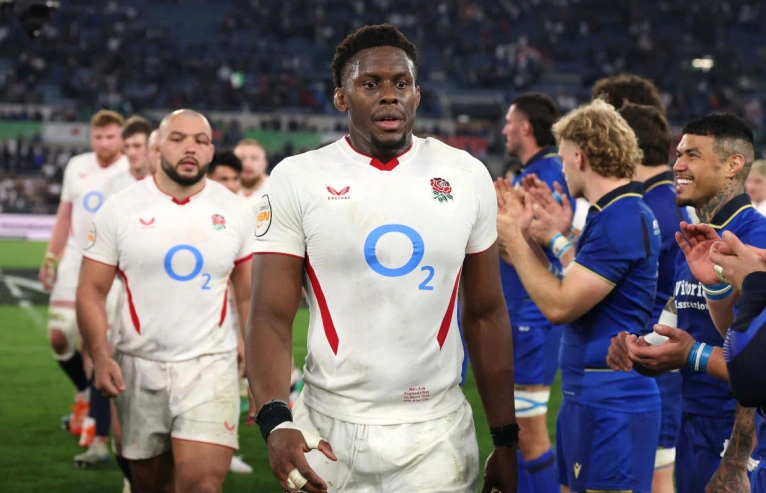 England could be heading for their worst ever Six Nations campaign as they prepare to face France in Paris on the back of three straight defeats (Photo David Rogers/Getty Images)
The voice of ex-Harlequins and England wingman Ugo Monye was typical of the torch-bearers and axe-wielders wending their way to the portcullis of the RFU castle. As Monye explained on ITV Sport:
“The conversation about Borthwick’s future has to start now. You look at the last couple of weeks. He gave faith to players before the loss to Ireland – then he rang a load of changes, and that didn’t work.
“France are top [of the table] and tracking pretty well. Scotland are getting better. Italy are getting better. Wales are getting better. England are on the slide. How do you arrest it?
“It’s only ever one of two things. It’s the players or the coach. At the moment, I don’t think the potential of the players is being met by the vision of the coach.”
There is another side to the story. Fabien Galthié is only now beginning to ponder the implications of a seven-try, 50-point mauling in Edinburgh. Andy Farrell’s Ireland were damned after defeat by France in round one but saved after victory over England in round three. Wales may have shown some improvement, but they have still not won a match.
The law of a post-Lions tour hangover is unevenness of performance, and all of Ireland, England and Scotland have experienced it in their current Six Nations seasons.
After Scotland subsided in a Roman rainstorm in round one, it was Gregor Townsend in the stocks, the pelting with rotten vegetables had begun and the catcalls for Toony’s head were almost as loud then as they are for Borthwick’s noggin now. Standing on the verge of Scotland first title triumph in 27 years, the shellacking has stopped and the accusing voices have melted back into the anonymity of the crowd.
None of the curves of development in the current Six Nations have been either smooth, or linear, or predictable, and there may still be one or two surprises in store on the final weekend of a topsy-turvy championship. Borthwick deserves a stay of execution, at least until the final results are in, and there is ample time to digest them fully.
The law of a post-Lions tour hangover is unevenness of performance, and all of Ireland [18 Lions in 2025], England [15] and Scotland [12, including five replacements] have experienced it in their current Six Nations seasons. There have been one or two highs but there have been just as many inexplicable lows for all three nations. Only Wales [2 Lions] have had a relatively steady curve of development, but it has occurred at a far lower level of expectation.
How else can you explain the likes of skipper Maro Itoje, who was enjoying a man-of-the-match performance with three individual breakdown turnovers at the time, suffering the brain-fade which prompted him to slap down the ball at an Azzurri lineout drive in plain view of the referee? That cost him a yellow card, and alongside Sam Underhill’s sin-bin nine minutes earlier, it cost England the bench impact which was one of the major strengths of their game in November.
As Borthwick observed afterwards: “We’ve had seven yellow cards and a red card in four [Six Nations] games. Ultimately that period of 60 to 65 minutes was the key turning point today. I think the team, up to that point, had done a lot of very good things and got themselves into a winning position.”
To put that stat into perspective, England only had three yellow cards in four matches in November.
Three months ago, Steve Borthwick had the luxury of 2025 Lion Will Stuart backing up Leicester’s Joe Heyes from the bench in a one-two punch supreme from the tight-head berth, but with the Bath leviathan’s season-ending injury, the Tiger has had to play more minutes than before:
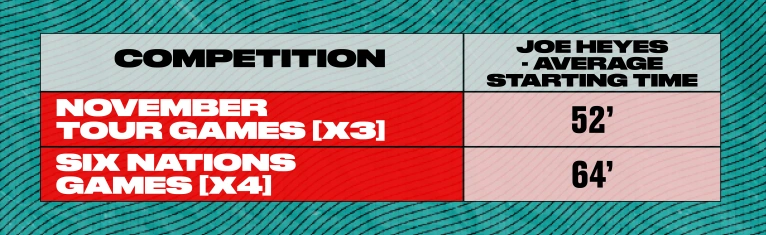
If you discount the first game versus Wales, Heyes has spent an average of 69 minutes on the field in the three losing matches against Scotland, Ireland and Italy. Instead of contributing an explosive half-hour off the bench as he did in November, 2025 Lion Ellis Genge has been required to spend over an hour grinding away at the coal-face in the same three losing causes in the Six Nations. England’s set-piece effort off the bench has crumbled to dust in scrum mentor Tom Harrison’s hands:
— William Bishop (@RPvids1994) March 9, 2026
In this long clip from a lineout, the Azzurri are looking to manipulate the defence to exploit the two English props defending together in the middle of the field, hitting the pair of Genge and Heyes no less than three times in under one minute of play. On the third occasion they get lucky, with centre Tommaso Menoncello aligned one-on-one against the Tigers’ No.3 close to the side of the ruck. There can only ever be one winner of that contest.
If there is one area in which Borthwick needs to unearth a more definite solution ahead of the final climatic encounter at the Stade de France, it is in the use of ball won from the transitions in the kicking game. England had no problem winning the lion’s share of ball won, or retained, from aerial contestables in Rome, especially in the first half:
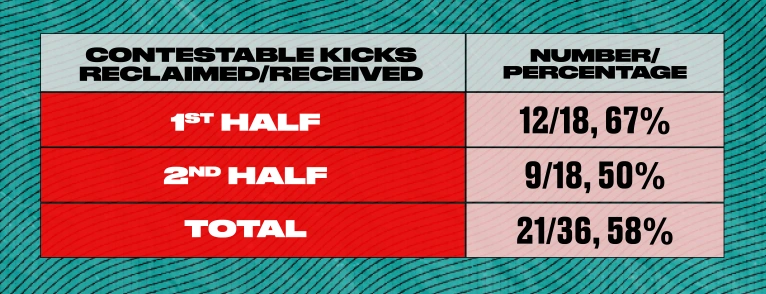
With Fin Smith yoked to an aggressive midfield featuring Seb Atkinson and Tommy Freeman, and with Elliott Daly starting at full-back instead of Freddie Steward, you would expect England to use the transition possession they won to attack with ball in hand, right? Wrong:
— William Bishop (@RPvids1994) March 9, 2026
— William Bishop (@RPvids1994) March 9, 2026
Kick to contest and reclaim by all means, but there must be a better attacking solution than simply to kick again having done the spade-work to create that gilt-edged attacking ball in the first place. By the end of the game, the Italian defence knew what was coming, and was well-prepared to defend the tame open-side diagonals coming their way:
— William Bishop (@RPvids1994) March 9, 2026
Even when the ball stays in play, there are three Italians and only one Englishman in the area when it lands. No wonder even the equable and mild-mannered Fin Smith looked distraught by the game’s end.
It was no better on kick returns, even when England made inroads on the run-back phase:
— William Bishop (@RPvids1994) March 9, 2026
— William Bishop (@RPvids1994) March 9, 2026
Ex-Northampton and World Cup-winning England scrum-half Matt Dawson summarised the current situation neatly on the BBC Sport website:
“England are never in a million years going to Paris and beating France by deploying the same kick-heavy strategy. If they do, that is a red flag against England’s coaching ticket.
“It may have worked during the 12-game winning run, but Scotland showed you need more than 40 points to beat France – and that was in Edinburgh.
“England have got to play, and they have the players to do that. I do not believe those players on the pitch, particularly the backs, enjoy the current style of play.
“There is nothing to lose in Paris, so let them play. Everyone on the planet thinks they are going to lose. A strategy should not rule every move.
“Why not go out there, and play in a style that is not completely alien to the player base? I don’t see wholesale changes to do this, as Borthwick tried that against Italy and must show some patience.
“The only player I would think about bringing in is Fraser Dingwall for Seb Atkinson. Deploy Northampton’s 10, 12, 13 and just go and attack France. Scotland showed they are beatable if you meet fire with fire.”
Now is not the time to bring out the firing squad and shoot the head coach in broad daylight. England have come too far in 2025 for that to be a sensible solution.
‘Daws’ is right about just about everything, despite his obvious leaning towards the green, black and gold. He could have added George Furbank at full-back too, with Elliott Daly shifting to the left wing. If you are going to install Fin Smith as your 10, give him the right players and structures around him, fill him with Franklin’s Gardens confidence, and take a proper tilt at a French side which will be inevitably vulnerable after shipping 50 points in Edinburgh.
Now is not the time to bring out the firing squad and shoot the head coach in broad daylight. England have come too far in 2025 for that to be a sensible solution. The villagers may be raging at the gate and demanding blood, but Borthwick has earned the right to recover lost ground, and not all the circumstances surrounding England’s sudden fall from grace have been under his control.
England’s players and coaches will be feeling acutely uncomfortable right now, and therein lies the opportunity for further growth. As Australian four-time Olympic rowing medallist Bo Hanson once put it succinctly, “Being uncomfortable is the life-blood of toughness.”