
The more AI evolves, the more apparent it becomes that marketing is not just susceptible, it is peculiarly vulnerable to its machinations.
That was confirmed last week when Anthropic, the cerebral company behind Claude, launched its new Labor Market Impacts report.
Every conversation about AI and marketing asks the wrong questions: Does AI write better ads? Do consumers accept it? Will Cannes Lions need a rethink?
But all of that is barely 20% of what marketers do. The other 80% looks even more vulnerable to the approaching AI threat.
Think about the full scope of marketing. Commissioning and interpreting consumer research. Analysing data. Sizing markets. Segmentation. Brand strategy. Positioning. Pricing. Customer journey mapping. NPD. Forecasting. Briefing. Budgeting.
Much of it is already in transition. AI has already infiltrated market research via synthetic data, which is not only quicker and faster than traditional market research—but more accurate too.
The same is true for competitive intelligence and analysis. What once required a small internal team, now requires a prompt.
Similarly, brand strategy decks that took eight weeks and a quarter million dollars to deliver can now be scaffolded in an hour.
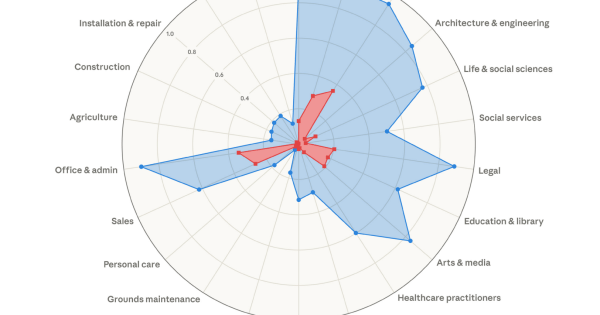
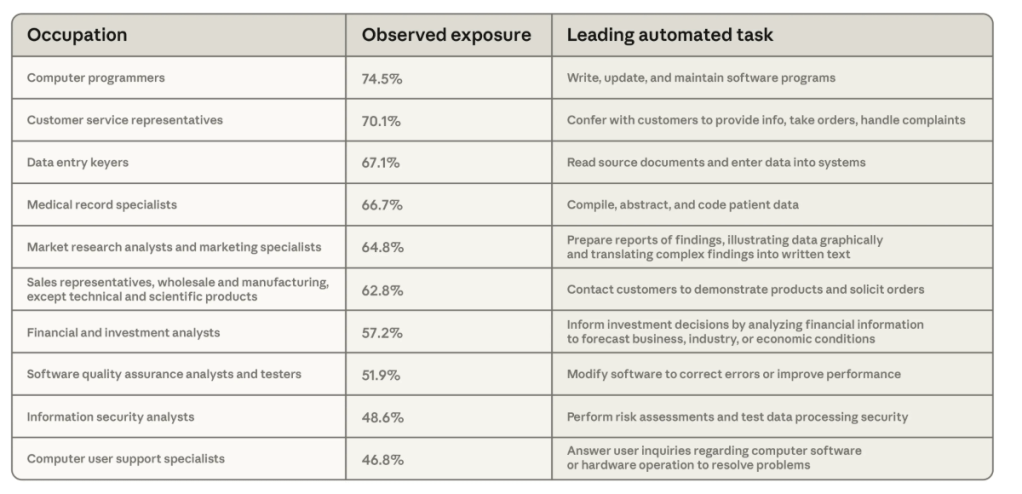
Anthropic’s new report ranked market research analysts and marketing specialists fifth on its list of eight hundred occupations most exposed to AI displacement—behind only programmers, customer service representatives, data entry, and medical record specialists.
This report does not represent the idle fears of marketers contemplating the risk of AI.
This is an independent, empirical estimate ranking every industry and projecting marketing almost at the top of the vulnerability table.
 Anthropic
According to Anthropic, 65% of the tasks performed by marketing professionals are eventually replaceable with AI operations.
That’s a frightening and important proxy for the difficult decade ahead.
4 reasons explain it
First, marketing work is unusually language heavy. Virtually everything marketers produce—strategies, briefs, reports, recommendations, presentations—is text. LLMs eat text.
Second, marketing sits at a curious intersection of creativity and process. It has enough structure to be codifiable and enough ambiguity to reward the kind of probabilistic pattern-matching that AI does well.
Third, marketing functions have been chronically under-resourced for years, creating constant pressure to do more with fewer people. AI doesn’t just threaten marketing jobs, it offers a solution to a problem that CFOs have been circling for a decade: a legitimate way to phase out the marketing “cost” from their organizations.
And fourth, one can find oneself in the marketing profession with no formal training in it. These people produce sub-optimal outcomes and are easily superseded by newly minted, all knowing algorithms.
Indeed, the transition has already begun in a slow, structural constriction of marketing that will take a decade before its full revolution has been revealed. The story of AI adoption will play out in four sequential chapters within our industry.
It begins with hiring
The Bureau of Labor Statistics projects that occupations with higher AI exposure will grow more slowly over the next decade. Marketing is near the top of that exposure ranking. According to Taligence’s analysis of active marketing job postings marketing jobs in the US fell by 7% year-on-year and 15% quarter-on-quarter in Q2 2025.
When the number of available roles drops, those currently employed stay put. Sure enough, the U.S. voluntary quit rate has fallen to 2%, the lowest in a decade, according to the BLS JOLTS data.
Less movement means the job market stagnates. When people stop leaving roles, roles stop being backfilled. And when roles aren’t backfilled, something insidious happens: the organization discovers it didn’t need those roles anyway.
Marketing Week found that almost a quarter of marketing businesses cut senior leaders last year and would not replace them.
With fewer marketing jobs existing and fewer people leaving the ones that do, salaries do not keep pace.
They don’t have to. It’s a buyer’s market. The 2025 CMO Survey—an independent U.S. study tracking 281 marketing leaders—found median marketing salaries stayed flat last year: a decline in real terms against inflation.
The distribution of this decay is not uniform, and that is perhaps the most disturbing detail in the Anthropic report.
Workers in the most AI-exposed occupations are disproportionately younger, more educated, and earlier in their careers. The data found hiring younger workers has specifically slowed in exposed occupations, roughly 14% less versus 2022.
A senior marketer with twenty years of institutional knowledge, client relationships, and strategic judgment is harder to replace. The junior analyst who synthesizes research, builds decks, and writes first drafts is not.
If you are under 40 and certain you want to stay in marketing, you face an existential career question.
Irrespective of your desire or talent, there may not be an industry for you to enjoy in the way old farts did across the last half century.
So what do you do?
First, get trained—most marketers have no marketing qualifications and that makes them easy to replace.
Second, move up or move out—the junior roles are disappearing fastest, so accelerate your seniority or find an adjacent field while you still can.
Third, learn to use AI tools fluently because the marketers who survive will be the ones directing the machine rather than competing with it. Finally, build human capital that AI cannot replicate: client relationships, institutional knowledge, management capabilities, or the ability to walk into a room and make shit happen.
The structural foundations of marketing are creaking. Tectonic change is underway. It will not be good. It will not be bad. It will be different.
At least 65% different, if Anthropic is correct.