
The year opens in mist. It lies in sullen stripes across grass the colour of a Dunlop flash. Bare trees rise from the waist upwards like bathers coming out of the sea. Pull your collar closer. This weather gets into your bones.
You feel David Hockney’s A Year in Normandie as much as you see it. Plenty of exhibitions promise an immersive experience. This one draws you in and wraps you up. Rarely has the Serpentine North gallery made a happier marriage with an artist. It’s a tricky space — a running track with two central chambers — often out of sympathy with its shows. The track works perfectly here.
A Year in Normandie is a 90m sequence of paintings that run around the circumference of the building. Along its length, Hockney leads you on a merry, melancholy dance as spring leads to summer and autumn to winter in the gardens around Hockney’s Normandy farmhouse. Many of us look back on 2020 as a lost or fallow year. For Hockney, iPad on his lap in the orchard, it was uncommonly fruitful.
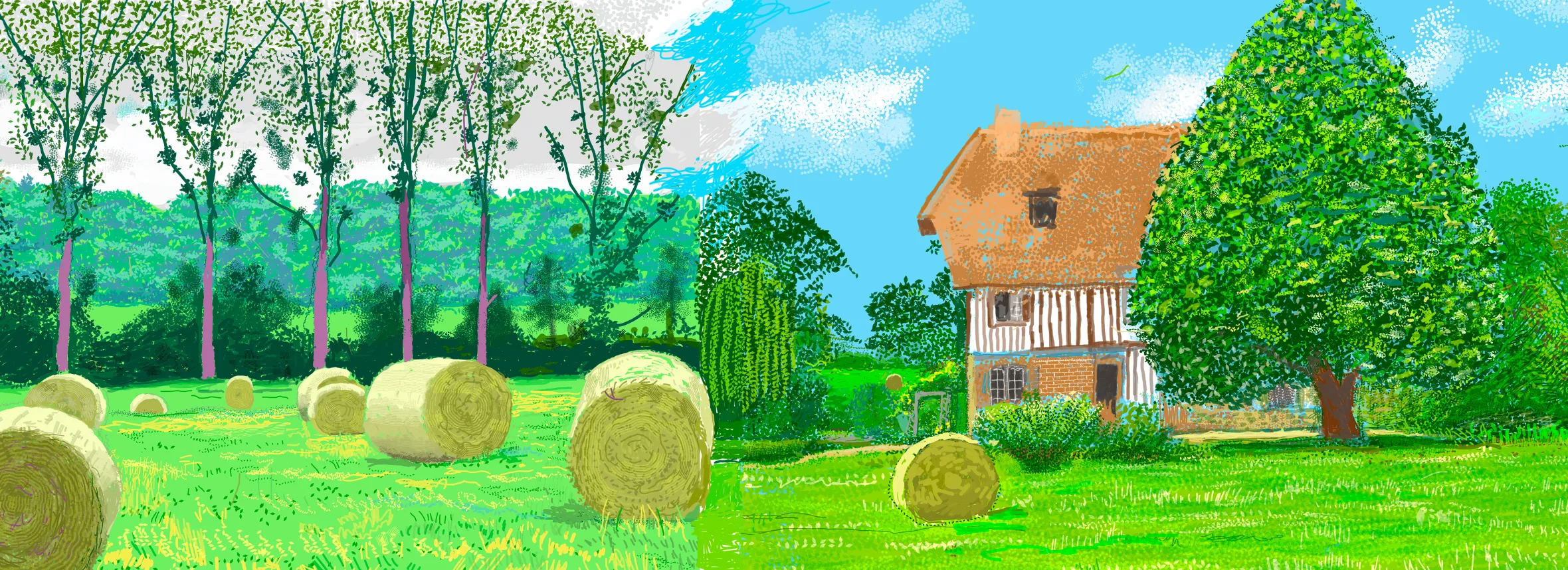 One of Hockney’s sequence of composite iPad paintingsDavid Hockney
In the two central rooms, five portraits and five still life paintings grouped under the umbrella title of Some Other Thoughts about Painting, all set above a gingham tablecloth, continue Hockney’s lifelong experiments with perspective and abstraction. They aren’t his best works and you’re not really here for them. You’re here for the Year.
Hockney has cited Chinese scrolls and the Bayeux Tapestry as inspirations for his frieze. It’s not just about the Year’s long, unspooling form. Hockney’s line-making has more to do with lettering or embroidery thread than with conventional painting.
The iPad drawings, printed on paper, lose focus the nearer you get. The interest isn’t in the individual brushstrokes — the finger being a blunter instrument than a tapered brush — but in the calligraphic swiftness with which Hockney conjures bark and blossom, turning leaves and fallen hay. His dandelions are just dots on lollipop sticks but he captures completely their brashness and cheer.
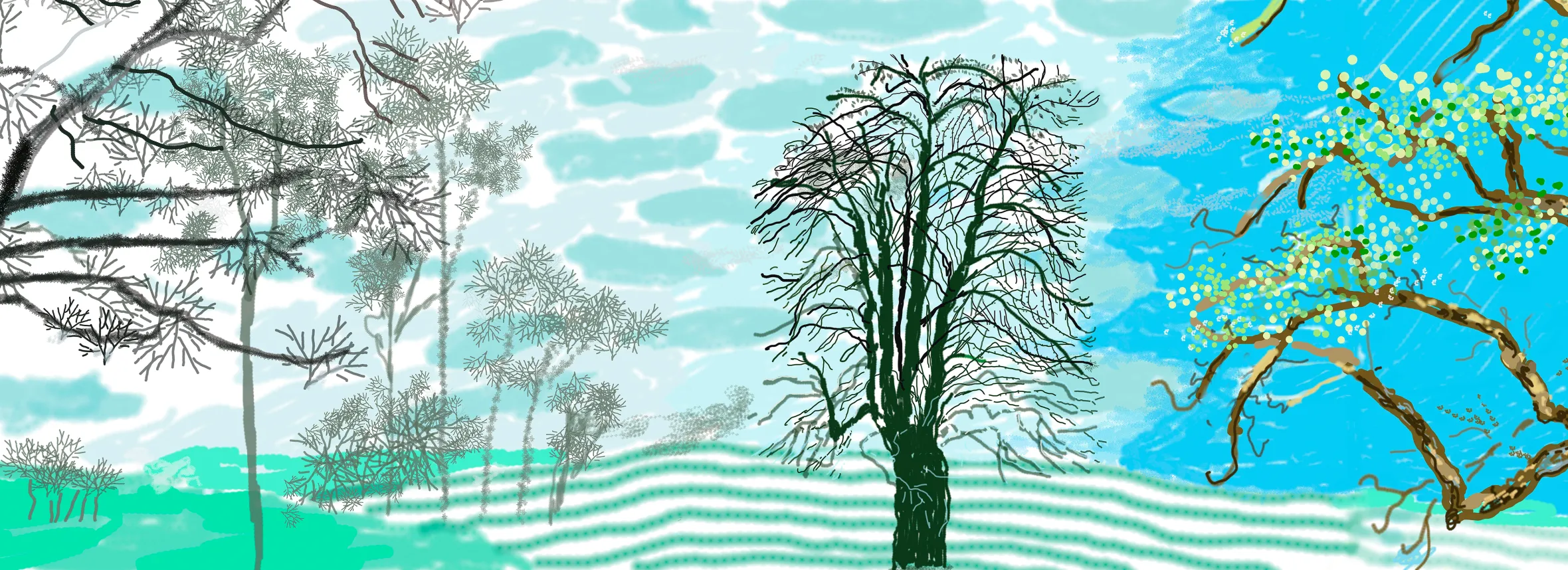 David Hockney; from David Hockney: A Year in Normandie
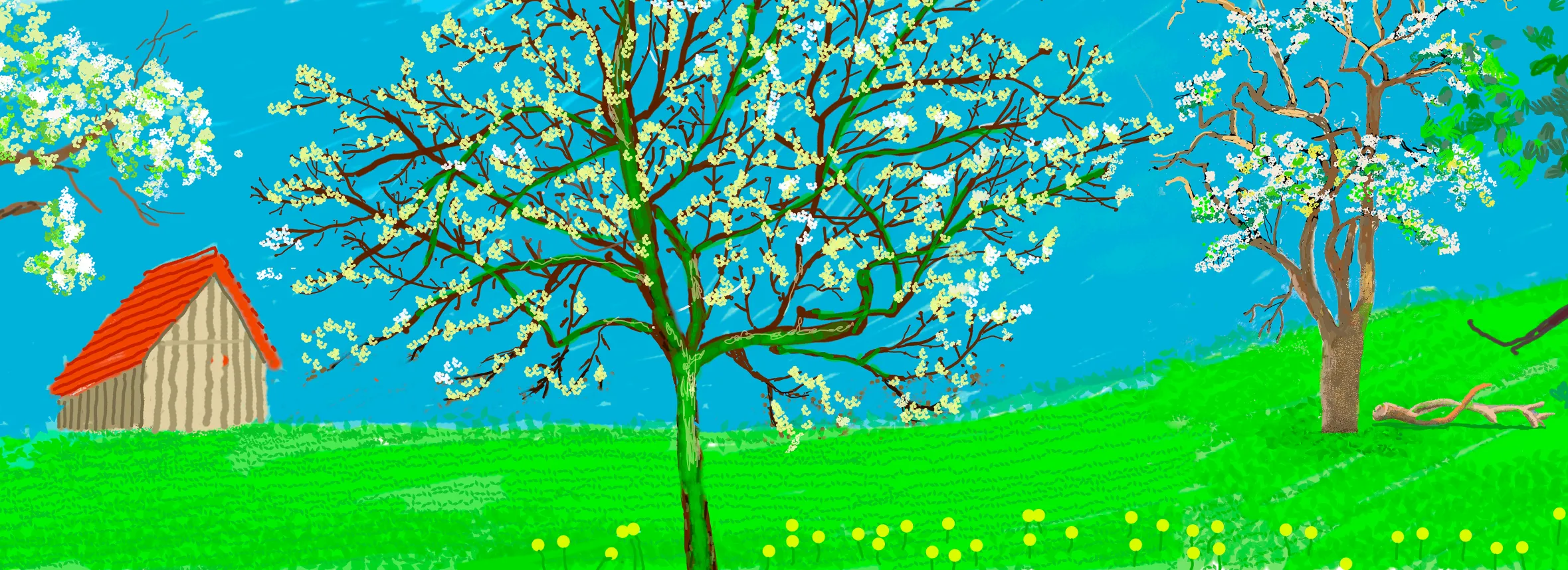 David Hockney; from David Hockney: A Year in Normandie
Somewhere between late spring and high summer, I was feeling iffy. Blossom and treehouses, irises and darling buds: these are a few of my favourite things. Wasn’t it lovely? Wouldn’t the Normandy tourist board be cherry pink with pleasure?
Then, unnoticed at first, we pass the solstice. There’s a sultry summer day when the air is purple with pressure. The light is lower, going golden, then just going, going… Autumn now. Streams swollen. More leaves on the lawn than above it. And I wasn’t iffy any more. The springtime mood, so preening and complacent in its preposterous costume of little-girl pinks, had stealthily, at first imperceptibly, been replaced by something else.
By the time I came to the solitary metal chair set out on a fine afternoon in autumn and looking towards the last snow-silent panels of winter, I was blinking back tears. Hockney is 88. This is a story of a year, told with Hockney’s inspired attentiveness to the transformations of time and light, but also the story of a lifetime. Gather ye rosebuds. Make that hay.
Walking back beside the Serpentine, it was hard not to think that this could be Hockney’s swansong. For this master of all media and man for all seasons, may there be many turns yet around the sun.
★★★★☆
A Year in Normandie and Some Other Thoughts about Painting is at Serpentine North, London, Mar 12 to Aug 23, serpentinegalleries.org