
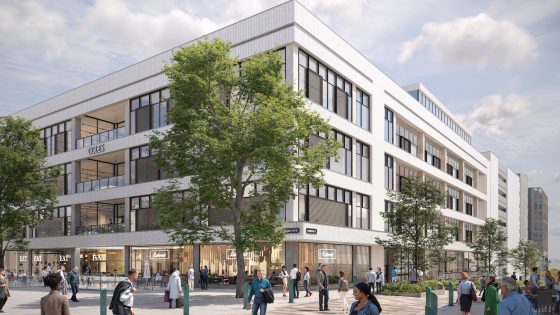
The council voted unanimously to allow the application at a meeting yesterday (10 March), favouring proposals to bring the post-war Cole Brothers building ‘back to life’ amid longstanding concerns that the renovation will lose some of its historic features.
AHMM had redesigned its initial plans in response to criticism from Historic England and the Twentieth Century Society, which were concerned about the proposed alterations to the building’s façade, principally the removal of original brown mosaic tile panels.
The 24,400m2 project for developer Urban Splash was submitted for planning in September. It brings the building back into use by integrating leisure, entertainment, shopping and office space. It includes a new rooftop terrace, which would make that part of the building ‘accessible for the first time’.
Although the plans were updated following heritage concerns lodged in November, they still include replacing original mosaics with brown perforated panels.
However, the revised design did include some alterations to the replacement panels, along with other subtle elements of the façade to ‘further reflect key elements of the character and proportions’ of the original building.
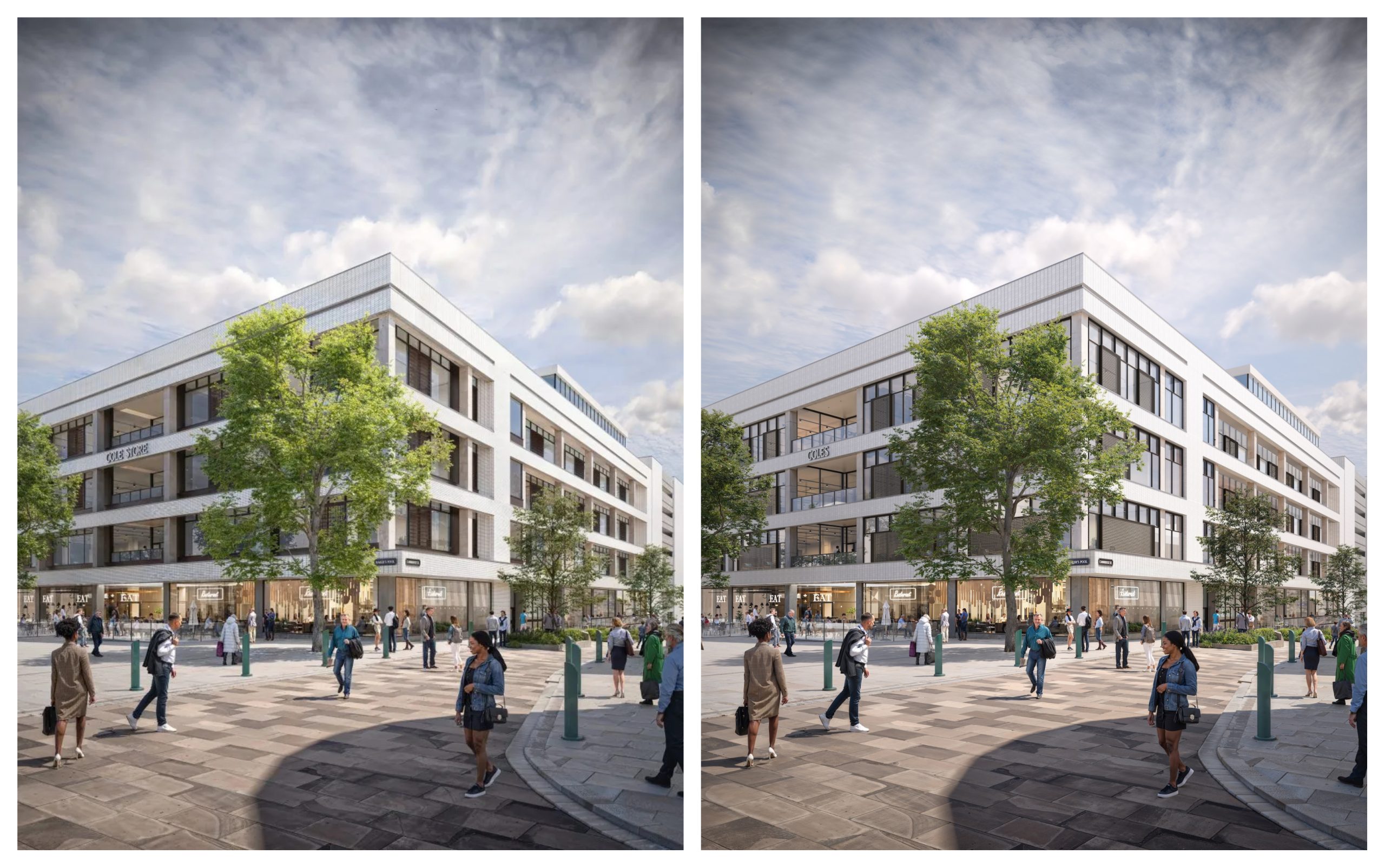
Subtle changes were made between the original design (left) and the updated and now consented design (right). Credit: AHMM
Historic England acknowledged that AHMM’s changes ‘better [retained] key elements’, but the heritage watchdog said the proposals would still ‘alter and dilute the original architects’ post-war vision’.
The 1963 building, designed by YRM, was originally the flagship department store for retail company Cole Brothers. In 2002, it became a branch of John Lewis, but it closed in 2021.
In 2022, the building was listed by then-culture secretary Nadine Dorries despite the council’s application for a certificate of immunity from listing (COI). The following year, the council appointed Urban Splash and AHMM to redevelop the building.
Commenting on the plans last November, Historic England said ‘Sheffield deserves better’, arguing that the previous proposal was a ‘missed opportunity to celebrate the architectural vision of this listed building’.
The Twentieth Century Society went even further by formally objecting to the plans, and has maintained this position despite the changes made in the now consented application.
The society said that, though it welcomed the efforts made to alleviate concerns, the loss of the mosaic panels was something it could not support.
A statement submitted to the council ahead of the meeting read: ‘The removal and replacement of the panels as proposed would significantly disrupt the building’s architectural composition.
‘As is stated in the Sheffield Unitary Development Plan, proposals that would affect the special interest of a listed building will be expected to preserve and repair original details and features of interest. In line with this, we would like to see a solution for repairing and retaining the brown mosaic panels.’
Hallamshire Historic Buildings also objected to the updated proposals on similar grounds, despite welcoming ‘the prospect of renovation in principle’.
Even so, the authority’s planning officers recommended approving the application, arguing that ‘the amended proposals show a well-considered scheme, which seeks to repair and renovate the building’, while the public benefits of bringing the site back into use after five years’ closure outweigh the less than substantial harm to heritage.
According to AHMM, the building is now ‘showing clear signs of physical decline’ and ‘many elements of the structure and envelope [are] either approaching or exceeding their serviceable life’.
The planning committee yesterday was partially dominated by concerns raised by local campaign groups over the retention and reopening of the Cole Brothers car park, arguing that the city already has ample parking and that the move would lead to significantly increased traffic.
A spokesperson for the developer pointed out that the car park would be reduced from 480 spaces to 190, and was intended primarily for those working in the building.
The scheme will also open up the Barker’s Pool and Cambridge Street frontages to create outdoor dining areas.
Since 2023, the building has been used as an events space for the community, including hosting the Crossed Wires podcast festival.
Urban Splash is looking to get started on site ‘as soon as they can’, and expects to begin work on the ground floors first.
Project data
Location Barker’s Pool, Sheffield
GEA 24,419m2
Local authority Sheffield City Council
Project type Mixed-use commercial and office
Architect AHMM
Developer Urban Splash
Planning adviser Made It Together
Heritage consultant Purcell
Structural engineering Booth King
Mechanical and electrical engineering Beechfield Consulting Engineers
Fire engineering Jensen Hughes
Planning reference 25/02741/LBC