
Somewhere in Sigma’s factory complex in Aizu, Japan, the company’s sole manufacturing facility, where every Sigma lens and camera is built, there is an engineering team that has been working on a single image sensor for nearly a decade. They have built prototypes, found flaws, gone back to the drawing board, lost their manufacturing partner, and started over. The sensor they are trying to build attempts something that has never been commercially viable at full frame scale: a three-layer design that captures color information at every single pixel without relying on a mosaic filter.
Every camera you have ever used, Canon, Nikon, Sony, Fujifilm, all of them, samples only one color per pixel. A Bayer filter mosaic sits in front of the sensor, allowing each photosite to record only red, green, or blue light. The camera then reconstructs the missing two color channels through a mathematical process called demosaicing, interpolating what it estimates the full-color value should be based on what neighboring pixels recorded. The results are remarkably good, good enough that most photographers never think about the compromise. But it is a compromise.
Foveon takes a fundamentally different approach. It stacks three photodiodes at each pixel location, each sensitive to a different depth of light penetration in silicon, aiming to record red, green, and blue information simultaneously rather than one color per pixel. The concept shares more in common with how layered film emulsions work than with anything in the digital mainstream. In theory, it eliminates the need for interpolation. In practice, it has been a commercial disaster for over twenty years, and the full frame version that Sigma promised in 2018 may never arrive.
This is not just a story about a sensor. It is a story about why being technically right does not guarantee market success, why manufacturing matters as much as design, and why even the most transparent CEO in the camera industry may not be able to will a technology into existence.
The Birth of Foveon
Foveon, Inc. was founded in 1997 in Santa Clara, California. The technology exploits a known property of silicon: different wavelengths of light penetrate to different depths in the material. Blue light is absorbed near the surface, green penetrates deeper, and red deeper still. By stacking photodiodes at three depths within each pixel, you can separate color information without a mosaic filter, though the stacked layers introduce their own absorption losses and crosstalk that require significant computational correction.
The concept was not entirely new. According to Wikipedia’s article on the Foveon X3 sensor, “In the late 1970s, a similar color sensor having three stacked photo detectors at each pixel location, with different spectral responses due to the differential absorption of light by the semiconductor, had been developed and patented.” That earlier design never reached commercial production. Foveon did.
The Sigma SD9, released in 2002, was the first production camera to use a Foveon X3 sensor. It was an APS-C-sized DSLR with a photosite array of 2,268 by 1,512 pixels, stacked three layers deep. The megapixel count was immediately and endlessly controversial. Sigma marketed it as a 10.2-megapixel camera, counting all three layers. Critics countered that it resolved detail like a 3.4-megapixel Bayer sensor, since resolution is determined by the spatial dimensions of the array, not the number of color channels at each location. That argument never fully resolved and haunted the technology for its entire commercial life.
But the images themselves told a different story. Photographers who shot the SD9 and its successor, the SD10, noticed something genuinely different in the files. Colors had a richness and dimensionality that contemporary Bayer sensors could not match. Detail rendering was distinctive, with dramatically reduced moiré and false color compared to Bayer sensors of the era, and no anti-aliasing filter softening the image. A small but fervent cult following formed almost immediately.
The Cult Years
Through the 2000s and 2010s, Sigma released a succession of Foveon cameras: the SD14, SD15, and SD1 DSLRs, the DP Merrill compact cameras, and the dp Quattro series. Each followed the same pattern: extraordinary image quality under ideal conditions, serious limitations everywhere else.
The limitations were consistent and brutal. Low-light performance was poor, partly because the deeper layers receive progressively less light as upper layers absorb photons, but more fundamentally because the heavy mathematical correction needed to separate the three overlapping color signals amplifies noise at higher ISOs. The result was that shooting above base ISO produced increasingly unusable results. Processing was agonizingly slow; Sigma’s proprietary Photo Pro software was required and notoriously sluggish. Color accuracy required heavy computational correction, because the three silicon layers do not separate colors as cleanly as a color filter does. Buffer depth was tiny, and the sensor read out slowly, making continuous shooting nearly impossible.
Sigma CEO Kazuto Yamaki has been remarkably candid about these trade-offs. In a 2024 interview with DPReview, he explained the unique character of Foveon images in technical terms: “Bayer sensors only capture R, B and G, so if you look at the spectral response, a Bayer sensor has a very sharp response for each color, but when it comes to Foveon there’s lots of crosstalk and we amplify the images. There’s lots of cross-talk, meaning there’s lots of gradation between the colors R, B and G.” That crosstalk, normally considered a flaw, is what gives Foveon files their distinctive look. The boundaries between colors are not sharp cutoffs but smooth transitions, producing a rendering that many users describe as more natural, more three-dimensional, more film-like.
Despite the limitations, Foveon users were among the most passionate in photography. Forum threads from the era read like religious testimony: photographers who had seen something in those files they could not unsee, and could not go back to conventional sensors. The rendering at base ISO in good light was, and arguably still is, unlike anything else in digital photography.
Sigma acquired Foveon, Inc. in 2008, bringing the technology fully in-house. In a 2024 interview at Sigma America’s Open House, Yamaki revealed the personal dimension of this decision: “Actually, it was my father who introduced part of the technology into the company. When he saw the technology, he was so excited, and he did not believe in the Bayer sensor technology because it does not recreate the beauty of the picture with the three-layer sensor, which, like film, should be able to create a very beautiful picture.” Yamaki added: “I also love the Foveon technology. I’ve been using a Foveon sensor camera for many years. Most of my family photos are taken by our Foveon sensor cameras, SD9, sd Quattro and DP cameras.”
That detail, a CEO whose own family photographs are shot on Foveon, says more about Sigma’s commitment to the technology than any corporate statement could.
The Quattro Compromise
In 2014, Sigma introduced the “Quattro” sensor architecture, a significant departure from the original X3 design. Instead of three full-resolution layers capturing equal amounts of data, Quattro used a full-resolution top layer for luminance and blue information, with quarter-resolution lower layers for red and green. The missing spatial detail in those lower layers was interpolated from the top layer.
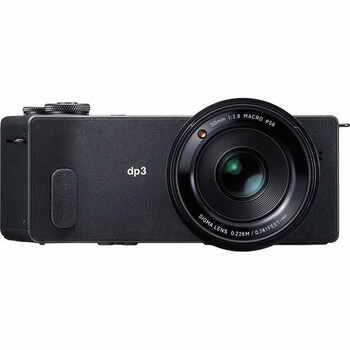
This was, in essence, a partial surrender. The original Foveon promise, full color at every pixel with zero interpolation, was compromised to improve processing speed, reduce file sizes, and lower manufacturing complexity. The dp Quattro cameras (dp0, dp1, dp2, dp3) were fascinating oddities: brick-shaped compacts with APS-C sensors and fixed prime lenses, ergonomically bizarre and optically stunning in their sweet spot.
But the Quattro architecture raised an uncomfortable question that Foveon loyalists did not want to confront: if you have to interpolate two of three color channels anyway, how much of the technology’s theoretical advantage actually survives? The answer depended on who you asked, and the resulting arguments consumed forum threads for years.
The Full Frame Promise
Then came the announcement that changed everything, or was supposed to.
At Photokina in September 2018, Yamaki revealed that Sigma was developing a full frame Foveon sensor for an L-mount mirrorless camera. The target launch was 2020. The photography world reacted with genuine excitement. Full frame Foveon, in a modern mirrorless body, with access to the entire L-mount lens ecosystem. This was the dream.
In 2019, Sigma announced and shipped the Sigma fp, its first L-mount camera, but with a conventional Bayer sensor. The fp was a statement of intent: Sigma could build modern, compact mirrorless bodies. The Foveon version would follow.
It did not follow.
In February 2020, Yamaki published a letter that landed like a gut punch: “As a result of careful and rigorous testing based on the latest development information, it has become clear that the launch of such a camera would be infeasible within this year.” He continued: “We have therefore decided that we should start over the project with a clean slate, putting the production plan for this new camera back to the drawing board and going back to the development of sensor technologies.” He added a line that revealed just how personally he took the failure: “I would like to emphasize that Foveon sensors are in a class of their own and that they are part of the identity of Sigma cameras that embodies our ideals and philosophies.”
One year later, in February 2021, Sigma published a formal development update that made the situation even more dire. Yamaki wrote: “We halted development of the project after the sensor we were working with could not go into mass production due to a critical flaw. As a result, we also terminated our contract with the sensor manufacturer with whom we had been collaborating.” The original sensor had been a 20-megapixel full frame X3 design developed with an external manufacturing partner. That partnership was over. The specifications were being completely revised. No camera body had even been designed. Yamaki stated plainly: “We determined that the original sensor specifications would make it difficult to develop a product that will meet our and our customers’ high standards, and accordingly we decided to go back to the drawing board.”
By 2022, Sigma announced it had reached the second of three development stages, a reduced-size prototype sensor with the target pixel architecture. Yamaki even said the sensor prototype “should be available sometime this year.” He acknowledged the limitations openly: “The Foveon X3 sensor is not a very versatile sensor,” specifically pointing to poor low-light performance, “but if there is a good amount of light, that camera can create very beautiful and impressive photos.”
The prototype came. It had errors.
In a 2024 DPReview interview conducted at CP+, Yamaki reported: “Unfortunately, we have not made any significant progress since last year. We made a prototype sensor but found some design errors. It worked but there are some issues, so we re-wrote the schematics and submitted them to the manufacturer and are waiting for the next generation of prototypes.” He added: “We are still in the design phase for the image sensor. When it comes to the sensor, the manufacturing process is very important: we need to develop a new manufacturing process for the new sensor. But as far as that’s concerned, we’re still doing the research.”
The manufacturing challenge was underscored by a revealing admission Yamaki made in an interview with YouTuber Matt Granger: “The project has been a bit delayed as previously scheduled because every time we learn the wafer and get the prototype sensor, we found some technical issues because we have never designed a sensor before by ourselves.” That admission is striking. When Sigma acquired Foveon in 2008, it remained a separate subsidiary with its own engineering team in Santa Clara. According to Wikipedia, Foveon ceased operations at its California location at the end of 2020 and development work was transferred to Sigma in Japan, though Foveon, Inc. remains a registered, active California corporation. The practical effect was that Sigma’s engineering team in Japan, which had never designed an image sensor from scratch, was now leading the project.
Then, at CP+ 2025, Yamaki told DPReview: “Yeah, of course,” when asked if Sigma was still working on a full frame Foveon. “It takes a long time, so after we brought the project from the US to Japan, we had to start from scratch.” He revealed new details: “We have been working with a university. It’s a joint project with a university in Japan. We worked with a researcher, a professor.” This was the first mention of academic collaboration, suggesting that the technical challenges had exceeded even Sigma’s internal capabilities.
The timeline, laid out in full, is devastating. Nine years of development. Three complete restarts. A terminated manufacturing partnership. An engineering team that has never designed a sensor attempting to build one that nobody else in the world has ever successfully manufactured at this scale. A camera that was supposed to ship in 2020 does not have a finalized sensor design in 2025.
Why Foveon Failed (and Why Bayer Won)
Foveon is not failing because it is a bad idea. It is failing because of the economics and physics of going against an entrenched standard.
The entire semiconductor fabrication industry is optimized for single-layer CMOS sensors. Every fab, every process node, every piece of deposition and etching tooling assumes a Bayer-type architecture with one photodiode per pixel location. Building a three-layer sensor requires custom manufacturing processes that no commercial fab has incentive to develop for a single low-volume customer. Yamaki has been explicit about this being the central obstacle. Finding a fab willing to produce a three-layer sensor using processes nobody else uses, for volumes that do not justify the investment in custom tooling, has proven nearly impossible.
Meanwhile, the Bayer filter got good enough. In 2002, when the SD9 debuted, Bayer sensors produced visible moiré, false color, and required aggressive anti-aliasing filters that sacrificed resolution. Those problems have been largely solved. Modern Bayer sensors with 40 to 60 megapixels of resolution, advanced demosaicing algorithms, and the option to remove the anti-aliasing filter entirely have closed the gap that Foveon was designed to exploit. Computational photography has further eroded the practical advantage: AI-powered noise reduction, sophisticated color science, and computational HDR extract remarkable quality from a theoretically “compromised” Bayer sensor. The purity of Foveon’s approach matters less when software can overcome most of the Bayer filter’s shortcomings.
And then there is the low-light problem. The market overwhelmingly values high-ISO performance. Wedding photographers shooting receptions at ISO 12,800, wildlife photographers working at dawn and dusk, photojournalists in available light; these are the use cases that sell cameras. Foveon’s three-layer design is inherently disadvantaged here because each layer absorbs some of the light before it reaches the layers below. A sensor that struggles above ISO 800 is commercially unviable for most working photographers, no matter how beautiful its color rendering at base ISO. Yamaki has acknowledged this directly. In the 2024 DPReview interview, he conceded: “We are trying to make our cameras with the Foveon X3 sensor more user-friendly, but still, compared to the Bayer sensor cameras, it won’t be easy to use. Low-light performance can’t be as good as Bayer sensor. A camera with Foveon sensor technology may not be the camera for everybody.”
There is also the ecosystem problem. Bayer sensors are supported by every raw processor, every editing application, every workflow tool in existence. Adobe, Capture One, DxO, Darktable; all built for Bayer demosaicing. Foveon files have historically required Sigma’s own processing software, which was slow and limited. The ecosystem disadvantage compounds the hardware disadvantage, making adoption harder even for photographers who are curious about the technology.
The analogy is imperfect but useful: Foveon is to Bayer what Betamax was to VHS, the arguably superior format that lost because the inferior standard had better economics, broader support, and was good enough for the vast majority of users.
What Foveon Means for Camera Innovation
Zoom out from the sensor itself and Foveon’s story reveals something important about the camera industry’s capacity for innovation. Sigma is the only independent camera company attempting to develop its own sensor technology from the ground up. Canon designs and manufactures its own sensors. Sony designs sensors and sells them to most of the industry, including Nikon and much of Fujifilm’s lineup. Samsung has its own fab. Everyone else is a customer, not a creator.
Sigma’s position is uniquely precarious: too small to justify the custom fab partnerships that sensor development requires, too committed to abandon the project after nearly a decade of investment, and too honest about the challenges to generate the kind of hype that might attract outside investment or partnerships. Yamaki’s transparency is admirable and nearly unprecedented in an industry built on secrecy and carefully managed product roadmaps. But it also means the photography world has watched this project stall in real time, year after year, trade show after trade show, one apologetic interview at a time.
The Foveon project reveals the true cost of sensor innovation. This is not a software problem that can be solved by talented engineers working late. It is a semiconductor manufacturing problem that requires specialized fabrication processes, yields that justify the expense, and partnerships with foundries that have no business incentive to take on the work. Sigma does not have the resources of a Sony or a Samsung. It is a lens company with a camera division, trying to do something that only the largest semiconductor manufacturers in the world are equipped to do.
The question nobody wants to ask out loud: should Sigma stop? The research and development resources going into Foveon could fund multiple lens development programs. Sigma’s Art-series primes, the groundbreaking Sigma 300-600mm F4 DG OS | Sports zoom, and the Sigma 20-200mm F3.5-6.3 DG | Contemporary superzoom have been both commercially and critically successful. Is the Foveon dream worth the opportunity cost?
Yamaki’s answer, across a decade of interviews, has been remarkably consistent. In that 2024 DPReview interview, he said: “Even if we successfully develop a new X3 sensor, we may not be able to sell tons of cameras. But I believe it will still mean a lot. Despite significant technology advancements, there hasn’t been much progress in image quality in recent years.” He is arguing, essentially, that the entire industry has been iterating on the same fundamental technology for two decades, and that a genuine alternative, even an imperfect, niche, expensive one, would be worth the effort of creating it.
That is either a visionary position or a sentimental one, and the difference depends on whether the sensor ever ships.
The Most Interesting Failure in Photography
The engineering team in Aizu is still working. Sigma is now collaborating with a Japanese university on the pixel architecture. Every prototype brings them incrementally closer to a design that works, or reveals another problem they had not anticipated. The full frame Foveon sensor may arrive someday, or it may become the most thoroughly documented failure in camera technology history.
The photography community is better for Foveon having existed. It proved that the Bayer filter is not the only way to capture color in digital photography. It produced images with a rendering quality that dedicated users still consider unmatched in the digital domain. It forced the rest of the industry to improve demosaicing algorithms and color accuracy, if only to close the gap that Foveon’s existence highlighted. And it gave us something exceedingly rare in the modern camera industry: a CEO who tells photographers the truth about what his company can and cannot do, even when the truth is that his engineers have been working on the same problem for nine years and still cannot guarantee it will be solved.
The most interesting thing about Foveon is not whether Sigma can build it at full frame. It is that 23 years after the SD9, no other camera manufacturer has brought a competing stacked-photodiode sensor to market in an interchangeable-lens camera. Researchers and startups have explored alternative approaches to full-color-per-pixel capture, but in the commercial camera world, the Bayer filter remains unchallenged, and Sigma remains the only company stubborn enough to keep trying to change that.