
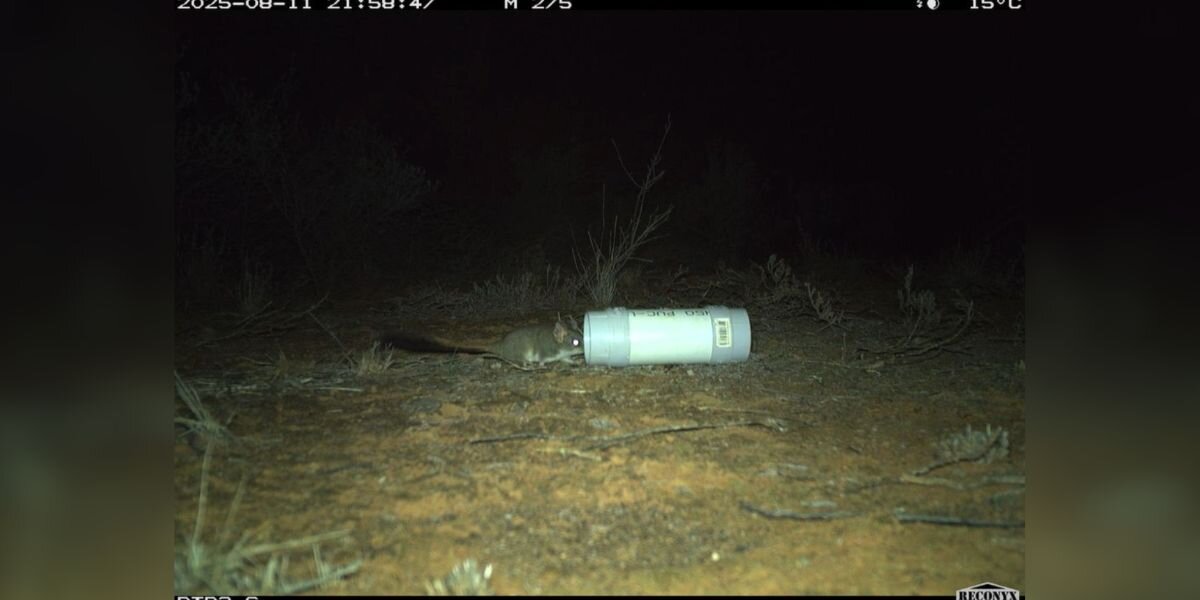
In the mallee woodlands of New South Wales, Australia, pint-sized marsupials called red-tailed phascogales once thrived.
Sadly, over the years, new predators were introduced to the area, decimating the unique species until they completely disappeared.
For over a century, local animal researchers failed to locate any red-tailed phascogales. Until recently, when they photographed a whopping 22 of them on hidden motion-sensor cameras.
 AWC
AWC
“We were stoked,” Australian Wildlife Conservancy (AWC) ecologist Dr. Rachel Ladd said in a press release. “We weren’t expecting to see so many so soon.”
The sightings weren’t just a lucky coincidence; they were the result of years of hard work. About a decade ago, AWC researchers began releasing the animals into predator-free areas within Mt Gibson Wildlife Sanctuary and Mallee Cliffs National Park. In May of last year, they continued their work at Scotia Wildlife Sanctuary, where they released 94 red-tailed phascogales in hopes the animals would thrive.
 Hannah Nichols
Phascogales typically build their nests in tree hollows, and they help the environment by acting as a form of pest control, feeding on “a wide range of insects and spiders,” according to AWC.
Researchers knew that capturing the tricky animals on film wouldn’t be easy, so they set up 47 motion-sensor cameras across three survey zones.
“Despite their agility and distinctive tail, phascogales are notoriously difficult to detect,” AWC wrote in the press release.
According to AWC, phascogales are small and lightweight, and they rarely linger anywhere for very long.
 Audrey Beard
“Even in fenced sanctuaries, they are considered one of the hardest species to monitor after release, making these early detections a valuable indication that individuals are adapting and surviving post‑reintroduction,” AWC wrote.
Seeing so many red-tailed phascogales is thrilling for the research team, confirming that their tireless work is paying off.
“Seeing the phascogales take those first steps toward re‑establishing a wild population is incredibly encouraging for everyone involved,” AWC senior ecologist Dr. Jennifer Anson said in the press release. “This type of significant wildlife conservation work is only possible because of long‑term planning and strong partnerships on the ground.”
To help other animals like phascogales, you can donate to the Australian Wildlife Conservancy. ‘Mystical’ Kitten With Enormous Eyes Is Not AI — She’s A Rare SurvivorShe’s a real tough cookie.