
This week has seen debate on whether working pays off when it’s time to retire.
Open image viewer
Working a low-paying job for 40 years yields almost the same retirement as someone with no work history. Image: Nanna Särkkä/ Yle
13.3. 14:05•Updated 13.3. 14:07
In Finland, a low-paid worker may end up with almost the same pension after a 40-year career as someone who has barely worked at all.
This stems from the structure of the pension system.
The country’s so-called guarantee pension and national pension top up the income of those with little or no employment history, bringing their retirement benefits close to those received by low-wage earners.
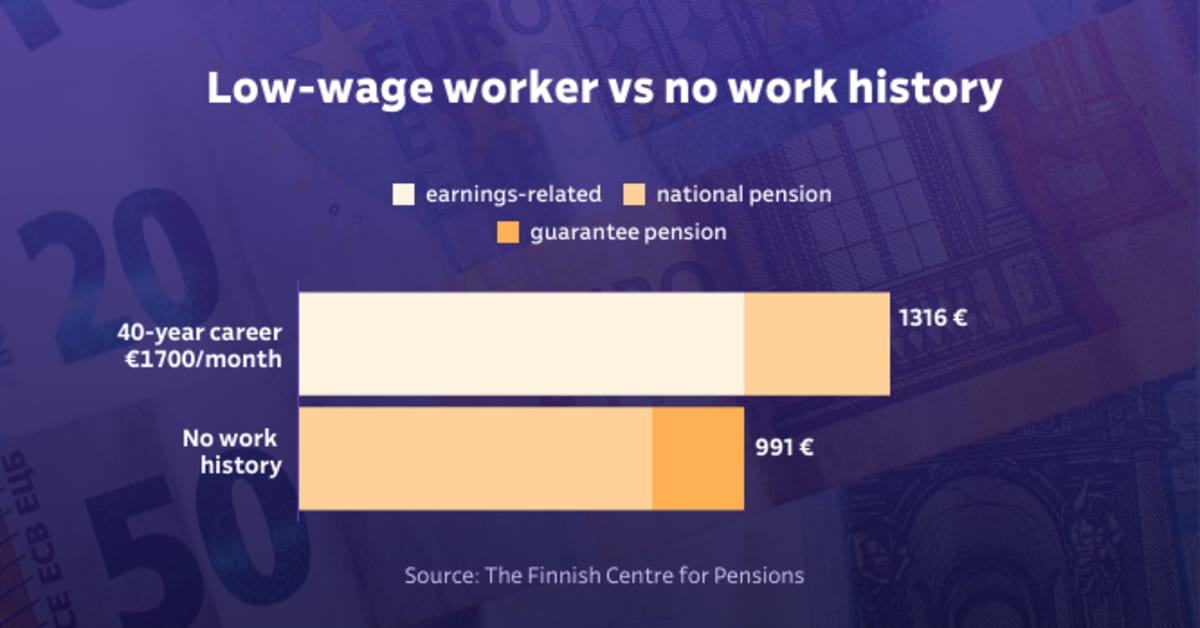
Someone earning 1,700 euros a month over four decades would retire with an earnings-related pension of about 1,300 euros a month before tax.
Meanwhile, a person with no work history at all receives a full guarantee pension of 991 euros.
Fairness questioned
Is the system a sufficient incentive to slog through decades of work when a neighbour can end up with almost the same pension without working?
This week, Suvi-Anne Siimes, who heads pension lobby Tela, highlighted the ‘incentive trap’ in an interview with Helsingin Sanomat.
Other pension experts have shared Siimes’ concern.
“It shows up in public debate and attitudes,” said Mikko Kautto of the Finnish Centre for Pensions. “Ultimately, it comes down to whether people perceive the system as fair.”

Open image viewer
Mikko Kautto of the Finnish Centre for Pensions said there is a clear incentive problem in the pension levels of low-paid workers. Image: Mimmi Nietula / Yle
The phenomenon reflects the structure of Finland’s pension system, where a guarantee pension secures a minimum level of retirement income for everyone.
Occupational pensions, paid by the country’s pension institutions, accumulate based on earnings and years worked. Benefits agency Kela tops up those with limited or no work history with national and guarantee pensions.
Siimes told HS that immigrants are accessing guarantee pension too easily. Newcomers to Finland qualify for the national and guarantee pensions after three years of residence in Finland.
The introduction of the full guarantee pension in 2011 was, in part, linked to immigration policy.
“It was designed to address the situation of low-income Ingrian returnees,” Kautto noted.
Ingrian returnees are the descendants of ethnic Finns from the former Soviet Union, who gained the right to settle in Finland under an ancestry-based policy introduced in 1990 by then-President Mauno Koivisto.
Vesa Rantahalvari of the employers’ group EK, meanwhile, pointed out further incentive problems.
Housing support is paid on top of pension income and is proportionally highest for those with the smallest pensions.
As a result, total income for recipients of the national and guarantee pensions can approach the retirement income of even a middle-earning worker.
“This is clearly not ideal from an incentives perspective,” said Rantahalvari. “Those with no work history end up in much the same position as people who have spent decades in the labour market.”
You can find out more about how Finland supplements small pensions here.