
Every other Sunday, for many years now, I have met with a small group of fellow Buddhists to study Tibetan Buddhist texts, principles, and meditation under the guidance of our long-time teacher. Before we begin studying, we chant together.
One line in particular has stayed with me: May confusion dawn as wisdom.
I have always liked the sentence, though I cannot claim I fully understand it. Most of the time confusion feels like something to get rid of as quickly as possible. But the chant suggests something different. It implies that confusion itself might be part of the process.
Still, I have often wondered how that could work in practice. Recently I walked into an art exhibition in Culver City that made the phrase feel less like a poetic idea and more like something you could experience.
The exhibit called Entangled Skin: Where Does the Dust Alight?, curated by Ann Shi at a poco art collective, takes its title from a famous Zen verse attributed to the seventh-century Chan master Huineng:
Originally there is not a single thing.
Where could dust alight?
The verse comes from a classic Zen teaching story. In the exchange, one monk writes a verse comparing the mind to a mirror that must be continually wiped clean so that dust does not collect on its surface. Another monk responds with a verse that challenges the comparison entirely. If originally there is not a single thing, he asks, then what mirror would there be to polish, and where could dust possibly settle?
The point of the koan is not to solve a philosophical puzzle but to loosen the mind’s attachment to the puzzle itself. Zen koans are designed to frustrate the rational mind in a particular way. Just when the intellect begins organizing the problem into something manageable, the ground shifts slightly and the explanation stops holding together.
Entering Through Disorientation
The Entangled Skin exhibition recreates this process physically. Instead of beginning with explanation, the show opens with a moment of perceptual uncertainty.
In a dimly lit foyer, a work by Kyoko Takenaka greets visitors with a creature emerging from darkness wearing a mirrored Noh mask. The mask hides the figure’s face while reflecting the viewer and the surrounding room.
From there the viewer moves through a narrow passageway where the architecture compresses the body slightly. The experience hints at an old Taoist story in which a fisherman discovers a hidden utopia only after squeezing through a narrow opening in a mountainside.
Dust as Connection
Dust serves as the central metaphor of the exhibition, though not in the way we usually think about it. Here dust is not dirt or decay. It is connection.
Atoms circulate constantly between bodies, landscapes, and objects. The particles that make up our skin once belonged to mountains, oceans, stars, and other living beings. Dust becomes a reminder that everything participates in the same ongoing circulation.
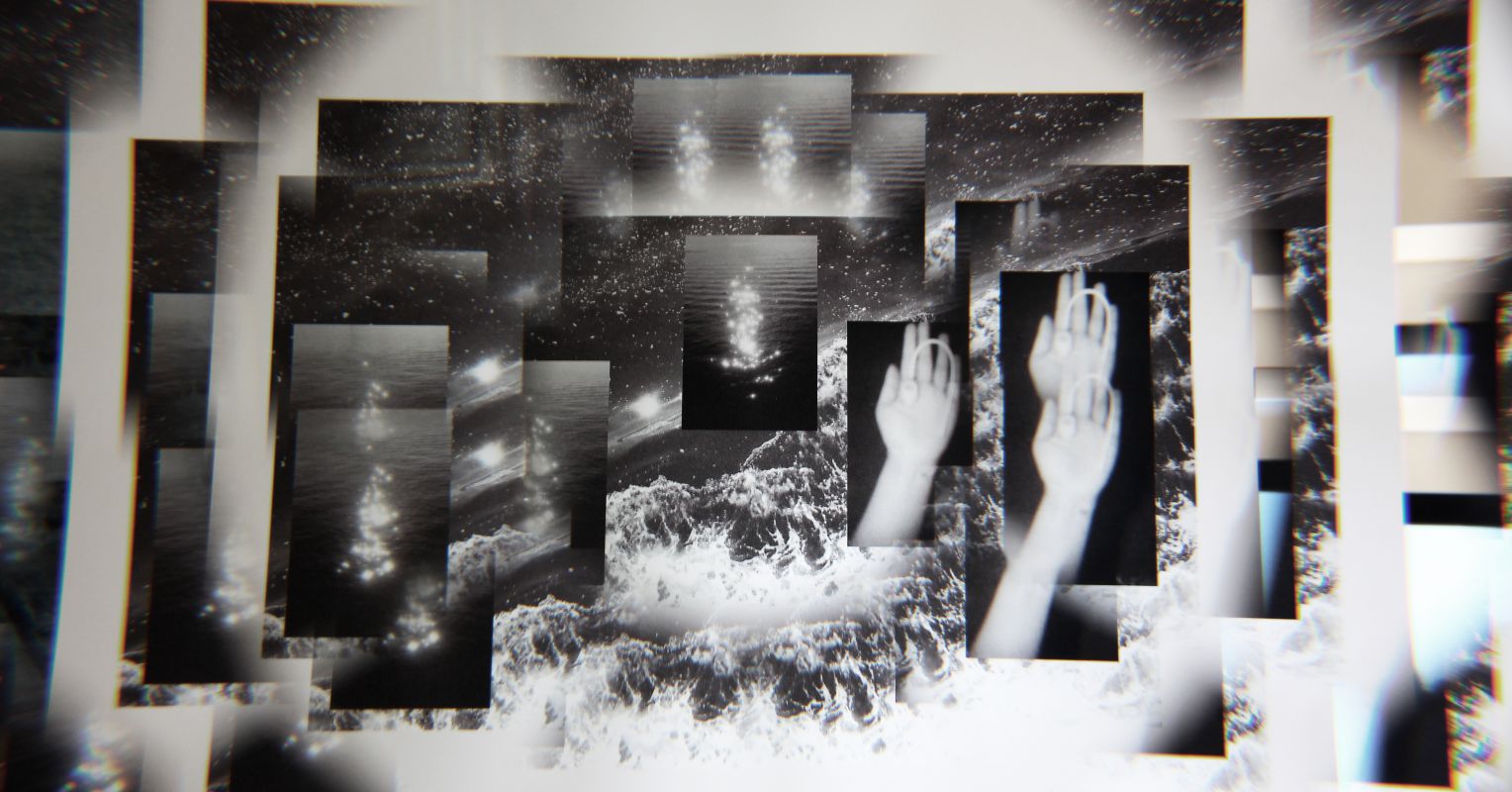
The exhibition reinforces this idea visually through its largely monochromatic palette. Without strong color cues, the eye slows down. Forms become slightly harder to categorize immediately.
In that softened visual field, objects begin to resemble one another in surprising ways. Skin, stone, cloud, ash, and shadow seem to belong to the same family.
A World Inside a Pinecone
In one room, Daniel Touff’s graphite drawings initially appear to be careful botanical studies of objects such as a ginkgo leaf, a pinecone, or a scholar’s rock. As the viewer spends more time looking, something interesting begins to happen with scale.
The pinecone begins to feel geological and monumental. The leaf starts to resemble a landscape.
Zen Buddhism contains a phrase suggesting that within a single flower a complete world unfolds. Touff’s drawings seem to play with that idea visually. Each small object carries the suggestion of something much larger. The humble pinecone begins to feel less like forest debris and more like a miniature planet.
Nearby, the ink paintings of Heng Yi expand this idea
further. Some works reference the Buddhist cosmological concept known as the Three Thousand Great Thousand Worlds, which suggests that the universe contains countless worlds nested within worlds.
The Curator as Nomad
The overall experience of the exhibition is carefully shaped by curator Ann Shi, founder of a poco art collective. Shi describes herself as a nomadic curator, which feels accurate. Her projects move across cities, traditions, and disciplines, weaving together mythology, cosmology, performance, and visual art.
Rather than simply arranging artworks in a room, her exhibitions tend to construct environments. Moving through the space becomes part of the experience and part of the meaning.
In Entangled Skin, the visitor passes through moments of uncertainty, physical compression, expanded perspective, and eventually a quieter space for reflection. The exhibition begins to feel less like a display and more like a series of perceptual adjustments.
A Word for When Art Moves Through You
While walking through the exhibition, I found myself thinking about a word I learned through my podcast Fifty Words for Snow, where my cohost Emily Garces and I hunt for words from other languages that do not have a precise English equivalent.
One of those words is duende, a Spanish term described by the poet Federico García Lorca. Duende refers to a mysterious force that sometimes appears in art when something deeper than technique is at work. It is the moment when a performance or artwork seems to tap into something raw and alive. You cannot plan for duende, and you cannot command it.
Reading Ann Shi’s curatorial statement, I was struck by the fact that the exhibition does not attempt to manufacture emotional intensity directly. Instead, it sets up a series of conditions. The curator cannot summon duende any more than a Zen teacher can produce enlightenment on demand. What she can do is create the circumstances in which something unexpected might arise.
The Bodhisattva’s Vow
The end of the exhibition explores the bodhisattva
vow that until hell is emptied, he will not become Buddha.
Many spiritual traditions promise liberation from suffering. This vow approaches the problem differently. Jizō refuses to leave until everyone else gets out. Within the logic of entanglement suggested throughout the exhibition, the vow begins to feel less like a heroic declaration and more like a reminder that awakening is not a neat or solitary project.
When Confusion Ripens
The exhibition never explains the dust koan or offers a final interpretation. Instead, it surrounds the viewer with images and materials that seem to belong to the same quiet, monochrome atmosphere. Graphite, ash-like textures, stone, shadow, and skin all appear in similar tones, as if the entire exhibit had been lightly dusted by the same substance.
Perhaps that is one way to think about confusion. Not as a mistake in our thinking, but as the moment when the categories we usually rely on stop working quite so neatly. Things become harder to label. Edges blur. The mind pauses for a second because its usual shortcuts are no longer available.
And in that pause, something else has a chance to appear. Not a clear answer, exactly, but the faint sense that another way of seeing might be beginning to take shape.