
We will now discuss in a little more detail the Struggle for Existence. ―Darwin
Compared with other mammals, human beings have large brains and access to types of intelligence that other animals cannot even contemplate (not that they would care!). As to the brain, scientists have explored several measures of interest, such as its absolute size, its size relative to the entire body, its structure, morphology, and complexity, as well as the total number of neurons. The emerging consensus is that the human brain is large and complex, but not bizarrely so compared with other species of interest. The brains of orca whales, for example, measure up to human brains to such a degree that we, as a species, have little reason for self-congratulation. Our species fits into Nature’s overall pattern and design as one among many (Herculano-Houzel, 2012).
As to intelligence, interspecies comparisons are complicated by the fact that different species have evolved intelligences that are adapted to their respective ecologies. In the bat ecology, for example, a bat is much smarter than a person. The standard impression that humans are overall smarter than other animals must therefore resort to indirect types of evidence and argument if it is to be convincing. For over a century, scholars have proposed myriad ways in which humans are cognitively unique, not only when compared with other mammals but even compared with our large-brained extinct cousins, the Neanderthals. Here, the emerging consensus is that besides similarities and continuities between animal and human cognition, there are also radical differences, mainly in the domain of symbolic reasoning (Penn et al., 2012). As to the Neanderthals’ inability to reason symbolically, the smart choice is not to jump to conclusions.
Both brains and wits evolved in the course of Nature’s game of mutation, survival, and reproduction. But how so? One would imagine the two kinds of evolution to go together, ultimately yielding a unified theory. At the present time, however, we can observe an interesting asymmetry. Students of brain development tend to focus on humans’ social intelligence as a driver of evolution (Dunbar, 1998). Living in small interdependent groups, the humans of the Pleistocene had to master difficult coordination problems while also seeking comparative advantage over their band mates. They had to model other minds who they knew were also modeling them. Adaptive advantage lay in being able to outmodel the other modelers while still getting along with them.
During my time as a social psychologist, the social-brain hypothesis has become ever more prominent, although some of its specific assumptions and predictions continue to be vigorously debated (e.g., Frith, 2007). So, one wonders: What is the alternative? A few years ago, Rosati (2017) refreshed a nutritional hypothesis. She argued that species’ food ecologies shape their intelligence. Comparing different species of primate, she finds that food uncertainty and diet diversity keep organisms on their cognitive toes. Chimpanzees show more cognitive complexity than bonobos or gorillas, and they also enjoy a more varied menu, albeit with fewer assurances as to where the next meal will come from. By extrapolation, Pleistocene hominids increased the number of their food sources, but often had to scheme and wait before they could fill their bellies. Rosati’s argument, like Dunbar’s, is intriguing but correlational. Comparisons between the two theories are complicated by the fact that the thing to be understood is executive function in the food theory and brain size in the social theory.
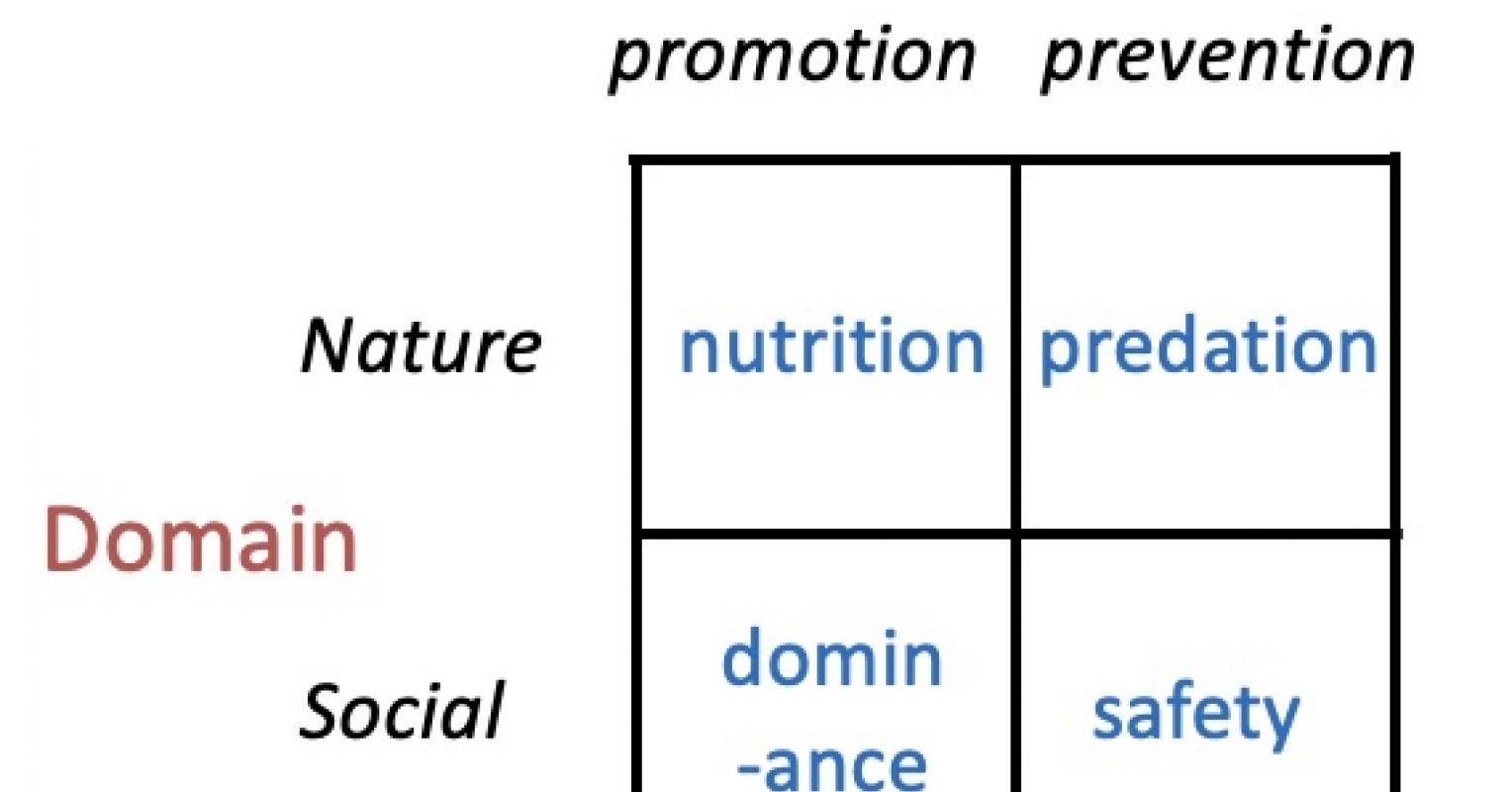
Not presuming to solve this problem here and now, I have set before me the modest goal of offering a structural scheme that situates the two theories in a common space. The figure below shows a 2 x 2 table, crossing the two domains, placing games against nature and social games in the rows, with directions of motivational interest (in the columns). Games against nature need not involve conspecifics, but social games, by definition, do. Motivation can take the form of promotion or prevention, where the former is about seeking, finding, and consuming, while the latter is about monitoring, avoiding, and escaping.
Looking at the four intersections of Domain and Direction, we see distinctive psychological tasks. Finding food requires a promotional motivation in nature; escaping predation (i.e., not becoming food for others) requires a preventional motivation. Acquiring dominance, status, and prestige is the stuff of social self-promotion, whereas finding safety from aggressive others is the goal of social prevention.
This scheme is certainly oversimplified. Acquiring food also requires social intelligence, as Rousseau noticed when describing the stag hunt, which became known as the assurance game in formal analysis. Avoiding predation is also enhanced by social collaboration, including collective defense against rival bands. Social dominance is enhanced for those who have mastered hunting skills, while finding safety from intruders benefits from non-social forms of intelligence, such as knowing the terrain and where to hide.
It may be too much to ask if one source of evolutionary pressure, natural or social, was predominant in the descent of the human. The two domains are too intertwined. We may observe, however, that the social hypothesis has the advantage of being more pertinent in early child development. Babies and toddlers lose no time in honing their social intelligence before they are expected to feed themselves. If social intelligence must come online before nutritional intelligence, then perhaps the former has more to tell us about our psychology than the latter.