
Are we about to say goodbye to Australia’s experiment with low unemployment?
The latest war in the Middle East has created the largest supply disruption in the history of the global oil market, according to the International Energy Agency (IEA).
The price of crude oil, gas, and fertilisers has soared. Petrol prices have surged in Australia and across Asia.
Energy independence? It would reduce the impact of global energy shocks
Before this war broke out, inflation hawks were already piling pressure on the Reserve Bank to lift interest rates.
Now, markets expect the RBA to lift interest rates this Tuesday, followed by another rate hike in May.
What happens after that is anyone’s guess.
But a prolonged war in the Middle East, coupled with sustained global energy price shocks, could help to kill Australia’s post-COVID experiment in keeping the unemployment rate well below 5 per cent.
Will 5 per cent unemployment become the norm in Australia again?
Keep unemployment low, pull inflation down slowly
In the last few years, this is what Australia’s unemployment rate has looked like.
It has hovered between 3.4 per cent and 4.4 per cent since October 2022.
The RBA has pursued a strategy of trying to bring inflation down slowly to keep unemployment as low as possible.
It has been a very different strategy from pre-COVID times.
Back in 2019, when Scott Morrison was prime minister, then-federal treasurer Josh Frydenberg had no ambition to drive the unemployment rate below 5 per cent.
The table below shows the unemployment forecasts in his 2019-20 budget:
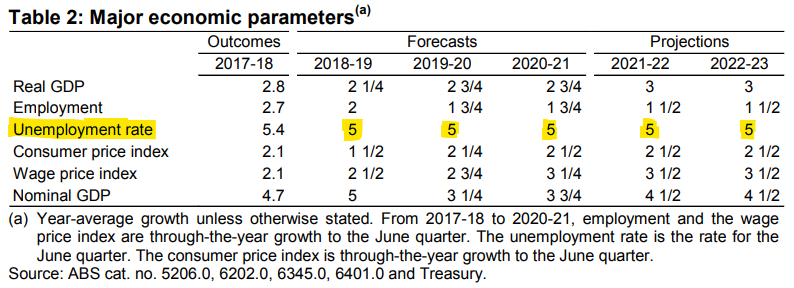
Commonwealth Budget 2019-20, Budget Paper No.1, page 1-8.
Back then, inflation was struggling for years to rise above 2 per cent, and wage growth was hitting record lows.
Wasn’t an unemployment rate of 5 per cent too high in that situation?
To boost economic activity, the RBA had kept interest rates at 1.5 per cent for almost three years (from August 2016 to May 2019).
Senior RBA officials were encouraging workers to ask for pay rises and reminding state and federal governments that extra infrastructure spending would be helpful.
Inflation remained tepid.
Then, when Mr Frydenberg released his 2019-20 budget, which showed his willingness to keep the unemployment rate at 5 per cent for another four years, the RBA lost patience.
It began cutting rates again.
By October 2019, the RBA had cut the cash rate to just 0.75 per cent. That was months before COVID-19 arrived in Australia.
Sorry, unemployment could have been lower
Then, a year into the COVID-19 pandemic, Treasury officials released a paper in early 2021 that acknowledged that their historic estimate of what “full employment” was in Australia was probably wrong.
They said they had thought “full employment” corresponded to an unemployment rate of 5 per cent.
But looking back, they said, they now thought Australia’s economy probably could have handled a lower level of unemployment over those five years to 2020, somewhere between 4.5 and 5 per cent.
Then, a few weeks after Treasury’s paper was published, treasurer Frydenberg announced that he would use his upcoming budget to deliberately drive the unemployment rate below 5 per cent.
Different inflation-fighting strategies
That is part of the backstory for where we find ourselves today.
After the start of the Russia-Ukraine war in 2022 sent a damaging wave of inflation through the global economy, the RBA lifted interest rates dramatically, but it chose not to lift rates as high as some other countries.
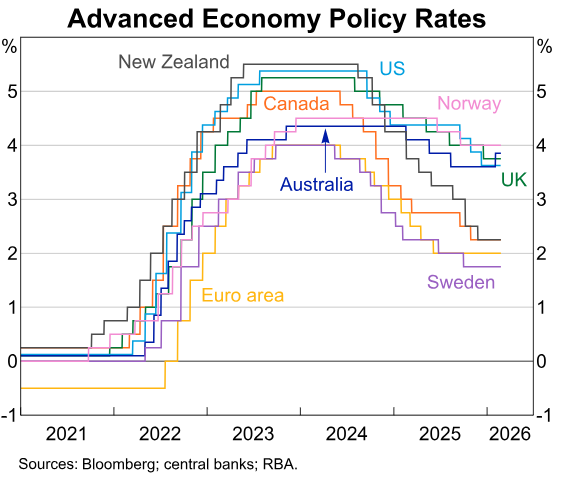
(Source: ‘Recent refinements to the dual mandate and navigating back to target,’ 2 March 2026, speech, Sarah Hunter, assistant governor (economic))
It said it did not want to engineer a recession in Australia to bring inflation down, and it was willing to pull inflation down gradually to keep unemployment as low as sustainably possible.
Ever since then, a cohort of economists has been critical of the RBA’s post-COVID inflation-fighting strategy.
Some have said the RBA should have lifted rates much higher in 2023 and 2024 to squeeze inflation out of the system for good and the fact that inflation started picking up pace again in the second half of 2025 was a problem that could have been avoided.
RBA officials have also felt the need, every so often, to remind some critics that low unemployment is actually a good thing.
But those arguments are quickly becoming yesterday’s problem. Now, everyone’s preparing for the war in the Middle East to send another damaging wave of inflation through the world’s economies, including in Australia.
Another wave of ‘new inflation’
Will the RBA be sticking with the same inflation-fighting strategy in this new inflationary crisis? Or will it change course?
A lot depends on how long this war lasts.
But the fact that the RBA is bracing for another global surge of supply-driven inflation so soon after the one in 2022 brings something to mind.
Are inflation-targeting central banks ready for the ‘new inflation’?
In October last year, two economists at the International Monetary Fund (IMF) published an interesting paper that found that inflation-targeting central banks performed no better than non-inflation-targeting central banks in the wake of the 2022 inflation surge.
They said the inflation-targeting framework was designed to manage demand-driven shocks, not supply-driven shocks.
And they warned the world was entering a period marked by sustained and overlapping supply disruptions, many of which were structural and slow-moving, that could challenge the inflation-targeting framework.
They dubbed it the “new inflation.”
“Supply-side shocks are becoming more frequent and structurally entrenched, driven by geopolitical realignments, evolving trade patterns, climate-related disruptions, and the demands of energy transition,” they warned.
“Central banks today operate in a more complex and uncertain environment than during the earlier decades of [inflation targeting].
“While the IT framework continues to offer important benefits, its application may need to adapt to the growing challenges posed by more frequent, global, and persistent supply-side shocks.
“The 2022 experience suggests that front-loaded tightening [of interest rates] does not guarantee improved inflation outcomes, raising questions about the appropriate pace and scale of response,” they argued.
On Tuesday afternoon this week, the RBA Board will announce its next interest rate decision.
Its cash rate target is currently 3.85 per cent.
On Friday, ANZ Bank increased its fixed mortgage rates by up to 0.25 percentage points in anticipation of the RBA lifting rates.