

It’s a snowy morning in east Berlin. In a small workshop inside a warren of tasteful modern offices, between walls lined with pliers, screwdrivers and duct tape, Tobias Zegenhagen is bending over the open door of an innocuous-looking box. It’s about 1.5m cubed and lined with thick, spiky white foam. Inside, a small microphone on a stand is pointing at a clamp that holds a throbbing pink vibrator.
“Noise is a very important issue for sex toys. People want them to be as silent as possible,” explains Zegenhagen, the 45-year-old product director of the Lovehoney Group, the world’s largest sex toy retailer. “There’s a room at the Technical University of Berlin the size of a soccer pitch, where you can drive in a car to test the acoustics. We basically downsized that. Then we test. Does the toy make a high-frequency noise, because squeaky is very unpleasurable?”
The recordings help to isolate exactly which part of the toy is making the noise so that developers can try to eradicate it.
Zegenhagen has a PhD in engineering and used to work for Siemens designing wind turbines and submarines. Now he and his team are applying German precision engineering to orgasms. “It isn’t what I initially envisioned for my career, to be honest, but from an engineering standpoint it’s not all that different from working on other types of consumer electronics,” he says.

The Lovehoney Group’s product director, Tobias Zegenhagen
GENE GLOVER FOR THE SUNDAY TIMES MAGAZINE
Not so long ago sex toys were viewed as seedy products bought in sex shops, but they’ve since entered the mainstream and represent a large and rapidly growing market. This is partly due to celebrities such as Gwyneth Paltrow and Lily Allen talking about theirs, partly because internet shopping means they can now be delivered to our homes in discreet brown parcels and partly because rapidly evolving technology is delivering thrills as never before. Then there’s the increased emphasis on female sexuality, especially the “orgasm gap” — figures from peer-reviewed studies and journals show that 85 to 90 per cent of men achieve orgasm during intercourse compared with only 32 to 65 per cent of women. Now women are reducing this discrepancy with an array of (very nearly) noiseless and often stylish USB-charged gadgets.
The Lovehoney Group was formed in 2021 in an estimated £1 billion merger of two sex-toy companies: the German “sexual wellness” brand Wow Tech and the British company Lovehoney, founded in 2002 in Bath. Today the group employs 850 people around the world. Reported sales for 2024 were £94.7 million.
In the UK the number of people buying sex toys rose by 64 per cent between 2017 and 2024. Research by Lovehoney in 2017 claimed that 2.9 million people in the UK owned at least one sex toy — a figure likely to have increased significantly since a lockdown sales boom. Globally, the industry is valued at more than £26 billion annually, about six times greater than the electric toothbrush market. The figure is forecast to rise to about £47 billion by 2030.
In some ways Lovehoney’s Berlin offices, where the company’s research and development take place, are like many others I’ve been in. But dotted behind the staff tapping away at keyboards are giant plush costumes of what — to my untrained eyes — look like aliens. “They’re clitoris costumes. They’re for education as most people don’t know what one looks like,” explains the PR manager Verena Singmann, 39, who is showing me around. Some companies have a coffee room. Here, tucked between the lavatories and a storeroom, there’s a masturbation room, a narrow space with a chaise longue and a variety of vibrators displayed on the walls. There’s no lock on the door, merely a sliding “occupied” sign. “It’s to normalise the idea of masturbation,” Singmann says. “but people can do whatever they like in there. We don’t ask questions.”

Lovehoney’s Berlin offices have a masturbation room to “normalise the idea”
GENE GLOVER FOR THE SUNDAY TIMES MAGAZINE

Lovehoney’s masturbation room
GENE GLOVER FOR THE SUNDAY TIMES MAGAZINE

A Lovehoney employee in an “educational” clitoris costume
GENE GLOVER FOR THE SUNDAY TIMES MAGAZINE
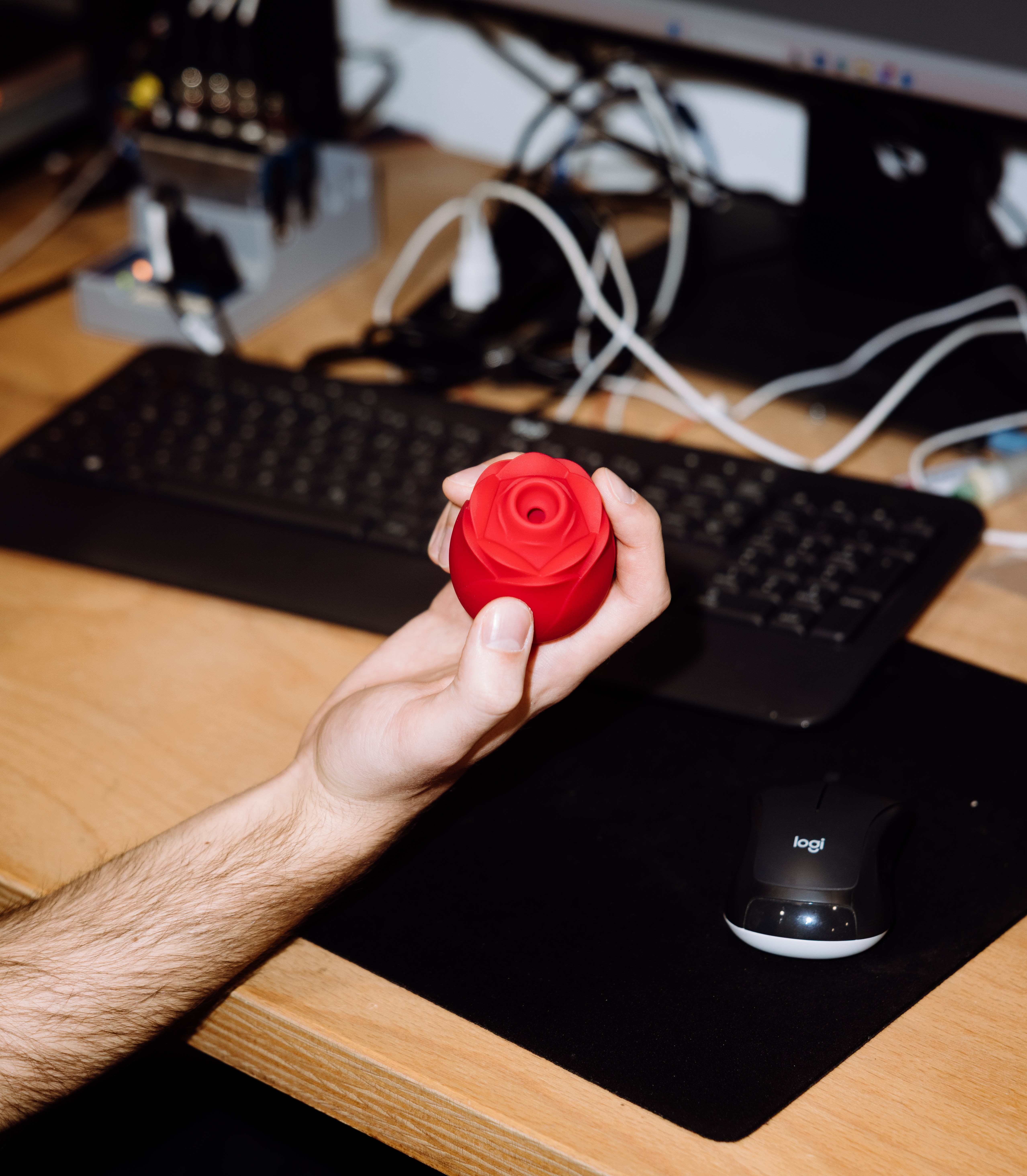
In the lobby there’s another plush costume — this time in the form of a giant black vibrator. Glass cases and cabinets are packed with the company’s bestsellers. There’s a cute plastic pink rose, which looks like an ornament you might see in a chintzy B&B, but turns out to be a clitoris sucker. “There’s a trend for more playful shapes like these. You could leave them lying around and no one would know,” Singmann explains.
She shows me a chrome showerhead designed with the upmarket bathroom fixtures manufacturer Hansgrohe. It was created in response to research that found 28 per cent of women use this attachment for purposes beside washing their hair. “It’s always nice when a different industry isn’t afraid to collaborate with us.”
Next is a long purple stick with buckled collars at the base. Out of context I’d have guessed it was a dog-walking accessory, but I’m starting to know better. “It’s a spreader bar, you put it between your legs,” Singmann says. This is a product from the Fifty Shades of Grey brand with which the company has a licensing deal. “Those books and films allowed a lot more couples to explore their kinky side.”
During the Fifty Shades mania of the early 2010s, it seemed as though everyone was reading about BDSM on their morning commute. The trilogy sold 165 million copies worldwide and is just one of the cultural moments that helped to popularise sex toys. Another was Sex and the City in 1998, when Charlotte rhapsodised over her new rabbit vibrator. Today Singmann shows me shelves laden with malformed dildos — some scarily huge, some tiny, ridged, contorted, in every colour, with names such as Creature Cocks Sea Monster that cater to the “romantasy” fiction craze in which women often have sex with mythical creatures. “It’s a huge trend.”

A selection of prototypes created by 3D printers
GENE GLOVER FOR THE SUNDAY TIMES MAGAZINE
Lovehoney’s toys are manufactured in China, but development, rigorous quality control and testing take place in Germany. The products aren’t cheap — the company’s latest Womanizer clitoral suction stimulator costs £189.99 — but it can take five years and about a dozen iterations to perfect a toy. The team must ensure items can withstand being bent more than a million times in the case of a flexible rabbit, for example, or endure “stroking” more than 100,000 times for a male “sleeve” into which a penis is inserted. “The basic process is the same as for a cellphone, earbuds, a hairdryer, whatever…” Zegenhagen says.
In one room rows of 3D printers purr ready to churn out prototypes. Monitors display graphs tracking the varying pressure modes of a vibrator. One engineer in jeans and a baseball cap is examining data regarding a rabbit’s on-off switches: “We don’t want the button to feel loose after just 100 switches.”

A silicone “sleeve” for men, right, is put through its paces

Testing for endurance and flexibility
GENE GLOVER FOR THE SUNDAY TIMES MAGAZINE
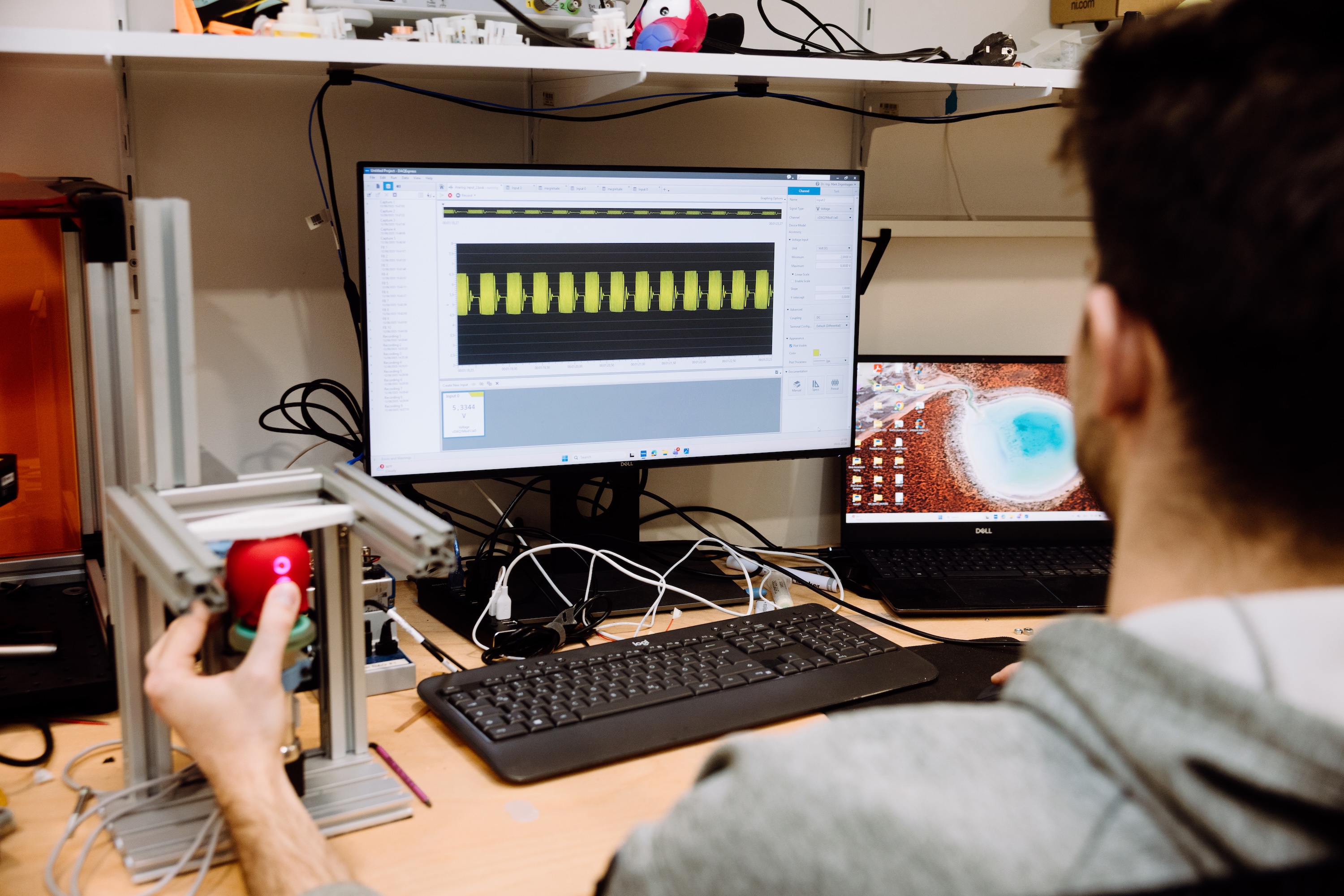
Checking the pressure exerted by a “clitoral sucker”, below
GENE GLOVER FOR THE SUNDAY TIMES MAGAZINE
GENE GLOVER FOR THE SUNDAY TIMES MAGAZINE
Archaeological finds reveal sex toys have existed since the Ice Age, with the earliest made of natural materials such as stone, bone, ivory and wood. Then came a long wait for the English physician Joseph Mortimer Granville to invent the first electromechanical vibrator in the 1880s, which was intended to soothe muscle pains in men. But around the early 1900s it began being marketed to men and women to tackle “wrinkles”. “Respectable” publications only stopped advertising them in the 1920s when erotic films and photos started to make their purpose clear.
Their renaissance came in the 1970s when the feminist Betty Dodson organised group masturbation workshops in New York, encouraging women to use the Hitachi Magic Wand, a product its Japanese manufacturer had always insisted is for pain relief. In 2013 it was rebranded and distributed by Vibratex as Hitachi distanced itself from its sexual associations.

The feminist Betty Dodson repurposed Hitachi body massagers in the 1970s
Another significant development was the invention of the Womanizer by Michael Lenke, a retired sixtysomething engineer from Bavaria, as a response to learning about the orgasm gap. In his basement workshop he used an old aquarium pump to replicate the sensation of oral sex on the clitoris, which he surmised would solve the problem. He recruited his wife, Brigitte, as a guinea pig, who recalled half-jokingly, “I’ve been through a lot.” Tests showed 98 per cent of users reached orgasm, sometimes within seconds. The device was launched in 2014 and has sold 11 million units, with updated models constantly in development.
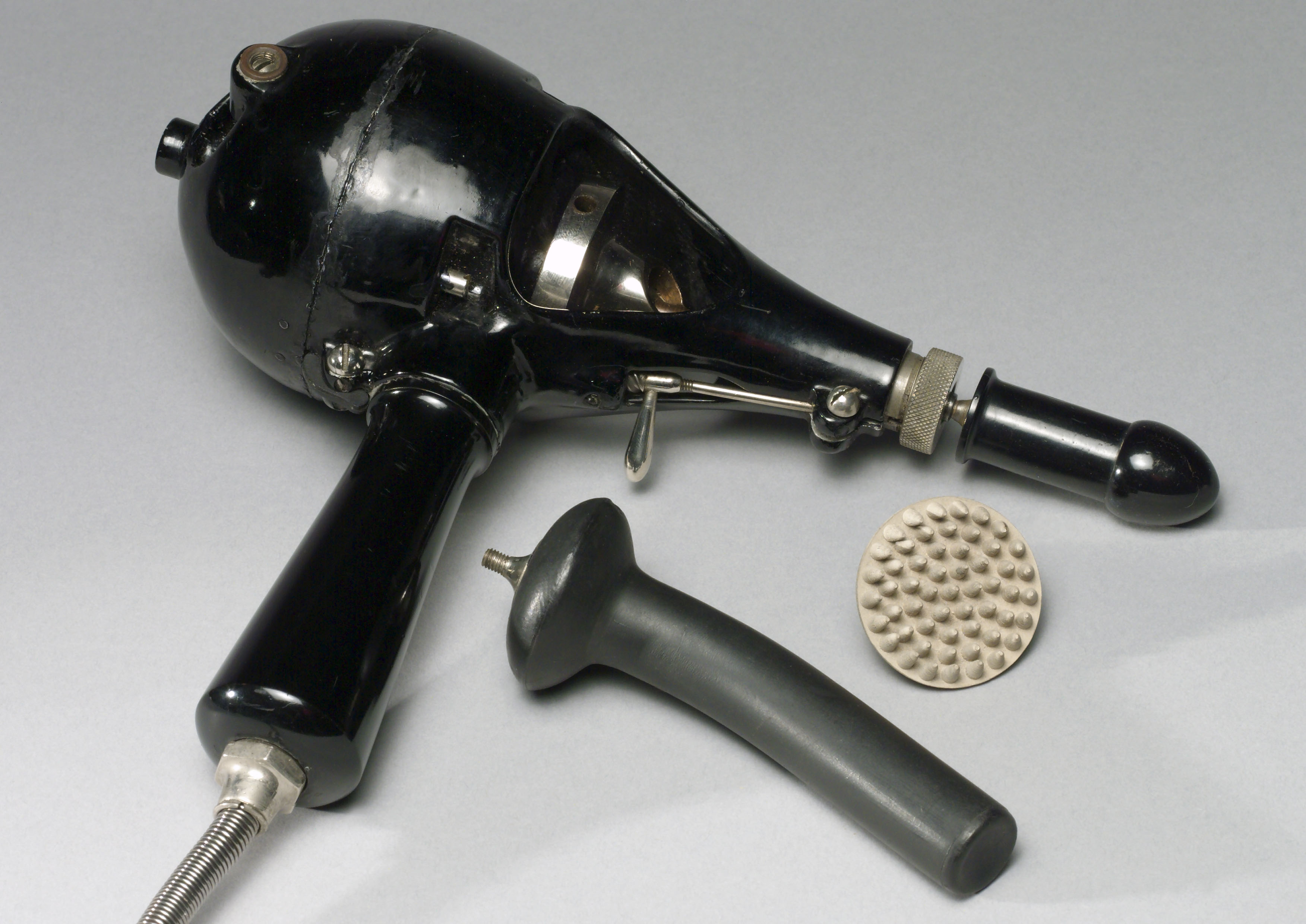
A vibrator sold in the US by General Electric Co in the early 1900s
GETTY IMAGES

19th-century dildos
GETTY IMAGES
Perfecting products requires extensive user testing, a unique challenge for the industry. “When you make a cell phone, for example, you give it to a user and observe them,” Zegenhagen says. “We can’t watch while people masturbate.” Instead extensive feedback is collected from 13,000 testers all over the world, aged between 18 and 70, recruited via Lovehoney’s online forums. (There’s no such thing as a full-time toy tester, although Lovehoney staff and their friends and family have first dibs.)
• Wham, bam, thank you ma’am! Sex toy brand Lovehoney receives Queen’s Award
Volunteers test prototypes for two to three weeks, before completing a questionnaire. These are analysed by Lovehoney’s user research manager, the sexologist Elisabeth Neumann, 33, who will then probe further through focus groups and online interviews.

Lovehoney Group’s user research manager, Elisabeth Neumann
GENE GLOVER FOR THE SUNDAY TIMES MAGAZINE
“We ask, ‘How did you use it? What benefits did you experience? How did it influence your pleasure, your sexual arousal?’ ” Neumann says, sitting before me in sober black trousers and a pinstripe jacket. She has a master’s in sexology and has worked at Lovehoney for eight years.
Neumann’s questions don’t always receive straight answers. People don’t use sex toys in the same way they might use a dishwasher — results are far more dependent on testers’ mood and temperament. Then there’s language. “Anatomically, people’s sex education is not that good. So when they say, ‘I touch my clitoris,’ they may actually be referring to some other part of their body,” Neumann says. “And there are not many terms to describe the sexual experience. One common term is ‘pleasant’, but that can mean anything from ‘nice’ to ‘deeply orgasmic’. So during interviews we really have to dig deeply to discover, ‘No, how pleasant is this really for you?’ ”
For centuries the specifics of female anatomy have been an overlooked area of research, Neumann says, which has led to ignorance and misinformation. “When one starts to study female pleasure, you might hear about different ‘spots’ that are to be discovered: G-spot, C-spot, A-spot, O-spot. It is now our understanding that anatomy is not determined by spots, but that each woman has her own unique composition of clitoral structure, nerve endings, pelvic floor muscles and other anatomy that influence personal preferences and pleasure zones. It’s one of our challenges to develop products that bring pleasure to as many people as possible while acknowledging that everyone is unique.” Discoveries that have surprised Neumann include research that, far from being used by lonely spinsters, about 50 per cent of sex toys are used in a twosome. A recent study in the Journal of Sex Research by three medical psychologists showed that, in Europe at least, couples of all sexualities who use sex toys have better relationships, more sex and enjoy sex more.
Female sex toys dominate the market: 65 per cent of buyers are women. The reasons aren’t hard to fathom. “Men don’t need as much stuff because it’s pretty simple for them,” says Lucy Litwack, 51, owner of the upmarket British lingerie and sex toy brand Coco de Mer. The company was founded by Anita Roddick’s daughter Sam Roddick in 2014 but Litwack staged a management buyout in 2017.

Lucy Litwack, owner of Coco de Mer
SOPHIA SPRING / DRAPERS
“So often women have no idea what turns them on,” Litwack says. “Female pleasure is still something that is never talked about. Sex education in school is all about how not to get pregnant, how not to get a sexually transmitted disease. So many heterosexual women fake orgasms when they are with their partner because we’re people-pleasers, we seem more concerned about hurting a man’s ego than we do about our own satisfaction. Now it’s changing — they’re using toys to see what works for them and then expressing that to their partners. Some men are still scared of toys, they say, ‘Are you saying I’m not good enough?’ But now they’re starting to realise a toy just gives them one less thing to have to worry about.”
Litwack is trying to make sex toys as luxurious and female-friendly as possible. “I felt that so many out there were very rigid,” she says. “I really wanted to do something where the toys were moulded to your body, rather than the other way round.” With Coco de Mer’s toy developer, Helen Zeal, 53, Litwack has spent the past decade ensuring her toys are as bendy as possible. They have also created toys using dual-density silicone. “It has a squishy feel. You don’t hit metal at any point. That’s important for a woman’s pleasure.”
All products must be in compliance with EU product safety regulations, which require materials to be free from carcinogens and lead. There are no specific guidelines for sex toys, so Zeal tends to abide by the rules for children’s toys. “They’re often electronic, made of plastic and silicone, and in that area the standard is very high,” she explains.
Vivacious and glamorous, Litwack and Zeal are in a meeting room at Coco de Mer’s offices in Primrose Hill, north London. Walls and ceilings are painted cocoa brown, the brand’s signature colour, and we’re surrounded by tailor’s dummies draped in lacy lingerie. On the ebony boardroom table is a selection of toys the pair created together — with sleek, dark brown curved edges and rose-gold trimmings. Prices are top end. Its own clitoral sucker, the Stimulator, costs £185 but the products are far more attractive, and discreet, than the many neon numbers I’ve by now encountered. “Our customers don’t want hot pink, they want something they feel comfortable with in their homes and that they can travel with,” Litwack says.
Litwack has witnessed the sex-toy industry explode — the turning point being Covid when sales doubled. Since then toys have rapidly entered the mainstream, sold everywhere from Boots to Tesco. Coco de Mer’s products are available at its boutique in Knightsbridge and in department stores such as Selfridges and John Lewis. “We had a pop-up on the shop floor at the John Lewis Oxford Street branch,” Litwack says. “I was worried the staff would be horrified but they were so enthusiastic. If toys are being sold in the nation’s national treasure, you realise people don’t think they’re shocking any more.”
And what of the men? A survey of heterosexual men by the sex-toy brand Lelo revealed 54 per cent claim they’ve never used a toy. Of the 46 per cent who had, half had used one only with a partner. But now the male sector is making headway. At an upmarket hotel in Soho I meet Adam Lewis, co-founder and CEO of Hot Octopuss. The company brought the world the Pulse, often known as the first “guybrator” — a male vibrator.
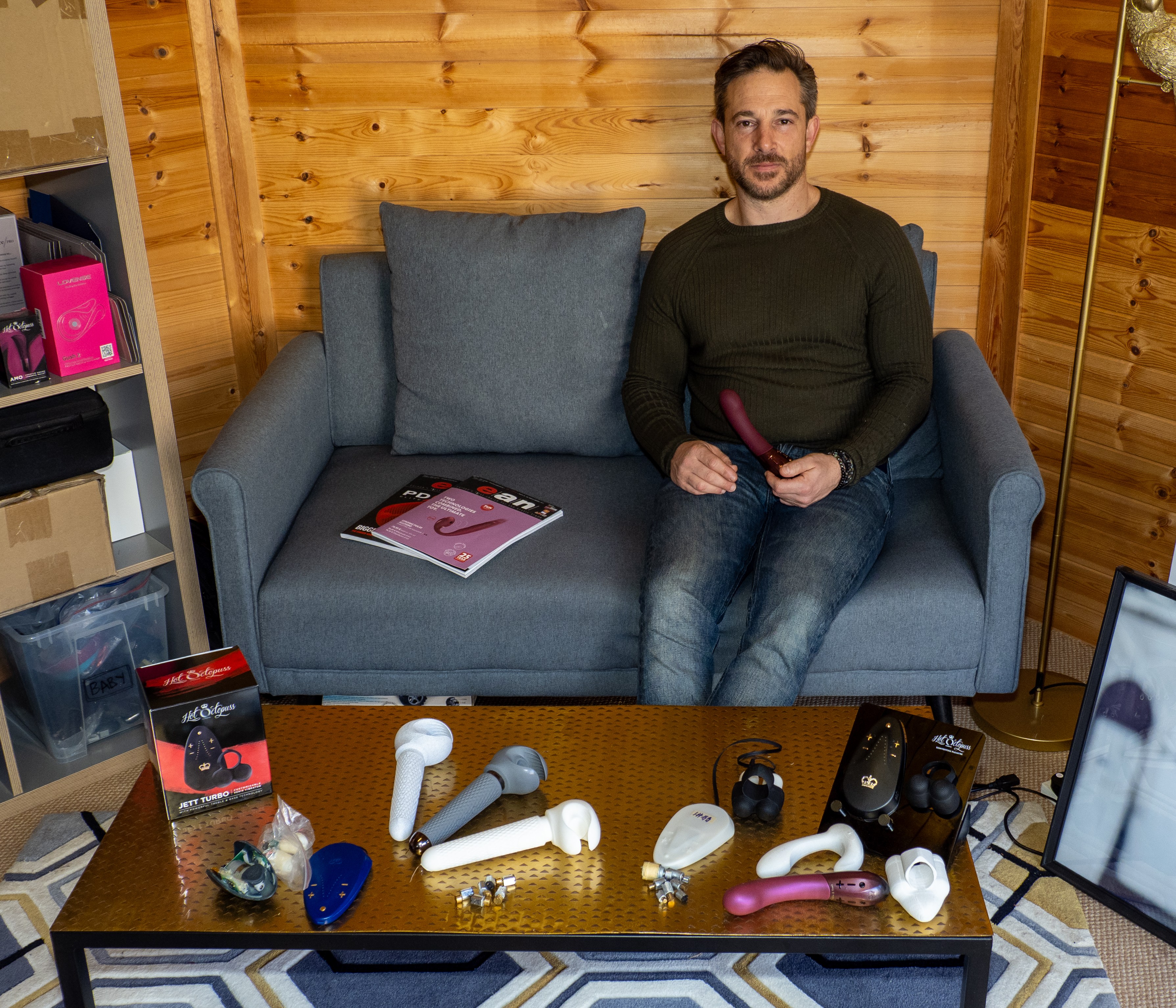
Adam Lewis, co-founder of Hot Octopuss, the company behind the first “guybrator”
PETER DENCH FOR THE SUNDAY TIMES MAGAZINE
Lewis, a softly spoken 47-year-old married father of two from north London and the former managing director of a conference company, has long been fixated on the lack of innovation in male sex toys. He says a vacuum cleaner formed part of his teenage sexual experiences. “Let’s just say I was experimental. If anything in the house vibrated, swirled or sucked, I had probably engineered a way to turn it into a sex toy. I’m no product designer but I knew what I wanted. There were so many sophisticated toys on the market for women but very little for men and what there was was all very phallic — strokers and blow-up dolls, relying on orgasm by just one method: the age-old up-down motion. I wanted something else.”
In 2011, lying awake after a party at 3am, Lewis came up with the idea for a hands-free vibrator that didn’t require an erect penis to achieve orgasm. “You just put this thing under your frenulum, which is just under the glans [the tip of the penis], and it does all the work,” he says.
He designed a prototype consisting of two vibrating eggs inside a sock and showed it to five different engineers. “Half said, ‘We can’t be seen to take on a product like this — what would our other clients say?’ One guy just walked out. But one company said, ‘We’ll give it a go.’ ”
However, vibrations still proved to work less successfully on men than on women. Lewis kept researching a solution, eventually unearthing a medical report about devices that had been used successfully to allow men with spinal cord injuries to ejaculate as part of IVF procedures. “These weren’t using vibrations at all, they were using oscillations with a disc that went up and down in a piston motion, creating this tap-tap-tap sensation.”
He contacted the Danish manufacturer of the devices and licensed the technology. After more research he came up with his patented PulsePlate Technology, where two motors — one clunkier bass, one oscillating treble — work together to produce “weird and wonderful” vibrations.
The Pulse was launched two years later in 2013 and to date the range has sold more than two million units. New versions are regularly rolled out and include a couples’ version, the Pulse Duo, costing £129. As ever, user responses are carefully noted.
“We get a lot of feedback from men saying, ‘Your product’s not big enough for us,’ ” says Dan Caplin, a sales director at Hot Octopuss. “Actually we test everything with a gentleman from Cornwall who makes porn films and is very well-endowed. He fits in, so…” Lewis adds with a sigh: “We would love to do a small, medium and large but we don’t have the volumes.”
The products weren’t aimed at what Lewis calls “the therapeutic space”, but from the start were embraced by men suffering from erectile dysfunction. Now the company, which employs 25 people globally, sends samples to urologists and attends urology conferences to explain how they can help men suffering from prostate cancer. “We’ve had so many letters from people thanking us, saying they thought they’d never orgasm again,” he says.

Research by Lovehoney in 2017 claimed that 2.9 million people in the UK owned at least one sex toy
GENE GLOVER FOR THE SUNDAY TIMES MAGAZINE
Where will the industry go next? Remote-controlled, Bluetooth-enabled toys are all the rage, to be used alone or on a partner. Sex dolls are being reimagined, incorporating AI technology to enable changing facial expressions and the ability to carry out conversations — yours for about £10,000. Other gadgets clip to relevant body parts which, via Bluetooth, move in time with the pornography of choice, with AI then refining the experience exactly to the user’s liking. Yet within the industry there’s scepticism around whether users will want their most intimate moments on the cloud.
“To personalise the experience, users have to share their data with us, and obviously how they use toys is very sensitive information,” Zegenhagen says. “It will happen but it will take at least another five years. And I don’t think robots will substitute human connection. We’re certainly not seeing big demand for them right now.”
Everyone I meet in the industry chats matter-of-factly about the most taboo subjects. Sometimes they have to be reminded that not everyone is so relaxed discussing bondage gear. “I remember once in LA we were having dinner after a trade show with a retired porn star, who was talking very knowledgeably about the different technologies, ‘Oh yeah, I was in this gang bang using this and that.’ The whole restaurant stopped talking, the waiter stopped pouring our water. But all of us were just nodding, ‘Yeah, yeah, OK,’ ” Lewis recalls.
Lucy Litwack has put her 78-year-old mother, who used to work as a jeweller, to work in Coco de Mer’s Knightsbridge boutique. “The worst experience of my life was the day I had to train my mum on how all the toys worked, the bondage stuff,” Litwack says. “It was horrific for me, but she’s amazing at the job. Now I get texts saying, ‘Darling, we’re running low on ball gags.’ ”
Despite the growing normalisation of such products, resistance remains. Meta, the owner of Facebook, WhatsApp and Instagram, won’t allow sex toys to be advertised across its platforms. “It’s very frustrating,” Litwack says.
This apart, what unites everyone I meet is a sense that they’re genuinely improving lives. Zegenhagen says: “When I worked at Siemens, I never had this feeling I was making a product that was making so many people happy. In contrast to what I did before, I really like it.”