

New data reveals how amateurs really score – and where most players can make the biggest improvements.
If you’ve ever wondered how your game stacks up against other golfers, there’s now a huge dataset that provides some answers.
The latest Annual Golf Performance Report from Shot Scope examines how amateur golfers score – and, more importantly, why they score the way they do.
Using on-course data collected throughout 2025, the report analyses performance across scoring, tee shots, approach play, the short game and putting to identify where strokes are most commonly gained and lost.
The scale of the study is enormous. In 2025 alone, Shot Scope tracked more than 74 million shots across over 870,000 rounds, played on 24,000+ courses in 124 countries. That makes it one of the largest real-world datasets ever compiled for amateur golf.
The findings let you see how you compare to other amateur golfers – and show what it takes to improve your scores.
Here are some of the biggest takeaways…
 You’re probably better than you think
Let’s start with a bit of perspective.
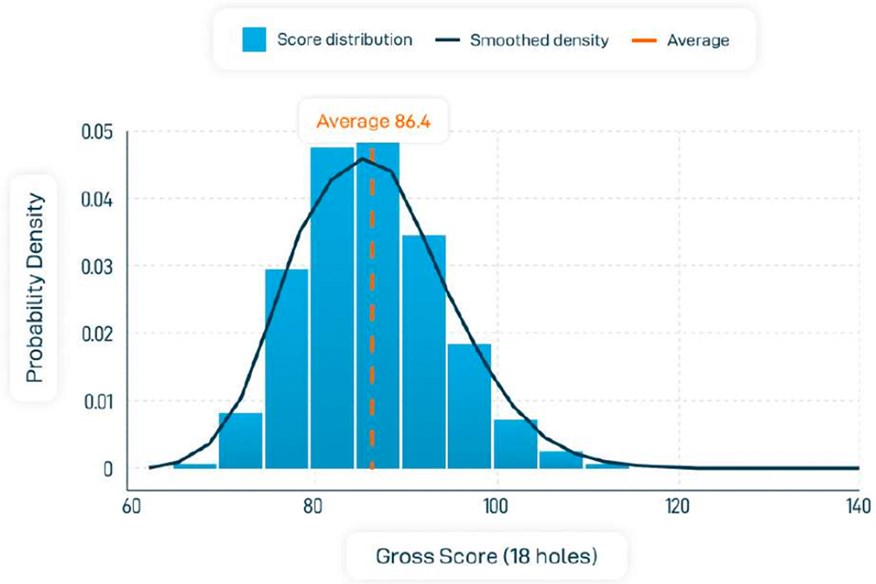
The average score for amateur golfers in 2025 was 86.4.
But remember: these are Shot Scope users, so likely more committed golfers than average. If you’re breaking 90, you’re doing pretty well.
But what about your best round? Would it surprise you that more than a quarter of golfers didn’t break 90 once in 2025? Or that less than a third broke 80?
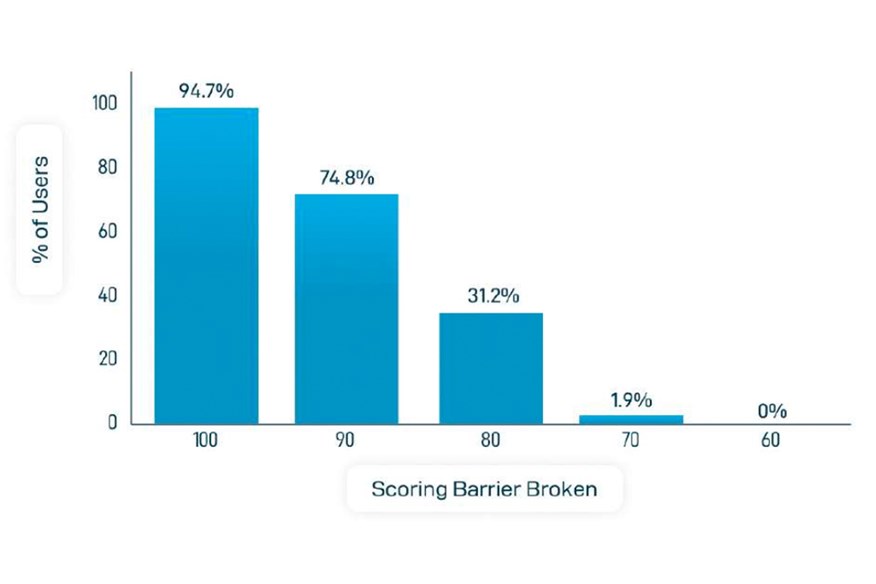
31.2% of golfers broke 80
74.8% broke 90
5.3% failed to break 100
Just 1.9% broke 70
In other words, the rounds most golfers consider “average” are actually better than many people ever achieve.
 It’s not about birdies
Watching tour golf can create the impression that low scoring is all about birdies.
In reality, amateur golf works very differently.
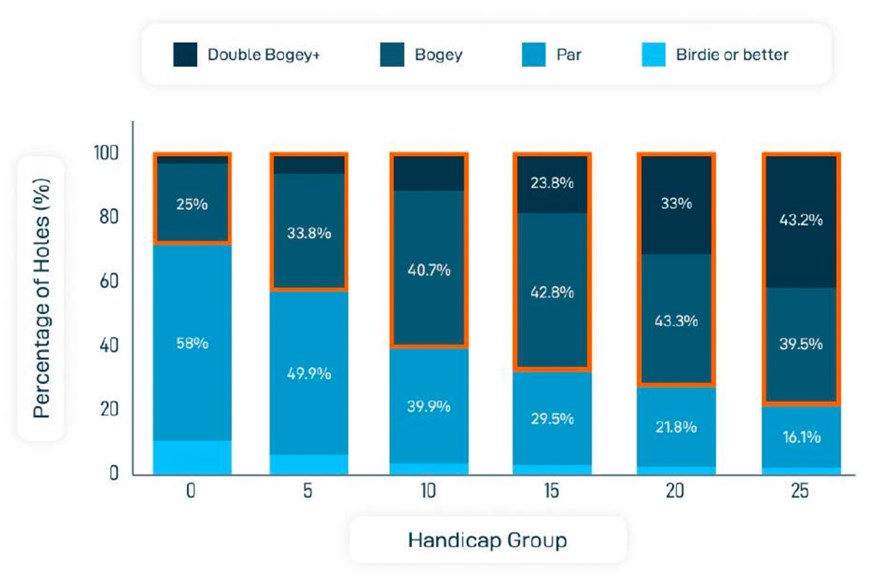
Even scratch golfers make birdie less than 10% of the time, which means fewer than two per round on average.
The real difference between low handicappers and higher-handicap players isn’t birdies – it’s big mistakes.
For example:
15-handicap: double bogey or worse on 23.8% of holes
20-handicap: double bogey or worse on 33% of holes
25-handicap: double bogey or worse on 42.3% of holes
Scratch players, by contrast, rarely make worse than bogey.
That highlights a crucial point about scoring: good golf is usually about limiting damage rather than producing brilliance. Avoiding doubles and keeping bad holes under control has a far bigger impact than chasing birdies.
 You don’t need to hit it further – just more consistently
Distance is often seen as the biggest advantage in modern golf, and there’s no doubt longer drives generally lead to better scoring.
A longer tee shot means a shorter approach, which statistically leads to closer proximity and fewer strokes to finish the hole.
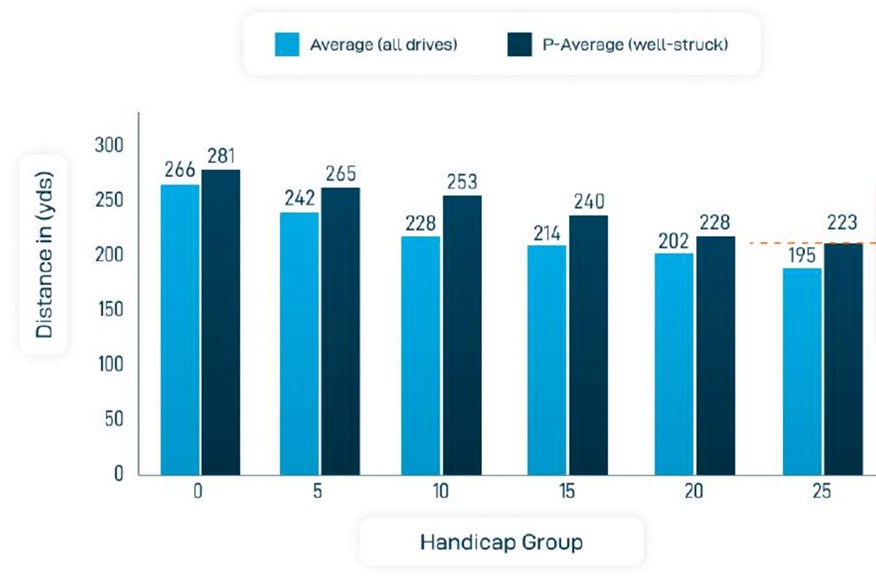
But the Shot Scope data reveals an interesting detail when you compare average drives with well-struck drives.
A well-struck drive from a 15-handicap golfer travels almost as far as the average drive from a 5-handicapper.
The same pattern appears across the board.
That suggests many golfers already have the potential distance required to play at a better level. The difference is consistency. Better players simply produce their good drives far more often, while higher handicappers mix in more poor strikes.
And while all golfers have a gap between their longest drives and their average ones, it’s a lot more pronounced for higher handicappers.
A 25-handicapper’s average drive is 12.6% shorter than their good ones.
A 15-handicappers average drive is 10.8% shorter than their good ones.
A 10-handicapper’s average drive is 9.9% shorter than their good ones.
A scratch golfer’s average drive is only 5.3% shorter than their well-struck ones.
Instead of chasing extra yards with your best swing, the smarter focus might be raising the standard of your less-than-perfect ones.
As the report explains: “Elite amateurs are longer on average, but there is a substantial distance overlap across all skill levels. Most golfers already possess sufficient distance to compete at a higher level than they are currently playing at.”
 You don’t need to hit it as close as you might think
Approach shots are another area where perception and reality can differ.
Many golfers imagine scratch players routinely firing iron shots to tap-in range. In truth, even very good players don’t hit it close very often.
From 150 yards, the average proximity to the hole is:
Scratch golfer: about 40-feet
25 handicap: roughly 70-feet
There’s an important strategic lesson here.
Because even good golfers aren’t knocking the flag out very often, aggressively chasing tucked pins usually doesn’t make sense. The safer play – aiming for the center of the green and avoiding trouble – often leads to better scoring over time.
 No one gets up and down as much as you think
The short game is another area where expectations tend to be unrealistic.
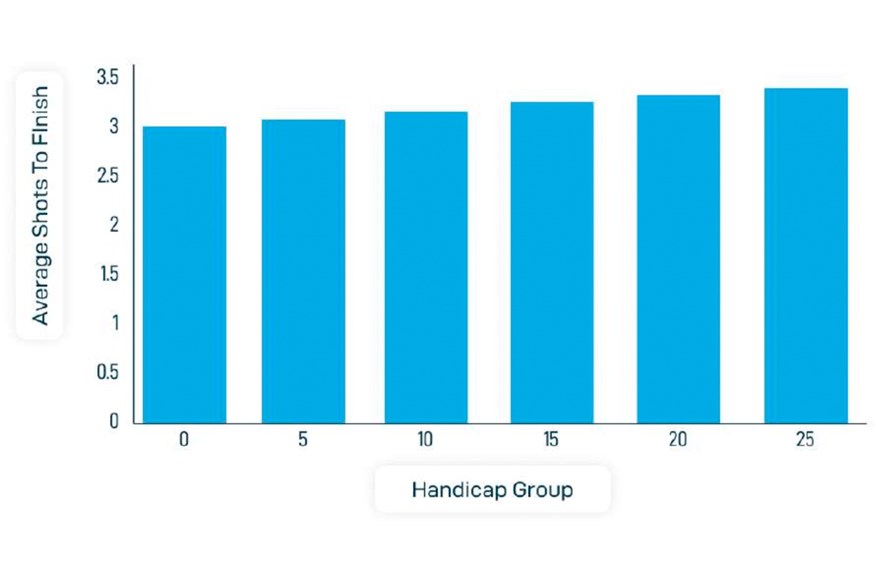
From 50 yards, golfers of every handicap level are more likely to take three or more shots to hole out than to get up-and-down in two.
And the gap between abilities is smaller than many people think.
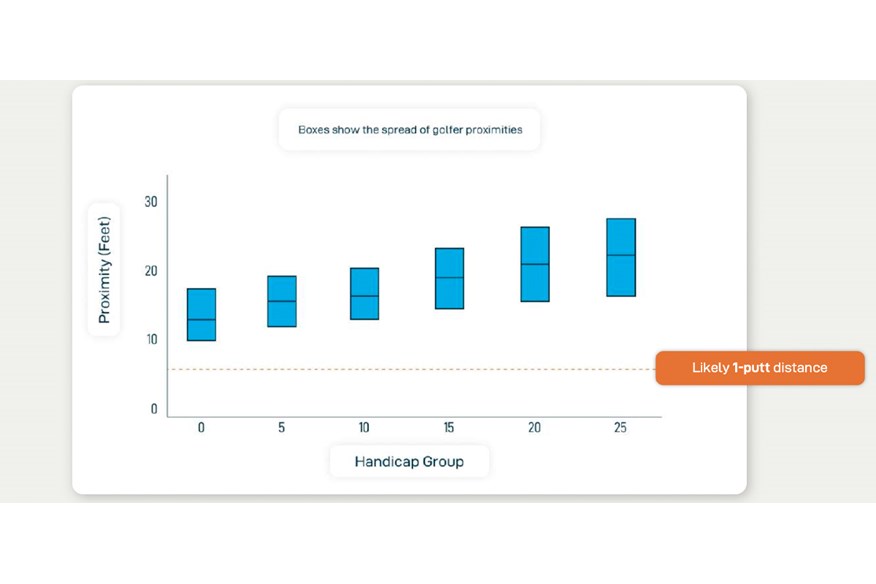
From 30 yards, most players – even scratch golfers – typically leave themselves outside realistic one-putt range. Lower handicappers do get it closer on average, but not close enough to expect to hole the putt regularly.
What does that mean for decision-making?
Taking on a risky shot to a tight pin usually isn’t worth it and, if you get it wrong, can easily turn a simple chip into a bunker shot or further recovery.
In many cases, the smarter play is simply to guarantee a two-putt – leaving the ball in a safe area rather than gambling for a rare tap-in.
Over a full round, avoiding the occasional disastrous short-game mistake can save several strokes.
 Short putts are what count
Putting statistics reveal one area where better players really separate themselves.
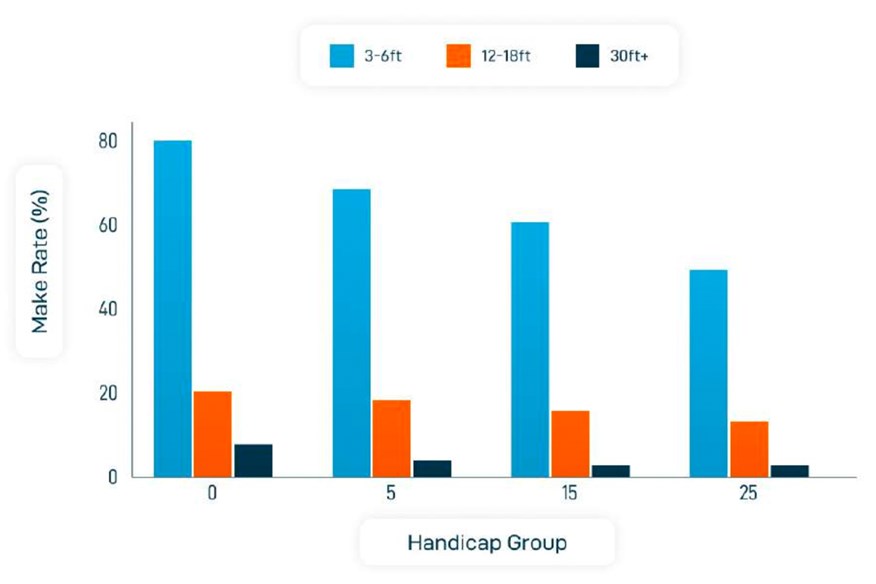
From 3-6 feet, the difference between handicaps is clear: the lower the handicap, the more of these putts get holed.
Beyond that distance, however, the gap narrows dramatically.
Give a scratch golfer and a 25-handicapper a 15-foot putt, and both are likely to miss the vast majority of the time.
That means improving your putting isn’t really about learning to hole more mid-range putts, because no one makes many of those. It’s about avoiding three-putts.
And the recipe for that is simple:
Improve pace control to lag long putts fairly close
Become reliable from inside six feet
Those two factors – lag putting and short-range confidence – account for most of the scoring advantage better players have on the greens.
 The real key to better golf
Taken together, the findings point to a simple conclusion.
Improving at golf rarely comes from spectacular shots. Instead, it’s usually about raising your floor rather than your ceiling.
That means:
Turning doubles into bogeys
Improving consistency off the tee
Playing smarter approach shots
Avoiding short-game disasters
Becoming dependable on short putts
Do that, and the numbers suggest your scores will start to move in the right direction.
Like this article? See more TG content in your feed! Click here to add Today’s Golfer as a preferred source on Google.