
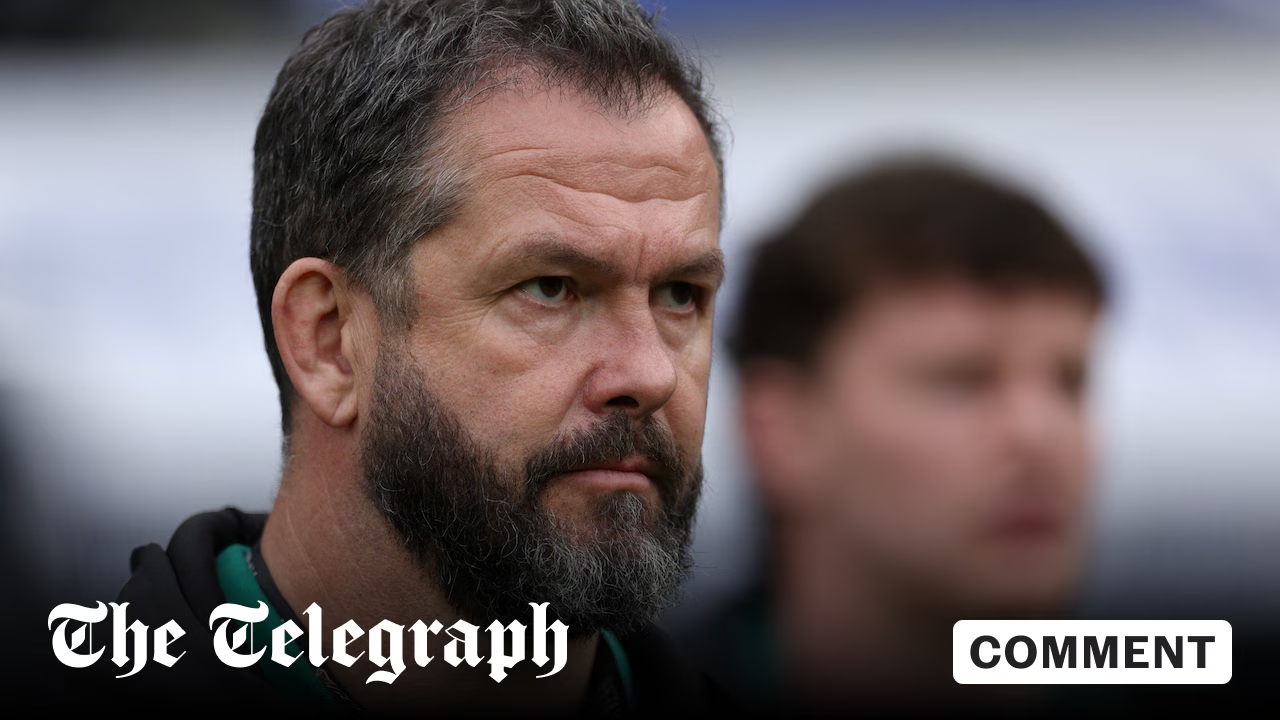
Farrell’s great asset is his empathy, understanding how best to manage his players’ emotions. The past five weeks have shown it to its fullest extent, with Ireland improving everything from their kicking to their handling to their scrummaging. One uncharacteristically feeble display against France lit the spark, fuelling a resurgence that culminated in sumptuous play against title-chasing Scotland. “Faz is an incredible coach, an incredible motivator,” reflected Tom O’Toole, a revelation since replacing Jeremy Loughman at loosehead and driving his team-mates towards the Triple Crown. “He spoke to me a few times, one-on-one.”
All of which leaves the RFU with an overriding imperative: to secure Farrell as Borthwick’s successor, regardless of the cost or the complexity. It will not happen overnight. While Borthwick has bought himself time, thanks to that heady adrenalin rush in Paris, Farrell has signed a contract tethering him to Ireland until the end of next year’s World Cup in Australia. But the arduous work of securing his services starts here. In succession planning of this magnitude, the RFU cannot afford to go into the process half-baked. It did so in 2018, when Eddie Jones turned up offering Farrell the job of defence coach, without any assurance that he might graduate to the head coach posting he craved. He rejected the proposition, enriching his reputation elsewhere.
Farrell left little doubt in his recent memoir that he had been open to persuasion, but that he would only make the leap if there were guarantees. “I asked about Eddie’s plans after the 2019 World Cup,” he said. “There was no way I was going to leave Ireland unless there was a specific commitment that reflected my ambition to become a head coach one day. Eddie hinted that he might be moving on, but there was nothing concrete.” Where the form of Jones’s England tailed off over the following three years, until the RFU reluctantly fired him, Farrell propelled a nation with barely a fraction of the playing pool to even greater heights.