
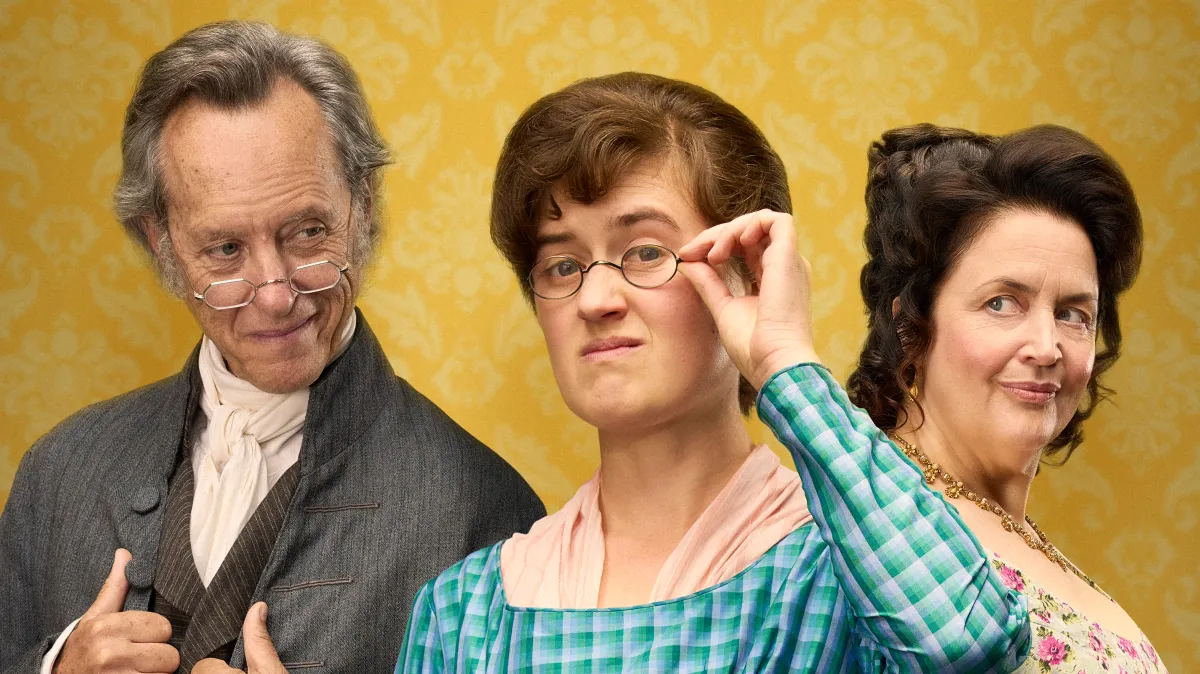
No one could accuse The Other Bennet Sister (BBC1) of being slow in getting to its point. Straight out of the traps in the first minute, it spelt out the meat of the matter. “To be poor and handsome is misfortune enough, but to be penniless and plain is a hard fate indeed,” said the voiceover. In a nutshell, that is the hand dealt to its heroine and the driving force of the plot, based on the 2020 novel by Janice Hadlow.
This is the story of Mary, the overlooked, wallflowerish Bennet sister of Pride and Prejudice. Her despairing mother (Ruth Jones in great overbearing form) snipes that her complexion is “awfully ruddy” and frets that her appearance might spoil the chances of her more fetching sisters, Jane (the beautiful one), Elizabeth (the witty one), Lydia (the spirited one) and Kitty (the good humoured one) to find suitable marriages to rich men, which could save the family from penury.
If you’re not the beautiful/witty/sparkling one, which one are you, Mary is left asking herself. She decides she will be the bookish one, a woman of knowledge. But in that era, is that necessarily the answer?
TV newsletter
What to watch or stream, plus news and reviews from our small-screen experts.
Sign up with one click
Ella Bruccoleri’s performance is skilfully judged as a geeky, unconfident, clumsy but clever “plain Jane”, a woman who knows she doesn’t fit in but never stops trying, which, at times, in itself is heartbreaking. I was going to say that Bruccoleri is perfectly cast but that almost sounds like an insult. Over and over again we are told that Mary is not what in today’s parlance would be called “a looker” with her blunt fringe and frumpy frocks. What I mean is that she plays the part with beautiful restraint and without ever becoming a caricature.
It is interesting to see this story from a fresh perspective, namely Mary’s bespectacled one, the shy sister emerging from the shadows to take centre stage to show what polite society life was like then for women like her when it was basically a marriage meat market.
These brisk, half-hour episodes canter along with a deftly light touch, meaning that scenes aren’t always subtle but they are extremely watchable. The humour is pitched just right. There is Richard E Grant as Mr Bennet, rolling his eyes behind his newspaper and, when Mary sings (badly) at an event, he steps in to stop her, delivering the famous line: “You have delighted us long enough.”
Around the dinner table Mary’s sisters suddenly notice something and are horrified: “Mary is wearing spectacles!” “I think you’re very brave to be prepared to look so ugly,” she is told. I suppose this is the early 19th-century equivalent of the saying: “Boys don’t make passes at girls who wear glasses.”
Humour and cruelty bounce along hand-in-hand. Mary’s spectacles ironically lead her to a nice, kind man who is interested in her: her optician, Mr Sparrow. At a dance, when they are enjoying each other’s company, snobbish Mrs Bennet barrels over to forbid her to dance with him again. “His father owns a shop. With a bell” she says, appalled. “I will not have you ruining your sisters’ chances of a match.” No thought for Mary’s chance of a match then.
I have only seen five episodes (only five were available) but suffice to say Mary moves to London where her qualities start to shine. Tuck in to enjoyable, escapist bonnet fare.
★★★☆☆
Available on iPlayer
Love TV? Discover the best shows on Netflix, the best Prime Video TV shows, the best Disney+ shows, the best Apple TV+ shows, the best shows on BBC iPlayer, the best shows on Sky and Now, the best shows on ITVX, the best shows on Channel 4 streaming, the best shows on Paramount+ and our favourite hidden gem TV shows. Don’t forget to check our critics’ choices to what to watch this week, and browse our comprehensive TV guide