
Lichtenberg, T. & Miguel, Y. in Treatise on Geochemistry 3rd edn., Vol. 7 (eds Anbar, A. & Weis, D.) Ch. 3 (Elsevier, 2025).
Fulton, B. J. & Petigura, E. A. The California-Kepler Survey. VII. Precise planet radii leveraging Gaia DR2 reveal the stellar mass dependence of the planet radius gap. Astron. J. 156, 264 (2018).
David, T. J. et al. Evolution of the exoplanet size distribution: forming large super-earths over billions of years. Astron. J. 161, 265 (2021).
Valencia, D., Moro-Martin, A. & Teske, J. in Treatise on Geochemistry 3rd edn., Vol. 7 (eds Anbar, A. & Weis, D.) Ch. 2 (Elsevier, 2025).
Zeng, L. et al. Growth model interpretation of planet size distribution. Proc. Natl Acad. Sci. USA 116, 9723–9728 (2019).
Owen, J. E. Atmospheric escape and the evolution of close-in exoplanets. Annu. Rev. Earth Planet. Sci. 47, 67–90 (2019).
Lopez, E. D. Born dry in the photoevaporation desert: Kepler’s ultra-short-period planets formed water-poor. Mon. Not. R. Astron. Soc. 472, 245–253 (2017).
Mousis, O. et al. Irradiated ocean planets bridge super-earth and sub-neptune populations. Astrophys. J. Lett. 896, 22 (2020).
Luque, R. & Palle, E. Density, not radius, separates rocky and water-rich small planets orbiting M dwarf stars. Science 377, 1211–1214 (2022).
Lacedelli, G. et al. Investigating the architecture and internal structure of the Toi-561 system planets with Cheops, Harps-n, and Tess. Mon. Not. R. Astron. Soc. 511, 4551–4571 (2022).
Burn, R. et al. A radius valley between migrated steam worlds and evaporated rocky cores. Nat. Astron. 8, 463–471 (2024).
Bean, J. L., Raymond, S. N. & Owen, J. E. The nature and origins of sub-Neptune size planets. J. Geophys. Res. Planets 126, e2020JE006639 (2021).
Rogers, J. G. On the road to the radius valley: distinguishing between gas dwarfs and water worlds with young transiting exoplanets. Mon. Not. R. Astron. Soc. 539, 2230–2241 (2025).
Fernandes, R. B. et al. Signatures of atmospheric mass loss and planet migration in the time evolution of short-period transiting exoplanets. Astron. J. 169, 208 (2025).
Demangeon, O. D. S. et al. Warm terrestrial planet with half the mass of Venus transiting a nearby star. Astron. Astrophys. 653, 41 (2021).
Kostov, V. B. et al. The L 98-59 system: three transiting, terrestrial-size planets orbiting a nearby M dwarf. Astron. J. 158, 32 (2019).
Zhou, L., Ma, B., Wang, Y. & Zhu, Y. Hubble WFC3 spectroscopy of the rocky planet L 98-59 b: no evidence for a cloud-free primordial atmosphere. Astron. J. 164, 203 (2022).
Bello-Arufe, A. et al. Evidence for a volcanic atmosphere on the sub-Earth L 98-59 b. Astrophys. J. Lett. 980, L26 (2025).
Zhou, L., Ma, B., Wang, Y.-H. & Zhu, Y.-N. Hubble WFC3 spectroscopy of the terrestrial planets L 98-59 c and d: no evidence for a clear hydrogen dominated primary atmosphere. Res. Astron. Astrophys. 23, 025011 (2023).
Cadieux, C. et al. Detailed architecture of the L 98-59 system and confirmation of a fifth planet in the habitable zone. Astron. J. 170, 154 (2025).
Gressier, A. et al. Hints of a sulfur-rich atmosphere around the 1.6 R ⊕ super-Earth L98-59 d from JWST NIRspec G395H transmission spectroscopy. Astrophys. J. Lett. 975, 10 (2024).
Banerjee, A. et al. Atmospheric retrievals suggest the presence of a secondary atmosphere and possible sulfur species on l98-59 d from JWST nirspec g395h transmission spectroscopy. Astrophys. J. Lett. 975, 11 (2024).
Parc, L., Bouchy, F., Venturini, J., Dorn, C. & Helled, R. From super-Earths to sub-Neptunes: observational constraints and connections to theoretical models. Astron. Astrophys. 688, 59 (2024).
Rajpaul, V. M., Barragán, O. & Zicher, N. A non-zero Doppler amplitude is not enough: revisiting the putative radial velocity detection of sub-Venus exoplanet L 98-59b. Mon. Not. R. Astron. Soc. 530, 4665–4675 (2024).
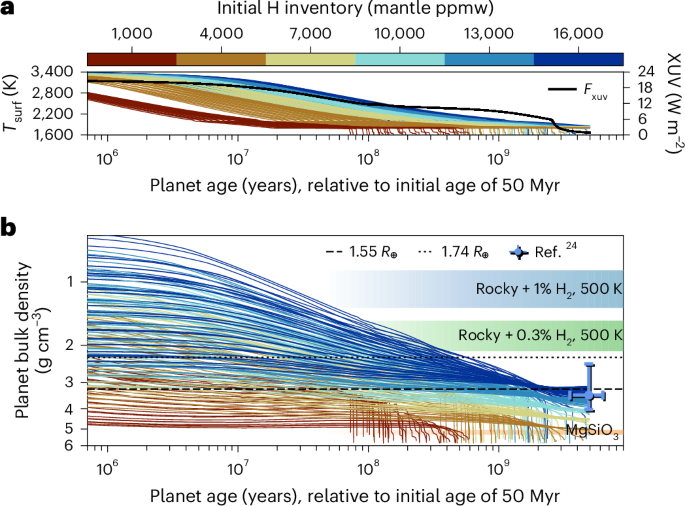
Lichtenberg, T. et al. Vertically resolved magma ocean-protoatmosphere evolution: H2, H2 O, CO2, CH4, CO, O2, and N2 as PRIMARY ABSORBERS. J. Geophys. Res.: Planets 126, e2020JE006711 (2021).
Nicholls, H., Lichtenberg, T., Bower, D. J. & Pierrehumbert, R. Magma ocean evolution at arbitrary redox state. J. Geophys. Res.: Planets 129, e2024JE008576 (2024).
Nicholls, H., Pierrehumbert, R. T., Lichtenberg, T., Soucasse, L. & Smeets, S. Convective shutdown in the atmospheres of lava worlds. Mon. Not. R. Astron. Soc. 536, 2957–2971 (2024).
Nicholls, H. et al. Self-limited tidal heating and prolonged magma oceans in the L 98-59 system. Mon. Not. R. Astron. Soc. 541, 2566–2584 (2025).
Innes, H., Tsai, S.-M. & Pierrehumbert, R. T. The runaway greenhouse effect on hycean worlds. Astrophys. J. 953, 168 (2023).
Lehmer, O. R. & Catling, D. C. Rocky worlds limited to 1.8 earth radii by atmospheric escape during a star’s extreme UV saturation. Astrophys. J. 845, 130 (2017).
Venturini, J. et al. The nature of the radius valley. Hints from formation and evolution models. Astron. Astrophys. 643, 1 (2020).
Righter, K., Sutton, S. R., Danielson, L., Pando, K. & Newville, M. Redox variations in the inner solar system with new constraints from vanadium XANES in spinels. Am. Mineral. 101, 1928–1942 (2016).
Gaillard, F. et al. Redox controls during magma ocean degassing. Earth Planet. Sci. Lett. 577, 117255 (2022).
Krissansen-Totton, J., Wogan, N., Thompson, M. & Fortney, J. J. The erosion of large primary atmospheres typically leaves behind substantial secondary atmospheres on temperate rocky planets. Nat. Commun. 15, 8374 (2024).
Krijt, S. et al. in Protostars and Planets VII (eds Inutsuka, S. et al.) Ch. 28 (Astronomical Society of the Pacific, 2023).
Owen, J. E. & Wu, Y. The evaporation valley in the Kepler planets. Astrophys. J. 847, 29 (2017).
Costa, A., Caricchi, L. & Bagdassarov, N. A model for the rheology of particle-bearing suspensions and partially molten rocks. Geochem. Geophys. Geosys. 10, Q03010 (2009).
Namur, O., Charlier, B., Holtz, F., Cartier, C. & McCammon, C. Sulfur solubility in reduced mafic silicate melts: implications for the speciation and distribution of sulfur on mercury. Earth Planet. Sci. Lett. 448, 102–114 (2016).
Kubyshkina, D., Vidotto, A. A., Fossati, L. & Farrell, E. Coupling thermal evolution of planets and hydrodynamic atmospheric escape in mesa. Mon. Not. R. Astron. Soc. 499, 77–88 (2020).
Lopez, E. D. & Fortney, J. J. Understanding the mass-radius relation for sub-neptunes: radius as a proxy for composition. Astrophys. J. 792, 1 (2014).
Pierrehumbert, R. Principles of Planetary Climate (Cambridge Univ. Press, 2010).
Dorn, C. & Lichtenberg, T. Hidden water in magma ocean exoplanets. Astrophys. J. Lett. 922, 4 (2021).
Shorttle, O., Jordan, S., Nicholls, H., Lichtenberg, T. & Bower, D. J. Distinguishing oceans of water from magma on mini-Neptune k2-18b. Astrophys. J. Lett. 962, 8 (2024).
Elkins-Tanton, L. T. Magma oceans in the inner solar system. Annu. Rev. Earth Planet. Sci. 40, 113–139 (2012).
Hirschmann, M. M. Magma ocean influence on early atmosphere mass and composition. Earth Planet. Sci. Lett. 341-344, 48–57 (2012).
Marty, B., Zimmermann, L., Pujol, M., Burgess, R. & Philippot, P. Nitrogen isotopic composition and density of the Archean atmosphere. Science 342, 101–104 (2013).
Halliday, A. N. & Canup, R. M. The accretion of planet earth. Nat. Rev. Earth Environ. 4, 19–35 (2023).
Tsai, S.-M. et al. Photochemically produced SO2 in the atmosphere of WASP-39b. Nature 617, 483–487 (2023).
Powell, D. et al. Sulfur dioxide in the mid-infrared transmission spectrum of wasp-39b. Nature 626, 979–983 (2024).
Gressier, A. et al. JWST-TST DREAMS: sulfur dioxide in the atmosphere of the Neptune-mass planet hat-p-26 b from nirspec g395h transmission spectroscopy. Astron. J. 170, 292 (2025).
Wang, H. S., Lineweaver, C. H. & Ireland, T. R. The elemental abundances (with uncertainties) of the most earth-like planet. Icarus 299, 460–474 (2018).
Wade, J. & Wood, B. J. Core formation and the oxidation state of the Earth. Earth Planet. Sci. Lett. 236, 78–95 (2005).
Peslier, A. H., Schonbachler, M., Busemann, H. & Karato, S.-I. Water in the earth’s interior: distribution and origin. Space Sci. Rev. 212, 743–810 (2017).
Kite, E. S., Fegley Jr, B. F., Schaefer, L. & Gaidos, E. Atmosphere-interior exchange on hot, rocky exoplanets. Astrophys. J. 828, 80 (2016).
Kite, E. S. & Barnett, M. N. Exoplanet secondary atmosphere loss and revival. Proc. Natl Acad. Sci. USA 117, 18264–18271 (2020).
Bower, D. J., Sanan, P. & Wolf, A. S. Numerical solution of a non-linear conservation law applicable to the interior dynamics of partially molten planets. Phys. Earth Planet. Inter. 274, 49–62 (2018).
Bower, D. J., Hakim, K., Sossi, P. A. & Sanan, P. Retention of water in terrestrial magma oceans and carbon-rich early atmospheres. Planet. Sci. J. 3, 93 (2022).
Nicholls, H., Pierrehumbert, R. & Lichtenberg, T. Agni: a radiative-convective model for lava planet atmospheres. J. Open Source Softw. 10, 7726 (2025).
Sossi, P. A., Tollan, P. M. E., Badro, J. & Bower, D. J. Solubility of water in peridotite liquids and the prevalence of steam atmospheres on rocky planets. Earth Planet. Sci. Lett. 601, 117894 (2023).
Hier-Majumder, S. & Hirschmann, M. M. The origin of volatiles in the earth’s mantle. Geochem. Geophys. Geosys. 18, 3078–3092 (2017).
Sim, S. J., Hirschmann, M. M. & Hier-Majumder, S. Volatile and trace element storage in a crystallizing martian magma ocean. J. Geophys. Res.: Planets 129, e2024JE008346 (2024).
Guimond, C. M., Shorttle, O. & Rudge, J. F. Mantle mineralogy limits to rocky planet water inventories. Mon. Not. R. Astron. Soc. 521, 2535–2552 (2023).
Liggins, P., Jordan, S., Rimmer, P. B. & Shorttle, O. Growth and evolution of secondary volcanic atmospheres: I. Identifying the geological character of hot rocky planets. J. Geophys. Res. Planets 127, e2021JE007123 (2022).
Gaillard, F. et al. The diverse planetary ingassing/outgassing paths produced over billions of years of magmatic activity. Space Sci. Rev. 217, 22 (2021).
Guimond, C. M., Noack, L., Ortenzi, G. & Sohl, F. Low volcanic outgassing rates for a stagnant lid Archean earth with graphite-saturated magmas. Phys. Earth Planet. Inter. 320, 106788 (2021).
Hay, H. C. F. C., Trinh, A. & Matsuyama, I. Powering the Galilean satellites with moon-moon tides. Geophys. Res. Lett. 47, 88317 (2020).
Kervazo, M. et al. Solid tides in Io’s partially molten interior – contribution of bulk dissipation. Astron. Astrophys. 650, 72 (2021).
Renaud, J. P. & Henning, W. G. Increased tidal dissipation using advanced rheological models implications for Io and tidally active exoplanets. Astrophys. J. 857, 98 (2017).
Farhat, M., Auclair-Desrotour, P., Boué, G., Lichtenberg, T. & Laskar, J. Tides on lava worlds: application to close-in exoplanets and the early earth–moon system. Astrophys. J. 979, 133 (2025).
Hamano, K., Kawahara, H., Abe, Y., Onishi, M. & Hashimoto, G. L. Lifetime and spectral evolution of a magma ocean with a steam atmosphere: its detectability by future direct imaging. Astrophys. J. 806, 216 (2015).
Schaefer, L., Wordsworth, R. D., Berta-Thompson, Z. & Sasselov, D. Predictions of the atmospheric composition of gj 1132b. Astrophys. J. 829, 63 (2016).
Dziewonski, A. M. & Anderson, D. L. Preliminary reference earth model. Phys. Earth Planet. Inter. 25, 297–356 (1981).
Luo, H., Dorn, C. & Deng, J. The interior as the dominant water reservoir in super-earths and sub-neptunes. Nat. Astron. 8, 1399–1407 (2024).
Hirose, K., Wood, B. & Vocadlo, L. Light elements in the earth’s core. Nat. Rev. Earth Environ. 2, 645–658 (2021).
Bower, D. J. et al. Linking the evolution of terrestrial interiors and an early outgassed atmosphere to astrophysical observations. Astron. Astrophys. 631, 103 (2019).
Wolf, A. S. & Bower, D. J. An equation of state for high pressure-temperature liquids (rtpress) with application to mgsio3 melt. Phys. Earth Planet. Inter. 278, 59–74 (2018).
Lodders, K. & Fegley, B. The Planetary Scientist’s Companion (Oxford Univ. Press, 1998).
Boley, K. M. et al. Fizzy super-earths: impacts of magma composition on the bulk density and structure of lava worlds. Astrophys. J. 954, 202 (2023).
Unterborn, C. T. & Panero, W. R. The pressure and temperature limits of likely rocky exoplanets. J. Geophys. Res. Planets 124, 1704–1716 (2019).
Edwards, J. M. & Slingo, A. Studies with a flexible new radiation code. I: Choosing a configuration for a large-scale model. Q. J. R. Meteorol. Soc. 122, 689–719 (1996).
Amundsen, D. et al. Accuracy tests of radiation schemes used in hot Jupiter global circulation models. Astron. Astrophys. 564, 59 (2014).
Joyce, M. & Tayar, J. A review of the mixing length theory of convection in 1D stellar modeling. Galaxies 11, 75 (2023).
Johnstone, C. P., Bartel, M. & Gudel, M. The active lives of stars: a complete description of the rotation and XUV evolution of F, G, K, and M dwarfs. Astron. Astrophys. 649, 96 (2021).
Engle, S. G. & Guinan, E. F. Living with a red dwarf: the rotation-age relationships of m dwarfs. Astrophys. J. Lett. 954, 50 (2023).
Behr, P. R. et al. The MUSCLES extension for atmospheric transmission spectroscopy: UV and X-ray host-star observations for JWST ERS & GTO targets. Astron. J. 166, 35 (2023).
Tang, Y., Fortney, J. J. & Murray-Clay, R. Assessing core-powered mass loss in the context of early boil-off: minimal long-lived mass loss for the sub-neptune population. Astrophys. J. 976, 221 (2024).
Lichtenberg, T. et al. in Protostars and Planets VII (eds Inutsuka, S. et al.) Ch. 25 (Astronomical Society of the Pacific, 2023).
Johnstone, C. P. Hydrodynamic escape of water vapor atmospheres near very active stars. Astrophys. J. 890, 79 (2020).
Yoshida, T., Terada, N. & Kuramoto, K. Suppression of hydrodynamic escape of an H2-rich early earth atmosphere by radiative cooling of carbon oxides. Prog. Earth Planet. Sci. 11, 59 (2024).
Nicholls, H. Volatile-rich evolution of molten super-Earth L 98-59 d (simulations and code). Zenodo https://doi.org/10.5281/zenodo.17368256 (2025)