

Improving waste management in low- and middle-income countries could cut global pollution by 98%.
Of every 5 kilograms of plastic waste produced globally, 1 kilogram ends up polluting the environment.
This has serious consequences for people and other animals alike. It pollutes waterways, harms wildlife, and burning plastic generates toxic air that millions breathe.
But this terrible pollution is not inevitable.
In countries with good waste management systems, far less plastic pollutes the environment. Across high-income countries, plastic pollution per person is 100 times lower than in lower-income countries.
If every country managed its waste in this way, the world would cut plastic pollution by more than 98%.1
Why is this gap so large?
In the chart below, you see two key metrics: how much plastic waste is generated and how much plastic pollution is produced per person. These estimates are taken from research by Joshua Cottom and colleagues.2
Clearly, people in high-income countries don’t produce 100 times less pollution than those in lower-income countries because they use less plastic. Per person, they use much more.
The fact that more waste doesn’t automatically translate into more pollution is also clear when we look at the relationship betweeen waste and pollution by country.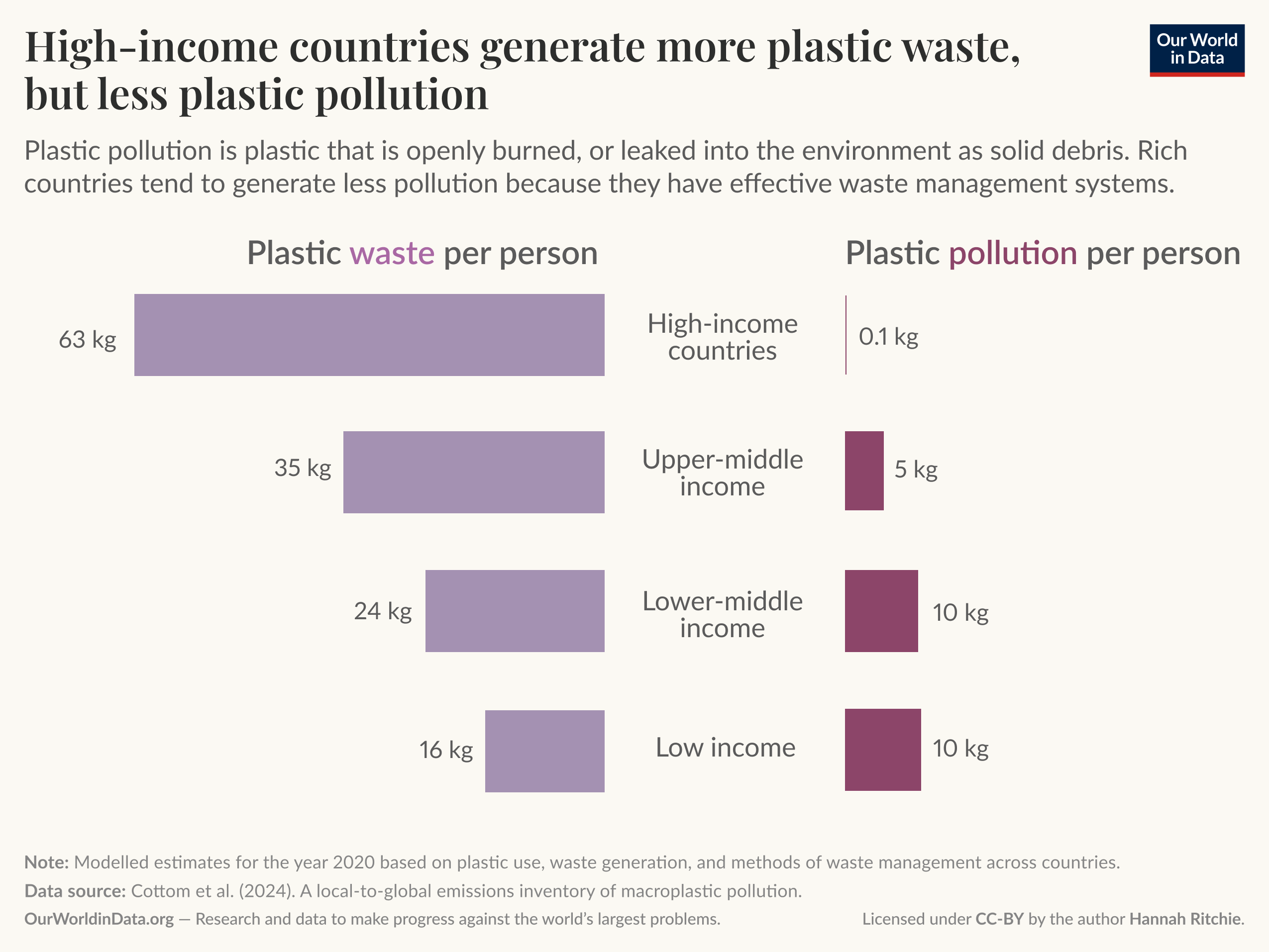
The huge difference in pollution rates is a consequence of how waste is managed. In high-income countries, most waste is collected and sent to controlled landfills or to facilities that incinerate or recycle it.
In many low- and middle-income countries, people find themselves in a very different situation: less than half of solid household waste is collected. People often have little choice but to burn or dump it. But even the waste that is collected is often left in open dumps, where it’s at risk of leaking into the environment.
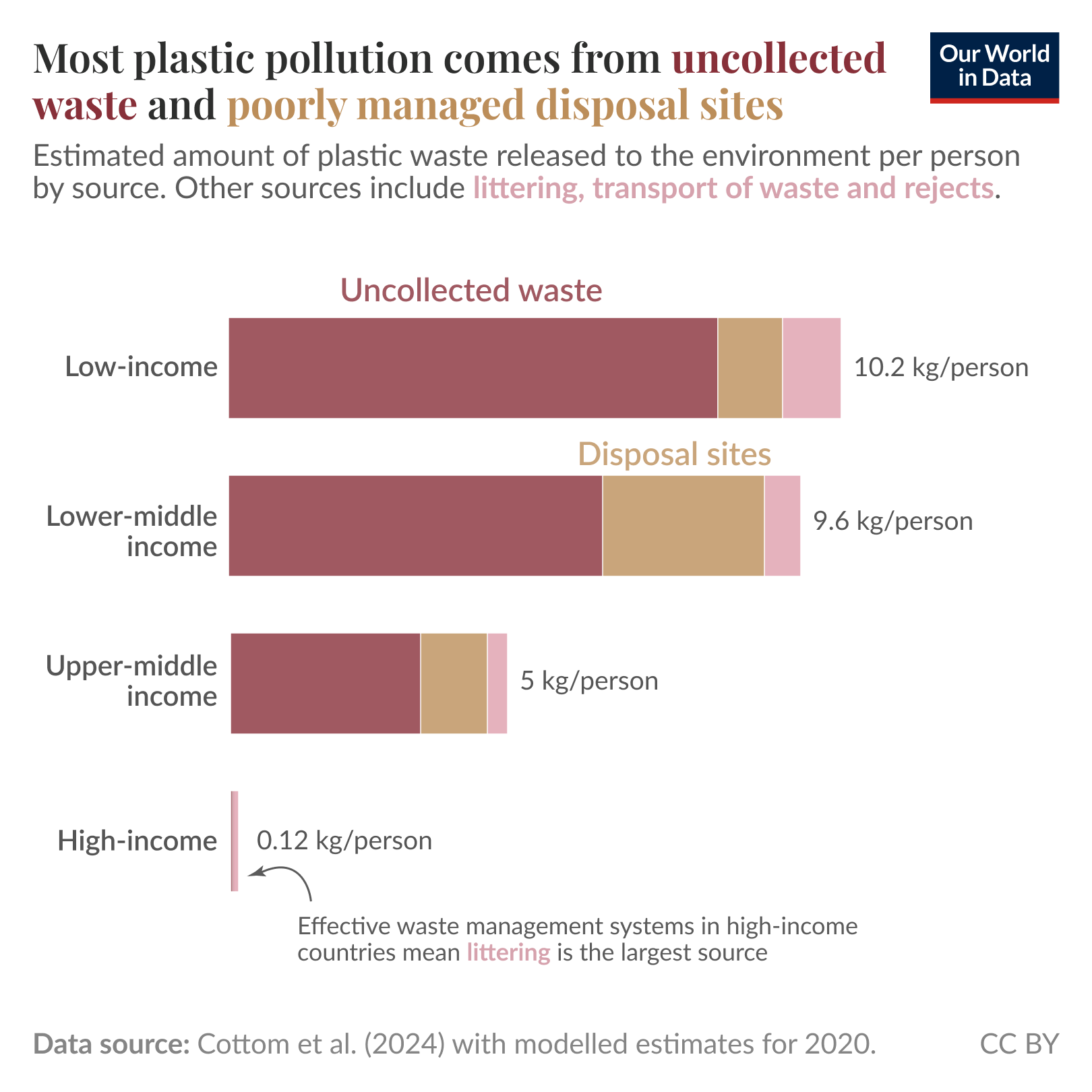
Most pollution, then, comes from uncollected waste and poorly managed disposal sites. You can see this in the chart.3
What, then, is causing plastic pollution in rich countries? Roughly half comes from littering: people thoughtlessly chucking their plastic bottles, wrappers, and bags. If we built a world where people don’t do this, we could increase that 98% reduction to 99%.
What does this mean for our options to tackle plastic pollution?
Cutting plastic use in rich countries has very little impact on global plastic pollution: the world’s high-income countries generate less than 0.5% of the total.
Reducing use in low- and middle-income countries could certainly help. But even large reductions wouldn’t get close to eliminating pollution. If one in every five kilograms of plastic waste in these countries ends up as pollution, even halving plastic waste would still leave tens of millions of tonnes leaking into the environment each year.4
If every country managed its waste the way high-income countries do, the world would cut plastic pollution by over 98%.
Improving waste management systems in low- and middle-income countries is therefore crucial. Getting there does not require fancy solutions. It needs investment in very basic infrastructure in the right places.
In a study published in Nature Sustainability, Malak Anshassi and Timothy Townsend estimate that high-income countries typically spend about $50 per person on waste management.5 In low-income countries, it’s $1 at most.6 This is where investment makes the biggest difference: each dollar spent upgrading systems in a low- or lower-middle-income country prevents roughly 25,000 times more plastic pollution than the same dollar spent on advanced infrastructure in a rich country.
Since capital is usually the constraint, focusing on basic infrastructure — collection and controlled landfills — beats expensive options like incinerators and recycling plants.7
For those passionate about ending plastic pollution, this is where attention and resources could make the biggest difference.
To most, this won’t sound like a particularly attractive way to spend money. Who really wants to invest in waste collection trucks and landfills? Not many. But for those passionate about ending plastic pollution, this is where attention and resources could make the biggest difference. Making the case for waste management and ways to make these processes and infrastructure cheaper could be the best thing you do to stop bottles clogging the world’s rivers and toxic pollution filling the air.
We already have the knowledge and tools to reduce global plastic pollution to just 2% of its current levels. With the right focus and investment, most of it is preventable.
Acknowledgments
Many thanks to Max Roser and Edouard Mathieu for editorial feedback and comments on this article.
Continue reading on Our World in DataCite this work
Our articles and data visualizations rely on work from many different people and organizations. When citing this article, please also cite the underlying data sources. This article can be cited as:
Hannah Ritchie and Veronika Samborska (2026) – “Why cheap waste management is key to stopping plastic pollution” Published online at OurWorldinData.org. Retrieved from: ‘https://archive.ourworldindata.org/20260316-124540/why-cheap-waste-management-is-key-to-stopping-plastic-pollution.html’ [Online Resource] (archived on March 16, 2026).
BibTeX citation
@article{owid-why-cheap-waste-management-is-key-to-stopping-plastic-pollution,
author = {Hannah Ritchie and Veronika Samborska},
title = {Why cheap waste management is key to stopping plastic pollution},
journal = {Our World in Data},
year = {2026},
note = {https://archive.ourworldindata.org/20260316-124540/why-cheap-waste-management-is-key-to-stopping-plastic-pollution.html}
} Reuse this work freely
All visualizations, data, and code produced by Our World in Data are completely open access under the Creative Commons BY license. You have the permission to use, distribute, and reproduce these in any medium, provided the source and authors are credited.
The data produced by third parties and made available by Our World in Data is subject to the license terms from the original third-party authors. We will always indicate the original source of the data in our documentation, so you should always check the license of any such third-party data before use and redistribution.
All of our charts can be embedded in any site.