

The fight between America’s political leadership and Anthropic, one of its leading AI businesses, shows no sign of calming down. But when it comes to national security concerns, the White House is firing shots in the wrong direction.
Beijing is challenging US dominance in AI and winning on popularity: China is fast becoming the AI factory of the world, just as it is for manufacturing. In a seminal moment last month, Chinese AI models were used more than American ones and the numbers are creeping ever upwards.
American AI companies, including Anthropic, argue that their models are being copied by Chinese rivals. And when it comes to technical capabilities, the US companies still hold a leading position. However, as Morgan Stanley analysts have noted, China is less concerned about building the most powerful AI and more focused on bringing AI to market. Last week, once again, the three most used models around the world were all made by Chinese companies: Minimax, Stepfun and Deepseek.
In the first week of March token consumption by the Chinese models increased by 35 per cent, reaching 4.19 trillion tokens, whereas US models saw the use of 3.63 trillion tokens compared with the week before. Tokens are small chunks of text, words or parts of words, that AI models use to read and generate language. This data is drawn from Open Router, a widely used platform that lets developers access hundreds of AI models. Ticking upwards like a taxi metre, the more tokens you use, the more it costs.
Why are Chinese models proving more popular? They are cheaper, charging a fraction of the cost of their US peers. For a million input tokens Minimax charges $0.30 for its M2.5 model compared with $5 for Anthropic’s Claude Opus 4.6 model. When it comes to output, Deepseek charges $0.28 per million tokens for its V3.2 model, compared with $15 for OpenAI’s ChatGPT-5.4 model. Ouch.
For many people’s purposes, the cheaper versions do the job.
How are they cheaper? Minimax claims that it spent just half a million dollars renting the computer power that it needed to train its M1 model last year, which if true, is nearly two hundred times cheaper than estimates of the training cost of ChatGPT-4o. Among other things, energy in China is far less of a constraint.
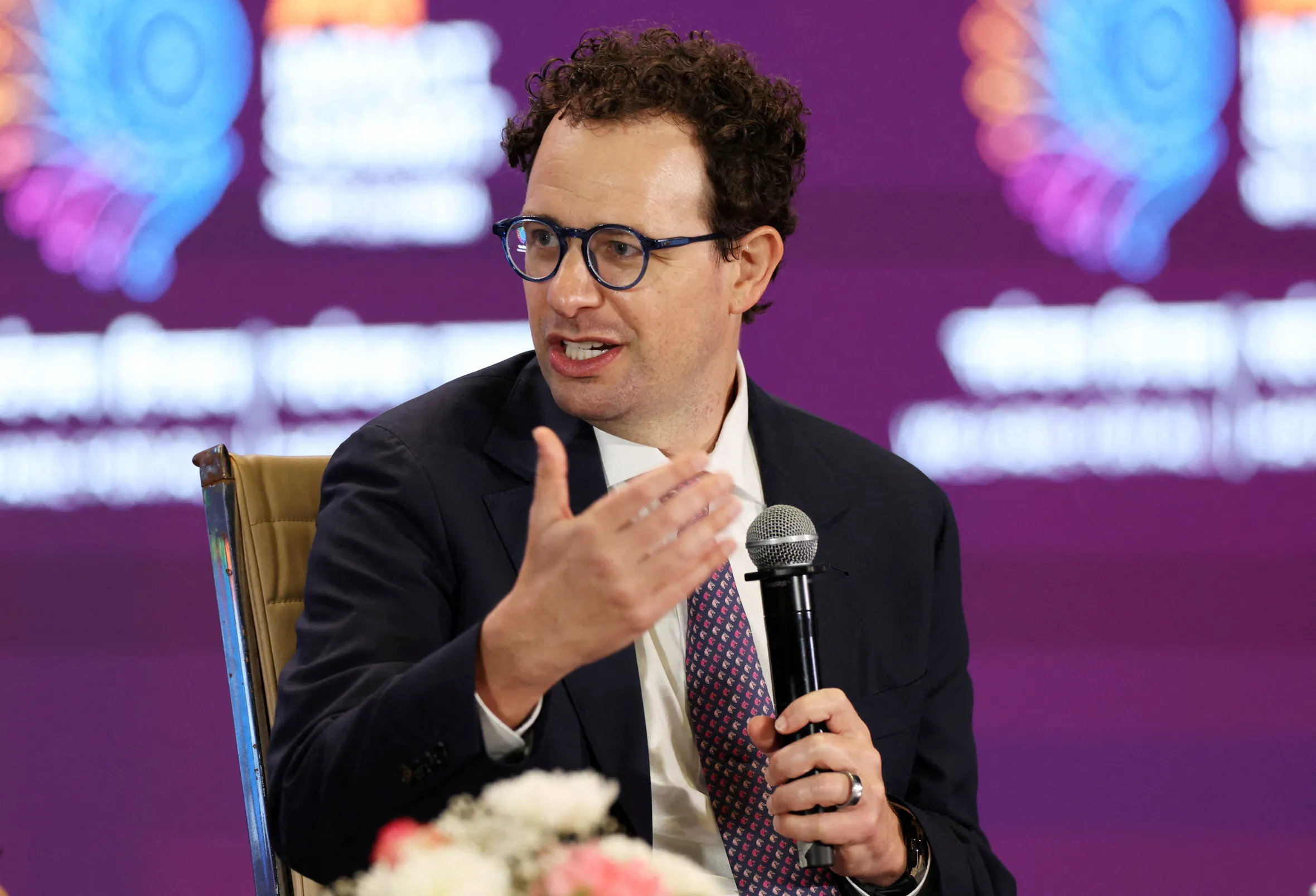 Dario Amodei, chief executive of AnthropicReuters
Minimax remains a minnow compared with OpenAI, which turned over $20 billion in 2025 but it is growing, with 70 per cent of Minimax’s $79 million revenue last year coming from outside China (the company floated in Hong Kong in January).
The top three Chinese models are notably all open source, meaning the underlying models are free to download, naturally keeping the cost down. Closed models, such as Anthropic’s, charge for both the model and the computing power to use them.
A paper from Massachusetts Institute of Technology found that “reallocating demand from observably dominated closed models to superior open models would reduce average prices by over 70 per cent”.
It seems consumers are catching on, even those you might not expect. Brian Chesky, the Silicon Valley stalwart who founded Airbnb, said in October that his company used Qwen by China’s Alibaba to power its customer service agent because it is “fast and cheap”.
Business newsletter
The business editor’s exclusive analysis of all the latest financial and economic news.
Sign up with one click
Then there is the Open Claw phenomenon. Some of the push towards cheap Chinese tokens is being led by the tech world’s obsession with the downloadable agent which can do online admin, take control of your inbox, make reservations or check you in for flights through messaging systems like WhatsApp.
Open Claw might be free to download, but the AI used to power it, is certainly not. A tool that powerful needs an awful lot of tokens, the cheaper the better.
Last month Peter Steinberger, Open Claw’s founder, enabled support for two Chinese models as the brains behind the agent. Ironically, Steinberger, because of his rip-roaring success building this maverick machine, is now employed by OpenAI.
This exponential rise in Chinese AI use is happening despite constraints imposed by the US. There is an argument that American restrictions on exports of chips such as Nvidia’s have made China more innovative.
What they lack in semiconductors, they make up for in engineering.
Technically, Chinese labs have perfected a more efficient “mixture of experts” (MoE) architecture, which means instead of running the whole AI brain for every question, it only uses the relevant parts.
China’s share of researchers with more than a thousand citations in academic articles has been rising steadily and is now on par with the US (both about 34 per cent). Academic citations are a proxy for quality and influence, they are not just about how much research someone is producing, but its importance.
Throw in significant Beijing government funding with a national strategy to achieve global AI leadership by 2030 and China’s success is not a surprise.
In all of this, Europe barely gets a look in. Yes, it has fantastic talent, yes, it is a major user of AI, but the fact remains that the Continent — including the UK — does not own the technology it is consuming.
“As AI gets embedded into the fabric of these apps, everything we buy and say and hear online will be shaped by models trained abroad,” researchers warned on Monday, in a report by Prosus, one of the world’s biggest tech investors.
There’s no doubt Europe needs to grapple with this sovereignty problem. As the US could one day too. While Washington and Silicon Valley bicker among themselves, AI is being increasingly Made in China.