
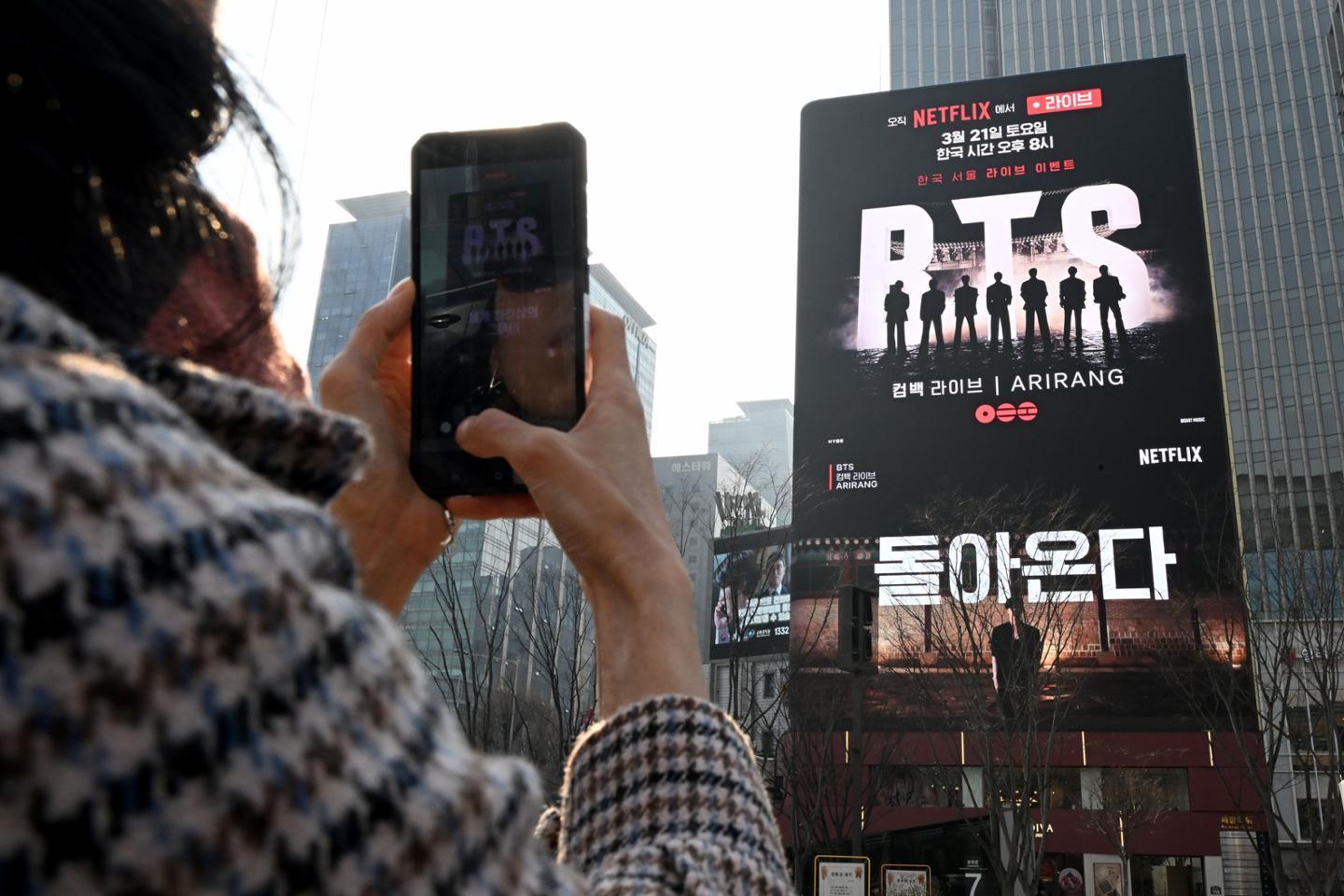
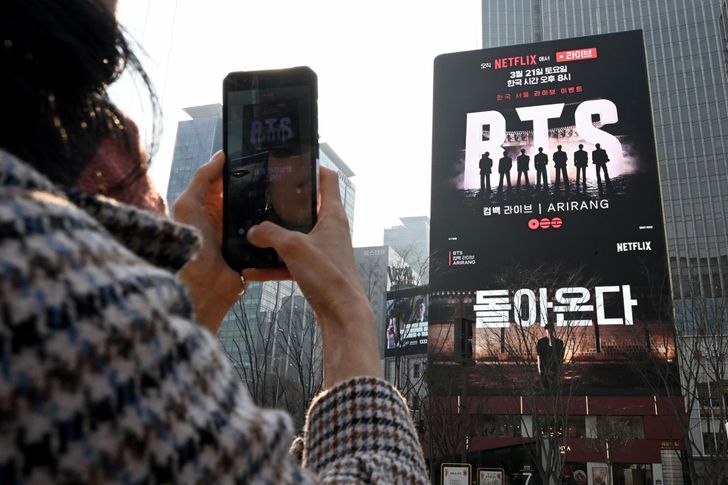
A fan records a promotional video for BTS’ comeback on an electronic billboard near Gwanghwamun Square in Jongno District, central Seoul, Tuesday, four days ahead of the supergroup’s scheduled performance. Korea Times photo by Park Ji-yeon
K-pop supergroup BTS is returning from a nearly four-year hiatus with an 82-show world tour that analysts project will generate massive economic activity, establishing an economic engine expected to surpass the financial impact of Taylor Swift’s recent global tour.
The Korea Culture and Tourism Institute estimates the upcoming 34-city tour will yield 1.2 trillion won ($840 million) per show. The Guardian reported that economists anticipate the North American leg alone will generate tens of trillions of won, significantly exceeding Taylor Swift’s 60-date North American tour, which generated about 7 trillion won.
Global media outlets are actively reporting on the comeback. The New York Times covered Korean fans rushing to internet cafes for tickets, while CNN broadcast its crew’s attempts to book seats. “BTS is not just a regular K-pop group. They are really the engine of the industry itself,” Berklee College of Music professor Ray Seol told CNN.
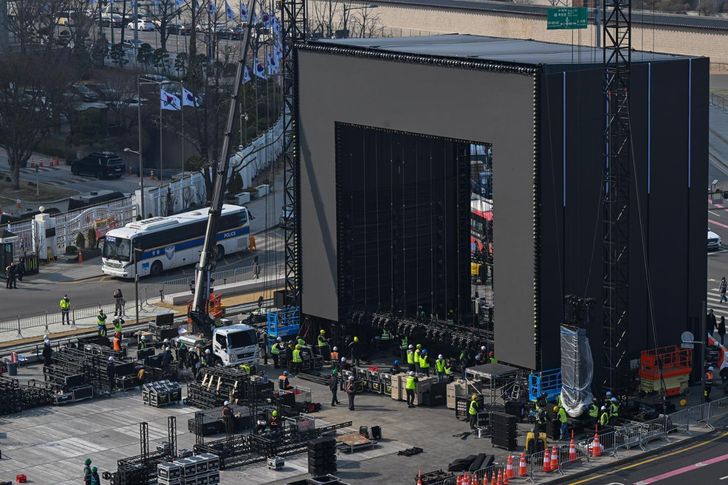
Workers install the stage for K-pop supergroup BTS’ upcoming comeback concert at Gwanghwamun Square in central Seoul, Tuesday, four days before the massive event. Korea Times photo by Park Si-mon
The local economy is already feeling the “BTSnomics” effect ahead of Friday’s release of the group’s fifth studio album, “Arirang.” Five-star hotel rates near Gwanghwamun have surged to 2 million won per night. Nearby department stores, duty-free shops and K-pop merchandise stores are bracing for a massive influx of tourists.
On Saturday, BTS will stage a monumental one-hour free concert at Gwanghwamun Square. The staging is highly symbolic, with the band expected to enter by walking down the “King’s Road,” starting from Geunjeong Gate at Gyeongbok Palace, passing through Heungnye Gate and ending at the main stage.
Broadcasting live on Netflix to an estimated 50 million viewers across 190 countries, the event will feature hits like “Dynamite” and the upbeat alternative pop song “SWIM,” the lead single from the upcoming album. The government and Seoul Metropolitan Government partnered with HYBE to use the showcase to promote K-culture and landmarks popularized by the popular Netflix animation “KPop Demon Hunters.”
To accommodate 260,000 expected fans, authorities are executing unprecedented plans, converting a 1-kilometer stretch from the square’s northern stage to City Hall Station into a 22,000-seat area. This marks the first time a large-scale performance at this location requires both traffic and building access to be completely restricted.
However, the decision has sparked significant debate. There is mounting criticism regarding the choice to hold the massive initial performance in the dense center of Seoul, a city home to nearly 10 million citizens. Critics contrasted the localized disruption with Lady Gaga’s famous free concert held on the expansive Copacabana Beach in Brazil.
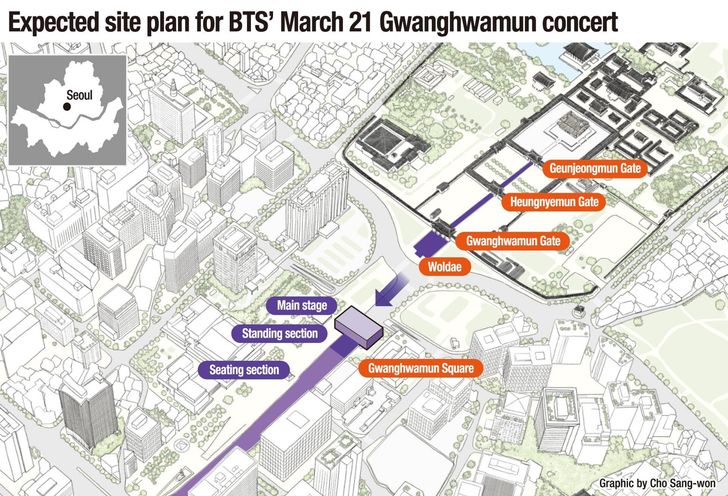
Korea Times graphic by Cho Sang-won
Critics Jung Min-jae and Lim Hee-yun questioned whether the performance is being pushed through unreasonably without specific criteria or consideration for citizen inconveniences. They argue that Korea has moved past its era of “cultural poverty” and must look further ahead rather than settling for disruptive “psychological victories.”
This article from the Hankook Ilbo, the sister publication of The Korea Times, is translated by a generative AI system and edited by The Korea Times.