
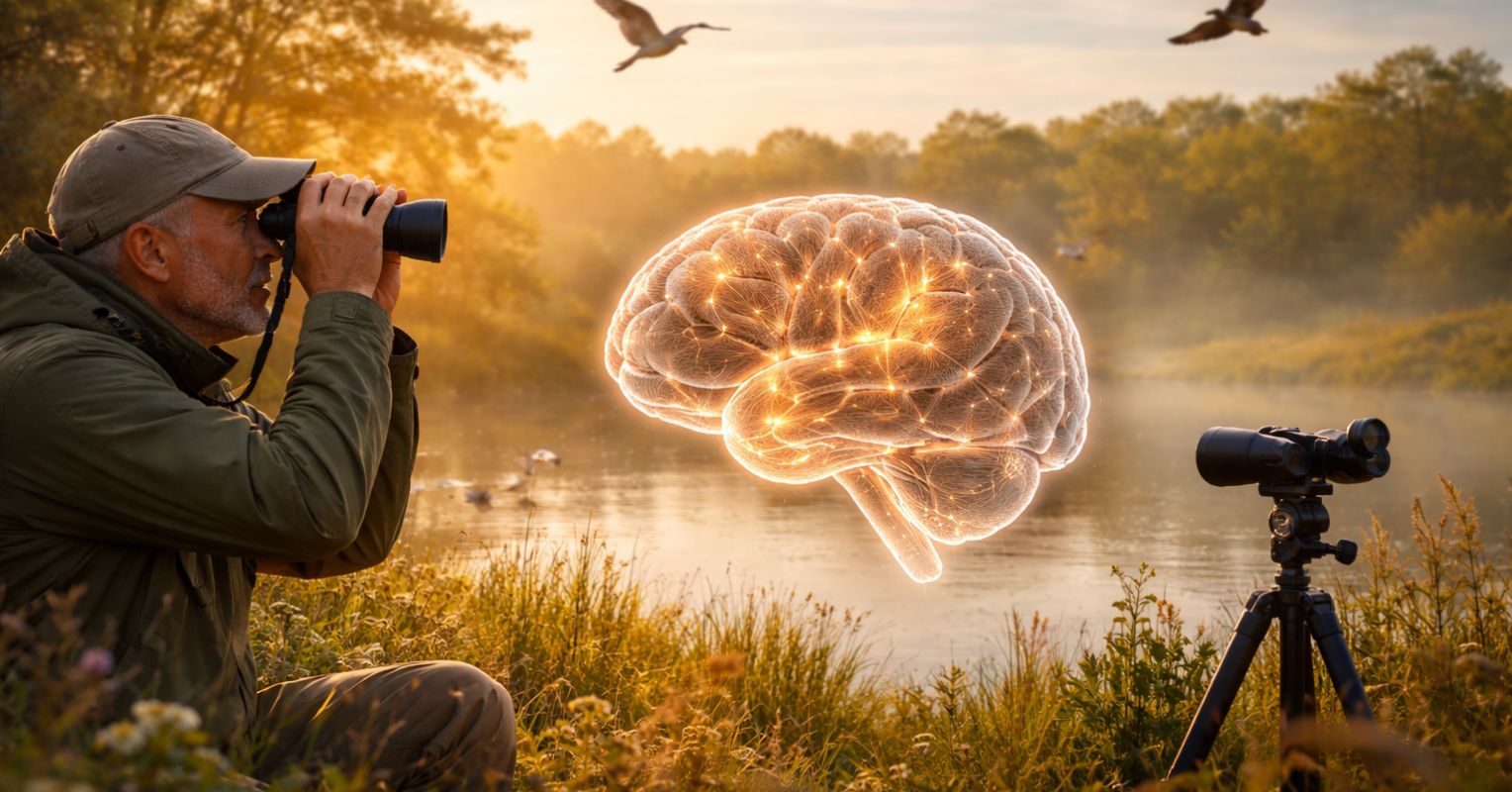
In the US, almost 100 million people report being birdwatchers, according to data on the U.S. Fish & Wildlife Service website. In the UK, hundreds of thousands of people participate in the annual “Big Garden Birdwatch.” Around the world, the pandemic is believed to have furthered spikes in interest, driven by the massive number of people affected by lockdown measures. But beyond obvious skills like learning to identify a cardinal by its song or gaining the ability to see subtle differences in seagulls, is it possible that birdwatching is beneficially rewiring our brains? A just-published study in the Journal of Neuroscience provides some of the best evidence to date that this popular hobby can do just that.
Scientists at the Rotman Research Institute in Toronto were curious about differences in the brains of expert birdwatchers and novices. To study them, they recruited 58 adults across a large age range. Half the participants were expert bird identifiers, while the other half were less adept. Then they sent all participants into specialized brain-imaging machines using diffusion weighted MRI to study brain structure, and functional MRI to look at brain activation while having them identify birds. Compared with the novices, expert birders showed more compact brain structure in regions involved attention and visual perception (frontoparietal and posterior cortical regions). The more compact the brain structure, the better the ability to identify birds. Interestingly, these same regions of the brain lit up on brain imaging when bird experts were identifying less familiar birds.
While this was a small non-interventional study, it suggests that the act of birdwatching to the point of developing expertise may rewire and restructure the brain. This builds on another recent study—“Creative experiences and brain clocks,” published in October of 2025 in Nature Communications—whose researchers showed that people who engaged in more creative experience had more youthful-looking brains, and that this was directly related to their degree of creative expertise. More generally, it’s known that participating in cognitively enriching activities (aka lifelong learning) may help to delay the onset of dementia, with a just-published Neurology study showing that people who had more engagement in enriching activities had a 38% lower chance of developing Alzheimer’s disease with an average 5-year delay in those who were eventually diagnosed.
Returning more specifically to the effects of birdwatching, there are additional reasons the hobby could help improve brain health. With social connections at the top of the list of things that support brain health, joining a social birdwatching group could provide a direct positive brain effect. Birdwatching can promote physical activity, an obvious benefit for the brain. Spending more time in nature is also increasingly linked to improved overall brain health, as is getting off of our digital devices. Finally, birdwatching may help people to destress, a key tool given that chronic stress is linked to cognitive impairment and harm to healthy brain wiring.
There’s still much more to learn about the potential benefits of birdwatching for our brain function and brain health. But while spending your day on the hunt for a hummingbird or rare raptor doesn’t replace the need to prioritize a healthy diet, good sleep, and regular exercise, it may still be rewiring your brain for the better.