
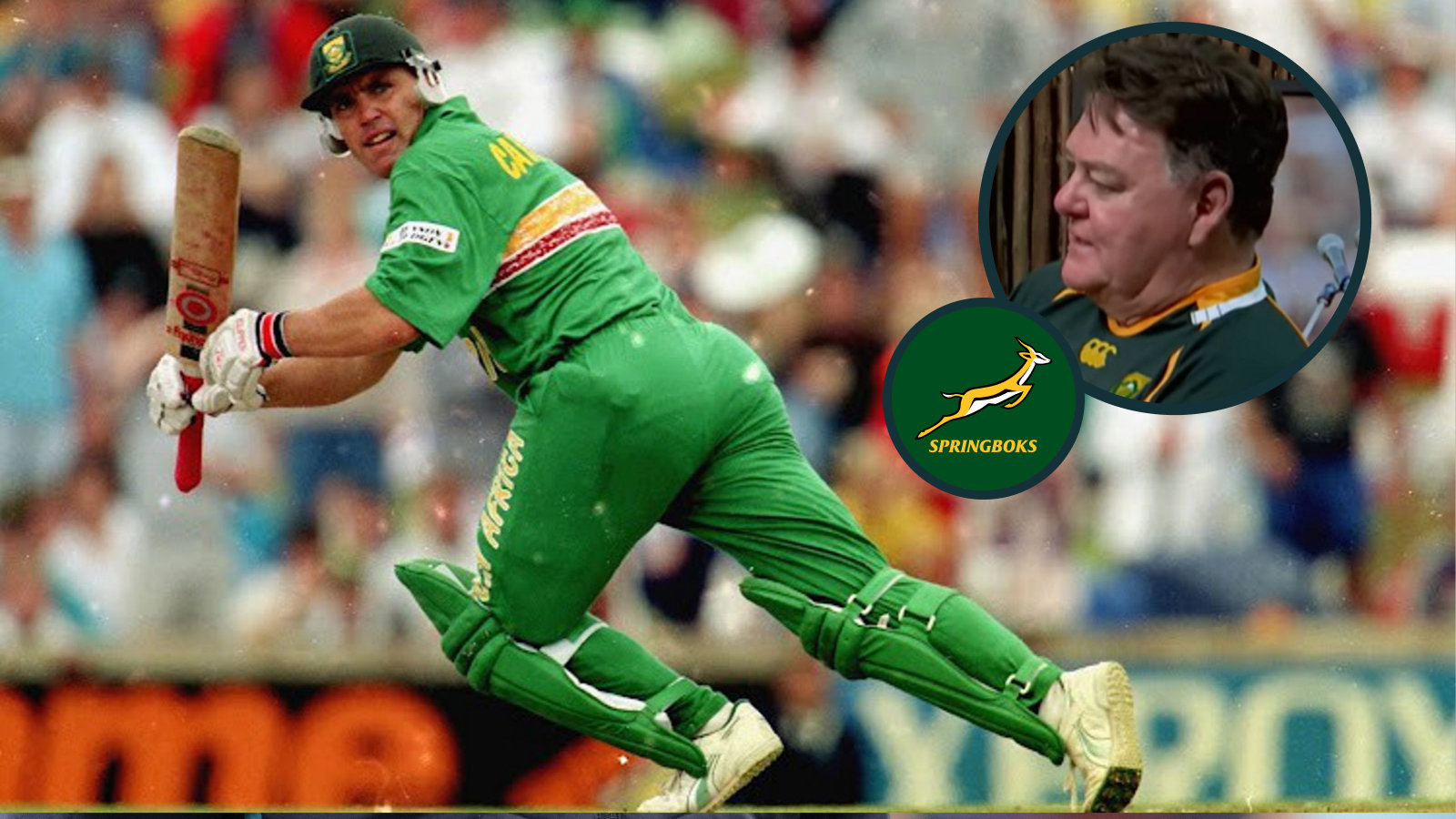
Planet Rugby features writer James While spoke to former South Africa international cricketer Dave Callaghan about playing rugby at club and provincial level alongside legendary Springboks centre Danie Gerber.
Port Elizabeth, mid-1980s. The isolation era. Eastern Province, cut off from the world, producing players the rest of rugby never got to see.
Dave Callaghan was one of them, good enough to play both rugby and cricket at provincial level simultaneously, good enough in both codes to represent his country.
29 One Day International caps for the Proteas, 493 runs at an average of 25.95, a bowling return of 10 wickets, and a List A career spanning 216 matches that produced 5,304 runs and 147 wickets.
In first-class cricket he made 7,730 runs at 36.12 with 18 centuries, and took 126 wickets at 29.07. A rugby talent that those who played alongside him in Eastern Province will tell you was of the same international calibre.
He was posted during national service as a sports coach, developing Black rugby and cricket players in the townships. Danie Gerber was working for the Department of Sport across the same patch of ground. Two men, one province, a friendship that would last a lifetime.
The story of how Callaghan ended up playing centre alongside Gerber at Despatch Club is pure South Africa.
“I was one of the few English guys that decided to go and play for Despatch,” he revealed. “And Danie came to me when I was coming to the end of my national service and said, ‘Soutie, where are you going to play next year?’ I said I was going to play for Crusaders, the English club at St George’s. And he said, ‘Soutie, as jy daar speel, sal ek jou moer!’ If you play there, I will sort you out.
‘It was probably the best move I ever made’
“I thought long and hard, which was about two seconds, and then decided to go and play for Despatch. It was probably the best move I ever made.”
It was the year that made him. Rugby and cricket for Eastern Province. Training alongside a player who was operating in a different dimension to everyone around him.
Callaghan is 61 now, and he still speaks about those sessions on the hills of Port Elizabeth with something close to reverence.
“Danie was before his time. In those days it was a so-called amateur sport, so practice was every afternoon, guys went to work and then arrived and had practice. Danie wasn’t like that.
“He used to say to me, ‘Soutie, how many sit-ups did you do today?’ And he’d say, ‘I did about 500 this morning before I got to work.’ There’s a very steep hill near Second Avenue. A grass patch, probably 150 metres up to the top. We used to do wind sprints up and down that hill at lunch, then go to Newton Park swimming baths and cool down, then go back to work.
“I didn’t know any other EP centre or player that trained as hard as he did. You sit and watch a guy like that, or you join him, and you realise that to get somewhere you’re going to have to do that extra mile.”
Danie Gerber may be the greatest rugby player the watching world never got to judge for itself. That is not hyperbole. That is the specific and irreversible consequence of politics colliding with genius.
Bill McLaren called him the finest centre the game had ever seen. Martin Johnson placed him in his International Rugby Hall of Fame XV. Ray Mordt, his Springboks teammate, said he was the most dangerous player in the world from broken play.
24 Tests in 12 years, in a country that spent the bulk of that period locked out of international sport. The verdicts are not those of sentiment. They are the assessments of people who understood exactly what they were watching.
Ask Callaghan what it felt like to stand outside him on a Tuesday evening in the Eastern Cape, in front of a few hundred people on a ground the world was banned from watching, and he goes quiet for a moment before he answers.
“I used to watch Guscott and think that was almost a mirror of Danie, similar size, similar sort of player. Guscott was very close. Not as good as Danie, though. Not quite.”
He gives you four things when you ask what made Gerber exceptional. Speed and balance. Strength. Vision. It is the second quality he returns to.
“He was so balanced as a runner that you couldn’t tell if he was going to sidestep left or right. There was no predominance one way or the other. He would sway left and go right, sway right and go left. Completely balanced.
“And then his vision, that was something second to none. He would look up and determine exactly where the weak spots in the defence were, and that’s where he would go. I’ve spoken to a lot of people about how Danie would have performed in today’s game with the defensive patterns they use now.
“He might not have broken the line as many times. From loose play, I promise you, he would gather the ball, look up and find the gaps. He had the vision and the athleticism. That doesn’t go away whatever era you’re in.”
In the centre channel at Despatch the arrangement was straightforward across the field, left and right centres rather than inside and outside. On attack it was a different matter.
‘Stay with me tonight and I’ll make you a star’
“On attack, Danie would generally come inside because he was stronger and he used to create the gaps. Across the field we just played left and right. He used to say to me on the field, ‘Soutie, bly by my vanaand en ek sal jou ‘n ster maak’ — stay with me tonight and I’ll make you a star.
“He could select exactly where he was going to go. Break the half gap, offload, and if we didn’t do that we had a massive winger with a right-hand fend who used to take two or three men and offload back inside.”
The side Callaghan was part of at Despatch was no ordinary club team. Around 12 or 13 of the squad held Eastern Province places at any given time.
Pote and Sieg Human, Dirk Naude, Lindsay Lake, the wings Kalie Grobler and Nicky White. Their scrum-half, Mynhardt le Roux, was built like a loose forward and played like one too, a physical presence around the base that Callaghan draws a direct line to the way Dewi Morris operated for England in the mid-90s.
They went to club champs in Durban multiple times and were formidable. The context matters because it explains why a year at Despatch was worth more than most careers, and why Danie Gerber at the centre of it was the education of a lifetime.
The discipline at Despatch was absolute. Meneer Jan Hurter was a headmaster, the first team rugby coach at the local high school, and a preacher. He was, Callaghan says, the only man in Eastern Province rugby that Danie Gerber addressed as Meneer. Everyone else went by their first name. Callaghan found out what that discipline meant in his first week.
“I bought everybody a beer after practice, like we do in cricket. Meneer Jan Hurter walked through and saw it. The next day at practice he said, ‘Men, what I saw yesterday is not what I want to see at Despatch. Rugby guys having a beer after practice. All of you run around the field ten times.’
Then he looked at me. ‘You, Soutie, you see that boulder over there? Pick it up.’ I went across and picked the smallest one I could find and came back with a little smile.
He said, ‘Follow them with that stone above your head.’ By the fifth lap it was on my neck and I was bleeding. He called me over. ‘Soutie, there are no shortcuts to success here.’ Those are the small disciplines that stayed with me. And I mean stayed with me.”
That last sentence carries more weight than it might first appear. In September 1991, aged 26 and at the peak of his powers, Callaghan was diagnosed with testicular cancer.
Surgery removed one testicle and affected lymph nodes from his neck and chest. Extended chemotherapy followed. Six months away from competitive sport, facing something that had nothing to do with sidesteps or wind sprints or hitting a cricket ball through the covers. He is clear, looking back, about where the resources came from.
“Definitely those years alongside Danie, and what Meneer Jan Hurter taught us. You realise it’s going to take more effort than anything else. You know there are no shortcuts. The bigger lesson was that when you’ve played rugby against the hard men, in tough conditions, and then you go through a difficulty in your life, you’re hardened.
“I can’t recall ever being scared facing any fast bowler after playing rugby. When I was going through the treatment, I went back to those days. The hill in Second Avenue. The boulder around the field. The 500 sit-ups before breakfast.
“You find out that you have more in you than you think. Playing alongside a man like Danie Gerber showed me that. Meneer Jan Hurter proved it. Those years gave me what I needed to get through.”
His first match back for Eastern Province at St George’s, he made 60-odd against Transvaal. He still gets gooseflesh thinking about it. Three years later, at Centurion against New Zealand in the Mandela Trophy, he scored 169 not out off 143 balls, took 3 for 32 with the ball in the same match and ran out Martin Crowe. Man of the Match.
The innings remains the highest individual ODI score by a batsman with only one fifty-plus knock in their entire career. His Instagram handle is @callaghan169. He does not need to explain why.
Danie Gerber played 24 Tests in 12 years. Callaghan has thought deeply about what that cost him, and speaks about it with a directness that makes the loss feel entirely concrete.
‘One of the world’s best at any time in the game’s history’
“He was not just a very good player. He was one of the world’s best, genuinely one of the world’s best at any time in the history of the game. When I look at what the world’s best players earn now, when I think about what Danie could have had, it would have been a complete game changer for him. Recognition is one thing and I do think it helps him that people still talk about him the way they do.
“He deserves every bit of that. What makes it hard is that recognition doesn’t pay the bills. A man of that talent, of that dedication, of those 500 sit-ups before the working day began, deserved the stage the game never gave him.
“24 Tests in 12 years. It’s criminal when you think about it. Criminal.”
Want more from Planet Rugby? Add us as a preferred source on Google to your favourites list for world-class coverage you can trust.
There is a generation of South African rugby players who gave their best years to a cause the world was not watching, who trained as hard as anyone in the game and performed on grounds that history has largely forgotten.
Gerber is the most gifted of them, though he is not alone in that story. Callaghan knows it from both sides, the international cricketer who carried Springbok-calibre rugby ability in an era when South Africa could not be seen, who lost years to isolation and then lost more to cancer, and came back to score 169 not out in front of a full house at Centurion.
The resilience is the same. The source of it is the same too. It came from a hill in Second Avenue, from Meneer Jan Hurter’s boulder, from a centre who did 500 sit-ups before breakfast and still found time to drag a Soutie through wind sprints at lunch.
When asked, at the end of a long conversation spanning forty years of shared history, whether he would choose Test rugby or Test cricket given the chance to do it all again, Callaghan laughed.
“Rugby was always something I wanted to do and enjoyed doing. Cricket was always something I loved. Rugby prepared me for everything else. Everything.”
Bly by my vanaand en ek sal jou ‘n ster maak.