
 Play Brightcove video
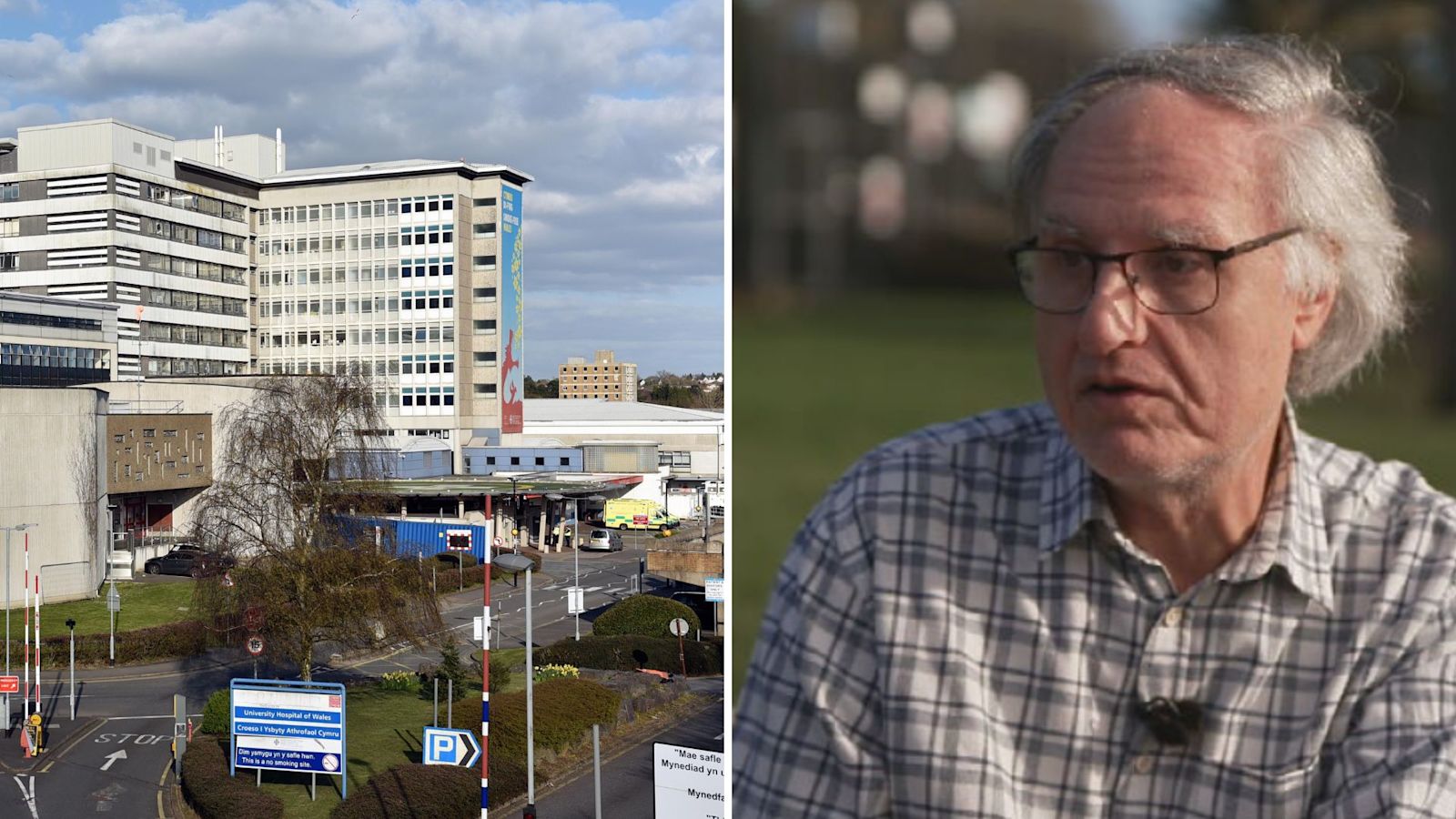
A leading consultant at Wales’ biggest hospital has said the current building is “not fit for purpose” and that staff are “fighting the infrastructure” to provide quality care for patients.
Professor Argiris Asderakis is a transplant consultant who has worked at the University Hospital of Wales in Cardiff for 25 years. He is highly skilled and treats some of Wales’ sickest patients.
Now, as chair of the British Medical Association’s local negotiating committee and a member of the Welsh consultants committee, he is speaking out about a structure that he says “is not made for modern hospitals”.
He describes seeing sewage leaks in various parts of the hospital more than once in the last year, toilets out of order, lifts breaking down and air conditioning and ventilation failing.
He claimed these ventilation problems caused theatres to be closed and forced operations to be delayed or cancelled. He said on one occasion a leak resulted in a vascular radiology suite being shut down for three weeks.
Professor Argiris Asderakis has worked at the University Hospital of Wales 25-years and says it is no longer fit for purpose
“It’s everyday problems, some of them may seem trivial but some of them are much more serious,” he said.
“This is a place where important operations are done like [for] aneurysms, which are life-threatening, where important diagnostic tests take place, and these tests didn’t happen.
“It’s not about a floor that leaks, it’s about how patients suffer.
“We had two days where three of the theatres had ventilation problems. They were sorted out within the hour because our estates team work really hard but that was an hour lost of theatres – for three days, for two or three different theatres.
“That means nine hours of work – a full day work for one theatre. Some patients were postponed that day as a result of that.
Professor Asderakis says that maintenance issues such as leaks or ventilation problems are near every day issues at UHW
“Nurses had to stay late that day so couldn’t be on shift the next day. That has a knock-on effect. You need a well-working system for a modern hospital to work and this is not conducive to that.
“We all try to mitigate for those circumstances. Our estates team are brilliant they try and do things – they provide miracles there – with an infrastructure which is not fit for purpose for the 20th century not to mention the 21st century.”
Figures published by NHS Wales Shared Services Partnership show that for the year 2024 – 2025 it would cost more than £1.4bn to fix the backlog maintenance costs across Wales’ NHS estate.
Of this, over two thirds of maintenance issues are considered “high” or “significant” risks.
The University Hospital of Wales (UHW) falls under Cardiff and Vale University Health Board. The cost of fixing growing maintenance problems across its sites is estimated at more than £111m. More than £41m of these are considered high risk maintenance issues.
Latest figures show that it would cost over £1bn to fix the backlog maintenance issues across the whole of the NHS Wales Estate
Construction of the UHW started in 1966 before being opened in 1971. While some parts of the current hospital have been updated since then, a vast majority of the main building still dates back over five decades.
There has been talk of replacing the hospital since before the Covid pandemic and health board bosses have previously said the site is “no longer fit for purpose”.
As part of their infrastructure plan in 2022-23 their report stated: “The timely replacement of UHW is absolutely critical to support our long-term strategy – the existing infrastructure is failing and much of the current hospital accommodation and departments are no longer fit for purpose in terms of functional layout, environmental suitability or physical condition.
“This results in poor patient experience, demotivated workforce and inefficiency in terms of service delivery, facilities costs and maintenance overheads.”
Professor Asderakis says that maintenance issues at the hospital are increasinly impacting patient care
But while Labour have pledged to rebuild the hospital if they win the Senedd Election in May, the Welsh Government have admitted plans are in their infancy.
Professor Asderakis said the structure is “at the end of its life cycle” and that a new hospital is badly needed.
He added: “It’s an alien structure, it’s a strange structure, it’s something that used to be called the nuclear structure which means it is something that is not made for modern hospitals. You cannot modify it. You cannot expand it easily and the assumption it was built on is well, well outdated now.
“The core building is beyond maintenance now. We need to have the infrastructure to do our job and give the best for our patients.”
He said that repairing the maintenance issues at the hospital is also essential in keeping medical staff working in Wales.
“[Patients] see a small part of the picture, we see the whole picture and it is quite demoralising,” he said.
“It’s particularly demoralising for younger doctors who think that this is normal, and it is not.
“We can see more and more colleagues leaving Wales, leaving the UK, because of infrastructure.
The Welsh Government says early plans are in place to replace UHW
“It’s not only about salaries – the things you hear in the news – you are put off if you work in a hospital that is not fit for purpose.
“If you cannot park, if you cannot do your work properly with modern IT equipment, if you cannot operate with modern lights, you say what exactly is the purpose – am I going to perform my best here?
“It’s an addressable situation if we plan for it. We all know money is tight but a plan is required.
“Every five years you delay the build of a new hospital it costs you probably twice as much.”
The Welsh Government said that it is more than half a billion pounds this year to “modernise and safeguard” the NHS estate and that “early planning is underway for the replacement of University Hospital of Wales”.
Patients have told ITV Cymru Wales of seeing leaks, ventilation issues and disrepair at the hospital
In a full statement they said: “The Welsh Government is investing over £500 million this year to modernise and safeguard the NHS estate. This investment includes upgrading critical infrastructure, replacing essential equipment, enhancing digital systems to support new ways of working, and backing major regional diagnostic and surgical hubs. Our commitment is clear: safe, modern, digitally‑enabled facilities for patients and staff across Wales.
“Welsh Government is making significant, targeted investments to modernise and safeguard the NHS estate across Wales.
“Over £500 million has been allocated this year to improve hospital buildings, replace essential equipment, modernise digital infrastructure, and support service transformation. This includes circa £100m in 2025-26 in discretionary capital, plus £40 million of focused investment to strengthen critical infrastructure, infection prevention, and fire safety.
“To improve access and reduce waiting times, Welsh Government is also backing major regional centres of excellence. The £29 million North Wales Surgical Centre will open shortly, and construction is underway on the over £100 million Llantrisant Health Park Phase 1 – a new regional diagnostic hub.
“It is recognised that several hospitals will require substantial redevelopment or full replacement in the coming years. Early planning is underway for the replacement of University Hospital of Wales, a new hospital for West Wales, and redevelopment work at Wrexham Maelor Hospital. These major schemes will be for the next Government to take forward and will require additional sources of capital beyond the current programme.
“This investment reflects Welsh Government’s commitment to ensuring safe, modern, high‑quality NHS facilities for patients and staff across Wales.”
Addressing the maintenance backlog with the health board itself, a spokesperson for Cardiff and Vale University Health Board said: “We recognise the challenges associated with delivering care in older healthcare environments, particularly at the University Hospital of Wales, and take the condition of the estate extremely seriously.
“Patient and colleague safety remains central to all activity. Services continue to operate with established and robust arrangements to manage and monitor risk, while acknowledging the experience of those delivering and receiving care within facilities that present complex and long-standing challenges.
“The Health Board is taking a structured and proactive approach to maintaining and improving the estate, with clear oversight of priorities and focus on areas of greatest need. This includes actions to support safe and effective care alongside longer-term planning to ensure facilities are resilient and fit for the future.
“Work is continuing in close partnership with Welsh Government to support ongoing improvement and investment, alongside a continued commitment to delivering high-quality care while strengthening the environment in which that care is provided.”
Reporting History sees journalists join News At Ten anchor Tom Bradby to revisit their remarkable on-the-day reports of the defining events of the modern age. Listen to the episodes below…