
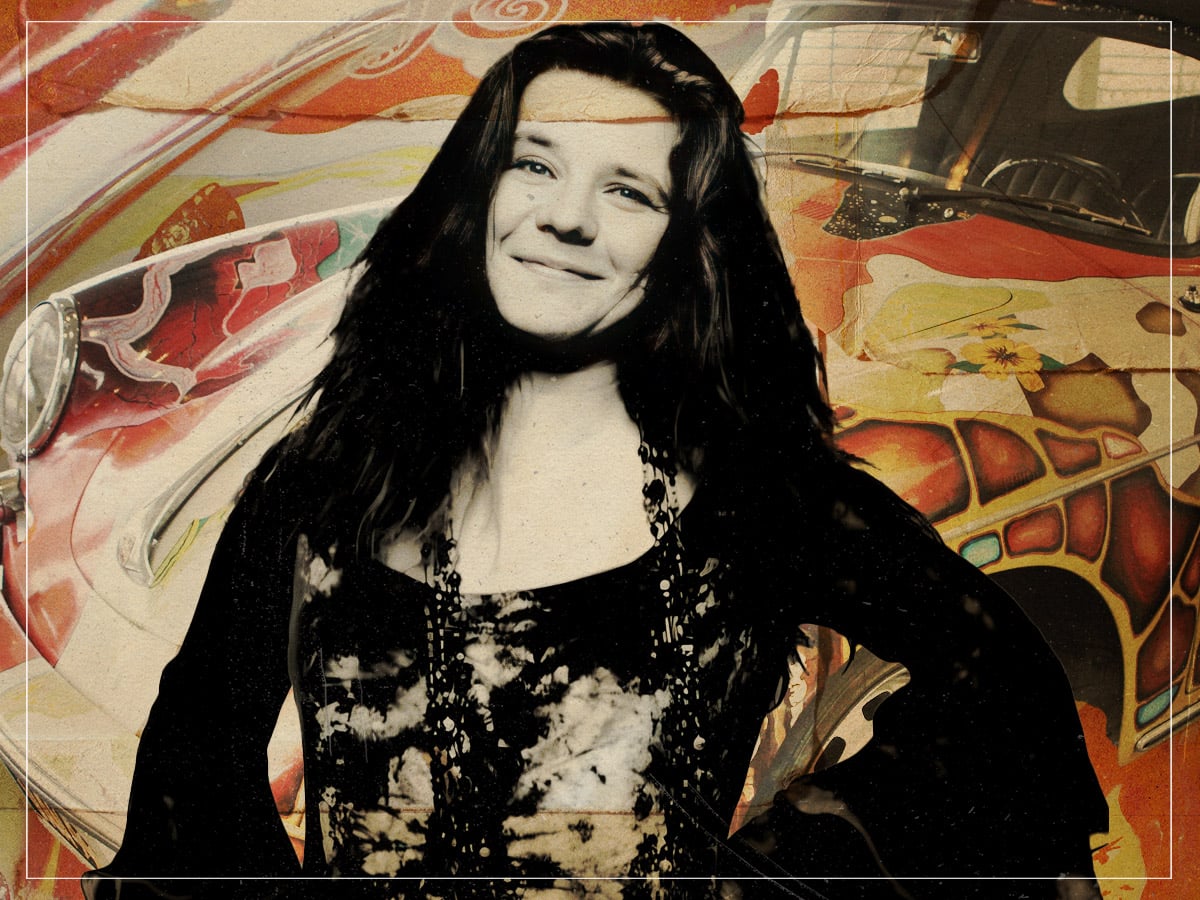
(Credits: Far Out / Grossman Glotzer Management Corporation / Sam Howzit)
Thu 19 March 2026 21:15, UK
As with any rock and pop icon who dies young, an enduring cultural fascination surrounds the short yet seismic life of Janis Joplin.
It’s an unfortunate tendency of music lore to elevate an artist’s tragic end to a realm of romanticised, frozen youth, often filtering out the complex circumstances and messy humanity that brought such promising lives to an end. Be it Ian Curtis or Kurt Cobain, their sad ends hopelessly fuel a mythos that can supplant the person to a poster idyll serving whatever fictions some hardcore fans have concocted to indulge their own flawed hero worship.
Yet, it’s certainly the case that the swift domino effect of lives snuffed out around the late 1960s and early 1970s indeed marked a symbolic bookend of the counterculture. Around Joplin’s death in 1970, Brian Jones, Jimi Hendrix, and Jim Morrison all struck a blow to the world of rock, symbolic casualties to the era’s unreined hedonism and illustrated the hippie promise’s dark end.
Joplin stood right at the centre of this cultural maelstrom. First fronting Big Brother and the Holding Company and unleashing lauded performances at both the Monterey Pop Festival and Woodstock, the Texan mezzo-soprano bellower was gifted with one of the most powerful sets of lungs ever witnessed in popular music, able to wield her stunning vocals between passionate howl and aching whimper with gripping, natural command.
Alongside her musical gifts was an insatiable appetite for drugs. Coupled with her well-known reputation for drinking Southern Comfort whiskey like a fish, Joplin was well acquainted with the chemical indulgences on offer among the emerging countercultural underground as early as 1963. Heroin, speed and psychoactives were no strangers to Joplin in her early 20s, prompting a brief detox respite at her Port Arthur family home after losing dangerous levels of weight from injecting methamphetamine.
The temptations proved too great. After a spell at university and trying to go ‘straight’, fear of the suburban housewife dead-end brought Joplin back to rock, joining forces with San Francisco’s Big Brother and the Holding Company and triggering her West Coast explosion in earnest. She was in her element. Such a surge brought with it all the old goblins, beckoning toward partying seriously hard, however.
“I might be going too fast,” Joplin confessed to The New York Times in March 1969, just a year before her death. “That’s what a doctor said. I don’t go back to him any more. Man, I’d rather have ten years of ‘superhypermost’ than live to be 70 by sitting in some goddam chair watching TV.”
She lived by her word. Continuing her tastes right up until the night she died, Joplin was discovered on the floor of her room in Los Angeles’ Landmark Motor Hotel on October 4th, 1970, the subsequent autopsy revealing heroin and alcohol in her system. It was speculated that the smack scored was far greater in potency than was understood.
Joplin died as she lived, in it for a good time and not a long time, a chartered course no doctor or authority figure could ever hope to have pulled Joplin away from her dedicated “superhypermost” ethos.
