
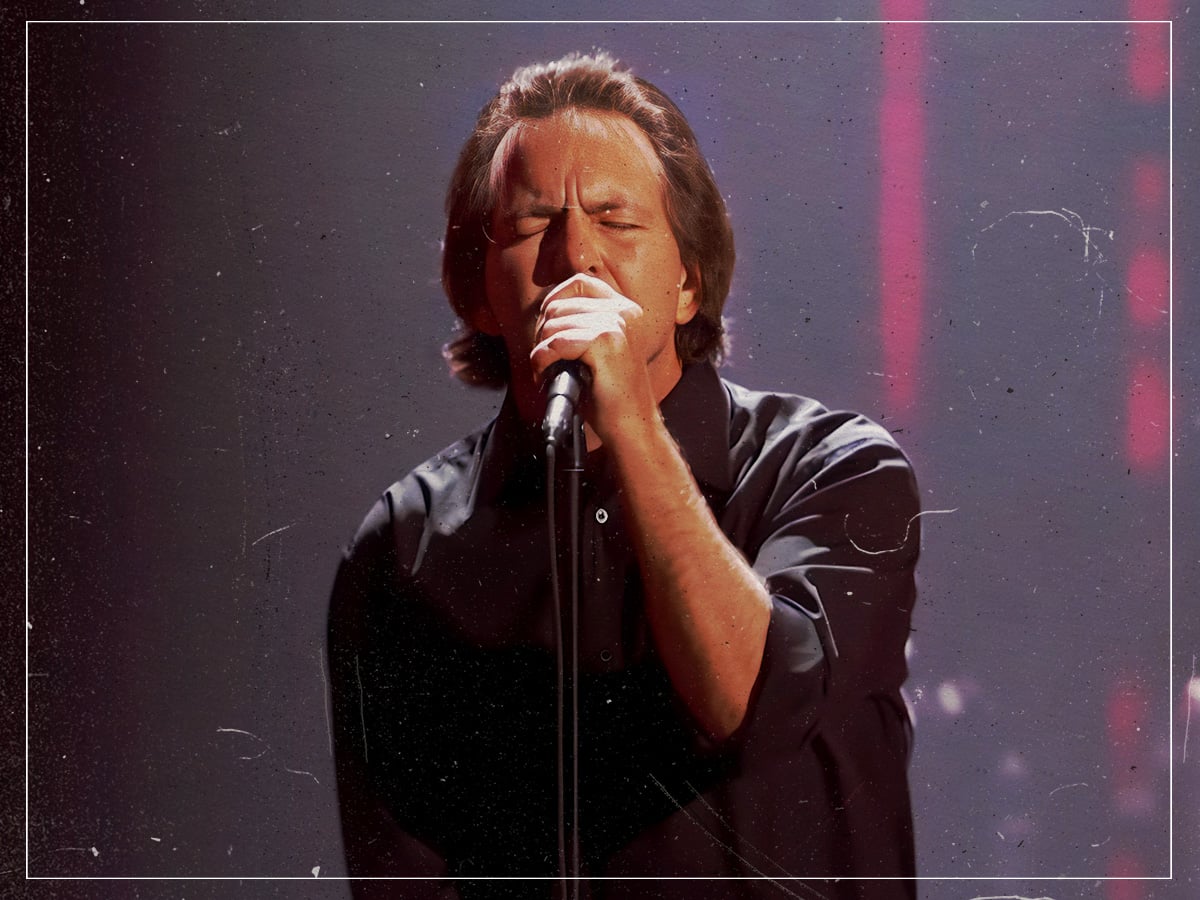
(Credits: Far Out / YouTube Still)
Fri 20 March 2026 4:00, UK
As the hedonism from the 1980s era of sex, drugs and rock ‘n’ roll was beginning to die down, grunge was the antithesis of the decade’s chaos, soundtracked by Seattle’s scene that found one of its most unique voices in Pearl Jam.
From the vocals of frontman Eddie Vedder came a reckoning with apathy, isolation and generational angst, sung with a baritone gravel. A natural storyteller, Vedder set Pearl Jam’s music to stories that resonated with a culture disaffected by the world in which they were living, offering a source of introspection. In turn, Vedder and Pearl Jam became Generation X’s potential answer to what came next, now that the days of partying and indulgence were beginning to fade out of view and, in their place, came “alternative” culture, as it was named under a wide umbrella.
Pearl Jam has since become known for their particular sense of humility, disillusioned by fame and both monetary and commercial successes and focused, as it were, on the music, before all else. Communicating with listeners across generations and providing a soundtrack to their inner thoughts took more precedence than any number of album or ticket sales – the latter in which Pearl Jam went so far as to wage a public retaliation against, directed at Ticketmaster and citing unfair ticket pricing.
Reflecting on how Pearl Jam has evolved, whether that be through pondering their relationship with their audience or considering how politics factor into their fanbase and lyricism, Vedder explained to The New York Times in 2022 that there is a constant evolution to be seen.
“I’m sure there’s been an evolution in everything we do,” he said. “It used to be youth against establishment and chaining yourself to old-growth trees and seeing how that played out. Then it evolves to how do we actually get things done? Because it seemed like rattling the cages was simply that… but at some point it was like, What do we want to achieve?”
 (Credits: Far Out / YouTube Still)
That central question of “achievement” has factored into everything that Pearl Jam has done since their inception in 1990. Forming from the remnants of proto-Seattle bands Green River and Mother Love Bone, Pearl Jam formed as the city’s sound was continuing to take shape, creating the signature that we recognise today: a punk-metal hybrid with a penchant for angered sensitivity in its lyrics. For Vedder, the culture that was brewing was a necessary change from the years gone by, both in terms of the music and the slow-but-certain societal shift.
“You know, I used to work in San Diego loading gear at a club,” he recalled. “I’d end up being at shows that I wouldn’t have chosen to go to – bands that monopolised late-80s MTV. The metal bands that – I’m trying to be nice – I despised. ‘Girls, Girls, Girls’ and Mötley Crüe: [Fuck] you. I hated it.”
Vedder expanded on the dual negative effects on the era’s music culture, and its emphasis on lyrics that blatantly centred on the objectification of women and a careless party-driven mentality. “I hated how it made the fellas look. I hated how it made the women look. It felt so vacuous,” Vedder asserted. “Guns N’ Roses came out and, thank God, at least had some teeth.”
Seattle, in Vedder’s eyes, was altogether different. “But I’m circling back to say that one thing that I appreciated was that in Seattle and the alternative crowd,” he noted, “the girls could wear their combat boots and sweaters, and their hair looked like Cat Power’s and not Heather Locklear’s – nothing against her.”
“They weren’t selling themselves short,” he emphasised. “They could have an opinion and be respected. I think that’s a change that lasted. It sounds so trite, but before then, it was bustiers. The only person who wore a bustier in the ‘90s that I could appreciate was Perry Farrell.”
His humorous nod to Farrell’s one-time stage uniform aside, Vedder’s sentiments regarding how women were rightfully given the space to reclaim their power in the wake of the grunge era stand true. Even while there was still plenty of work to be done – and there continues to be so – grunge saw the beginnings of a feminist reckoning, removed from the superficial portrayal of women in the decade prior.
