
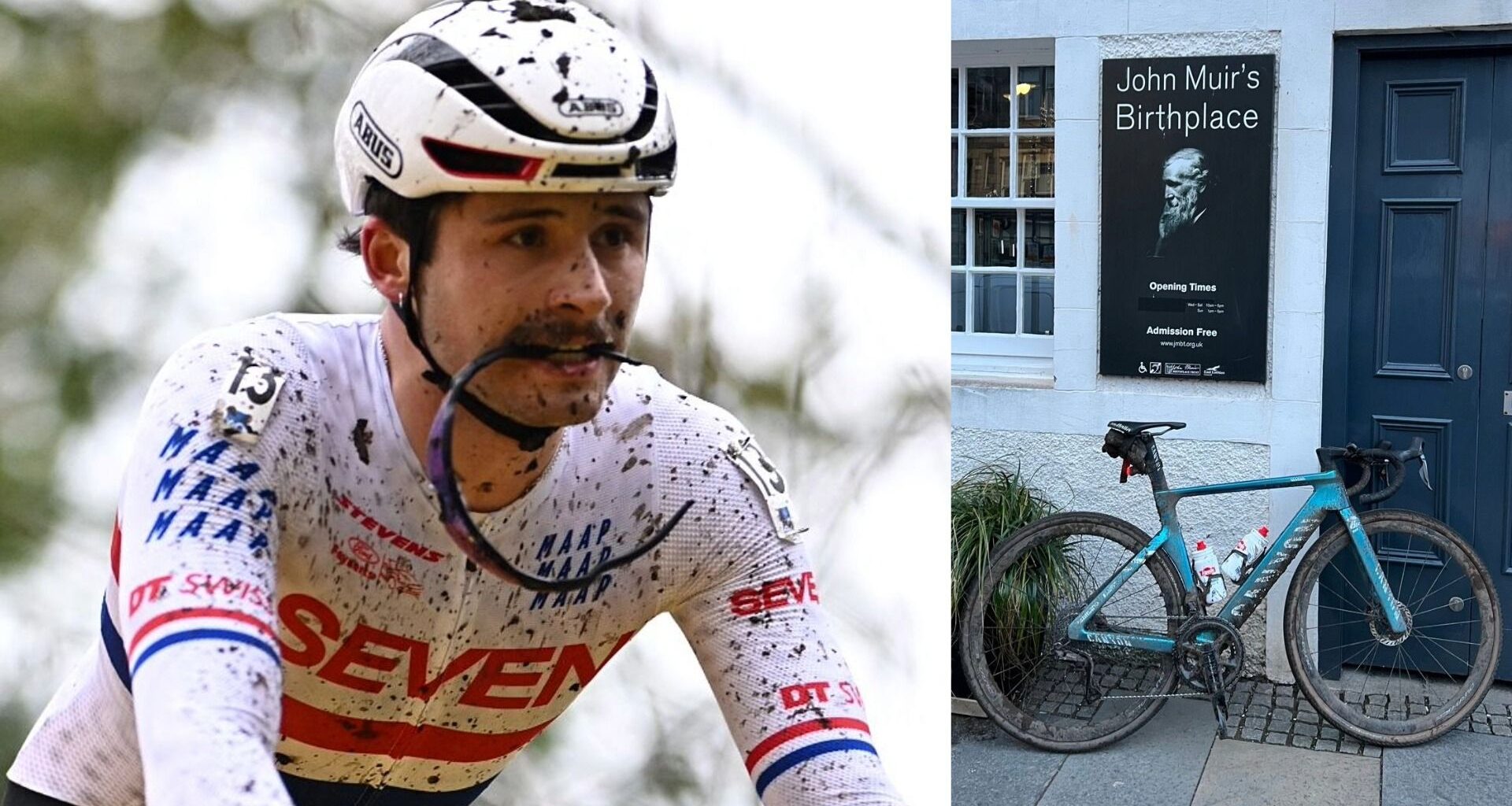
Pro racers don’t usually bother going after Fastest Known Times on bikepacking routes for the thrill of it, but Cameron Mason is no ordinary pro, and his set-up for his assault on the John Muir Way was even less conventional. Sat aboard an aero road bike, stuffed with tyres 6mm over the official clearance, the Scottish rider blitzed the 212-kilometre multi-terrain route in under eight hours last week, adding to the never-more-relevant debate over what bike is the right tool for the job at hand.
Mason, who races cyclocross for Seven Cycling and road for the Alpecin-Premier Tech Development team, was at a bit of a loose end earlier this month after capping his ‘cross season with third overall in the X2O Trofée series.
“I just was like, ‘I need to scratch that itch of just doing a bit of a mission’,” he tells Cyclingnews. “I’ve known about the John Muir Way for years. My childhood family home is on the route, and actually now my own home in Edinburgh is also on the route, so it goes through two very important places to me.”
Article continues below
You may like
The John Muir Way measures 212 kilometres from coast-to-coast in Scotland, starting in Helensburgh in the west and ending up in Dunbar in the east, featuring “a mixture of forest tracks, singletrack, canal towpaths, walking paths, cycling paths, landrover tracks and sections on roads”, according to the Bikepacking Scotland website.
After going out to recon the parts of the course he didn’t know so well, all that was left to do was wait for the trails to dry out and wait for a favourable westerly wind. “A few of these things came together to actually do the route and the I woke up one morning and got the train through to Helensburgh, and then just cracked on,” Mason says.
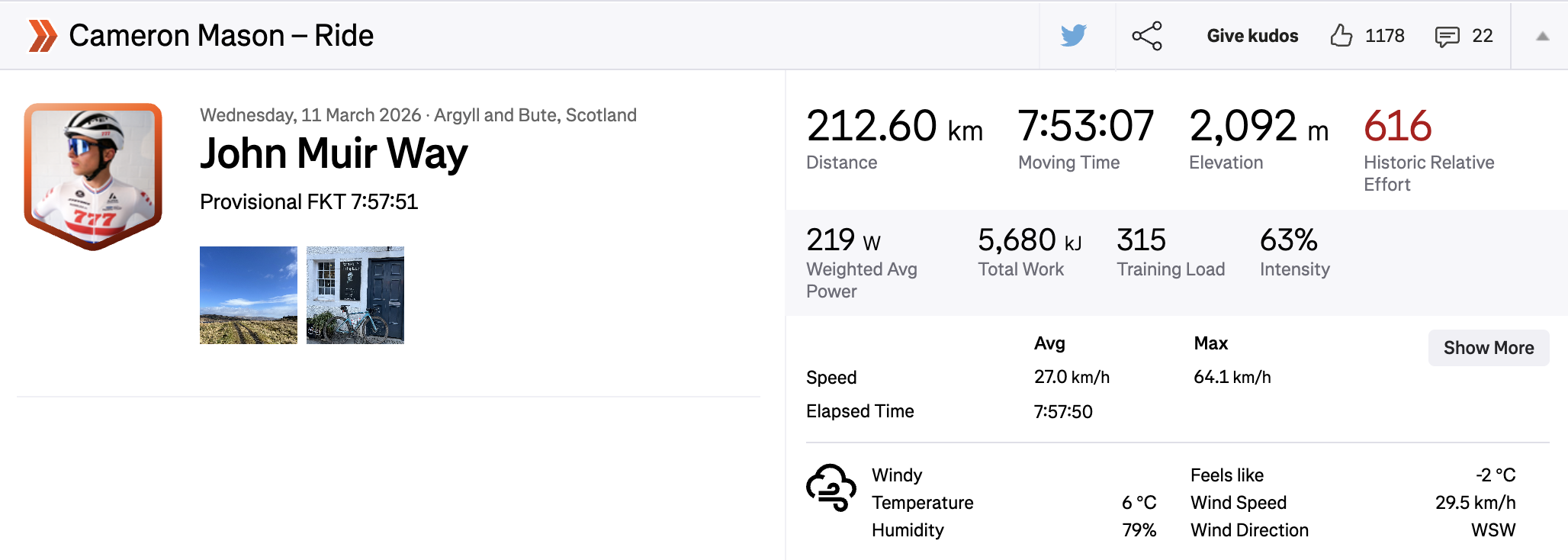
A screenshot from Mason’s Strava upload shows the stats (Image credit: Strava / Cameron Mason)Aero bike, road gearing, and squeezing in 38mm
The wind needed to be blowing at Mason’s back if he was to stand any chance of bettering John Mackenzie’s FKT of 8h 19m 42s – not to mention the second-best time of 9h 01m 20s held by Cyclingnews’ very own Graham Cottingham. But the dry conditions were especially important given his bike set-up.
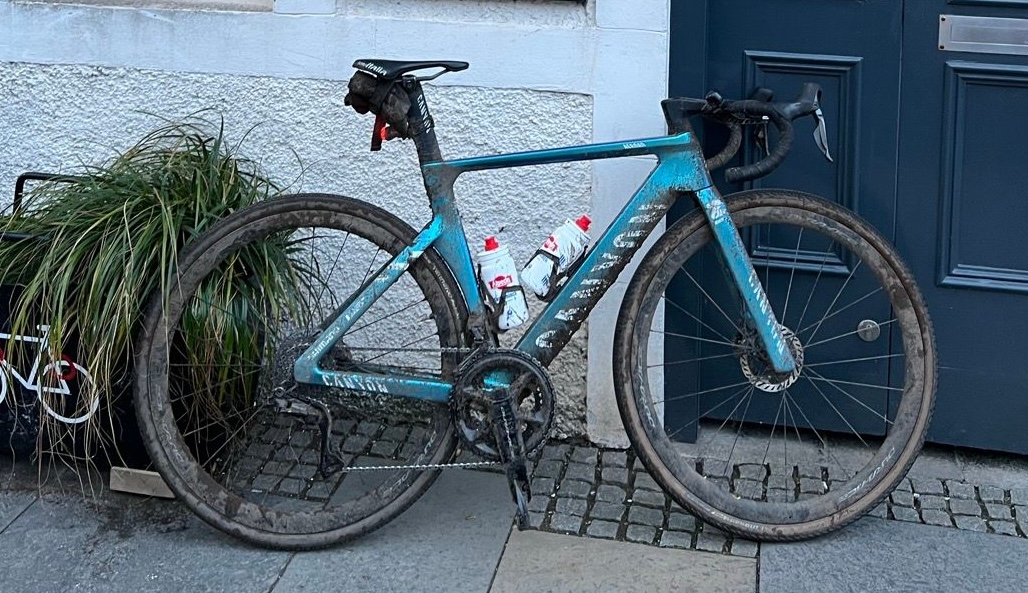
Remarkably, Mason completed the ride on a Canyon Aeroad, the German brand’s all-out wind-cheating road racing frame that has won the past three editions of Milan-San Remo.
“Normally, I would have done it on a gravel bike, I just didn’t have one from the team yet, because we’ve not had delivery of the new Stevens Camino, which is what I’d normally do something like this on. I knew the new Aeroad does take quite wide tires so I was like, ‘right, I’ll see what I can fit into it’.”
Cameron Mason’s Canyon Aeroad for his John Muir Way ride (Image credit: Strava / Cameron Mason)
In the end, despite an official tyre clearance of 32mm, Mason managed to comfortably fit in a 38mm gravel tyre on the front, along with a 33mm cyclocross tyre at the rear.
“The front tyre didn’t come up quite as wide as 38 because of the Dura-Ace rims I was on, so it fitted ok, but I needed it to be dry because I didn’t have room to be dragging mud up through the frame,” he explained.
What to read next
“The only thing I had to do was put a bit of electrical tape on the front derailleur Di2 cable, just to keep it flush so it wouldn’t rub on the tyre, and that was just a little mod beforehand. Everything else was totally stock and standard. Toe overlap was obviously worse, and that’s something you have to be careful of – you can’t turn very sharply. Apart from that, it was really sweet.”
The John Muir Way section of the FastestKnownTimes website says ‘a gravel bike is typically the fastest steed of choice with a MTB offering more comfort over the rougher terrain’. However, Mason went full aero frame and road gearing – 54-39 chainrings, 11-34 cassette – and even road pedals.
“Out of all of those kind of routes in Scotland, this is probably the only one that you could do with a kind of road set-up,” he said. “It’s not too hilly and there’s plenty of tarmac and plenty of smoother off-road sections. It was a nice challenge, and it felt like the set-up was a good balance.”
Mason’s ride may attract further debate over what he describes as ‘that age old question’ over what kind of bike is actually the right tool for the job, in an industry where gravel bikes have made a major market position of the space between road and mountain bikes.
“I feel like a lot of people go, ‘all right, I want a gravel bike and I want to ride gravel’. And then, in actual fact, the gravel they have available to them is like bridleways, canal paths and farm tracks. And that is so different from doing big mountain passes or gravel forestry,” Mason argues.
“Where I grew up, in West Lothian, the best gravel bike was always a cyclocross bike, because it would kind of fit that brief the best. It’s that age old question, and I still do recommend to people that they just buy a cyclocross bike if they want to buy a bike, because it still does the same job as it did 10 or 20 years ago, and there’s a reason why they were so popular.”
Not an FKT after all, but a rider bigger than himself
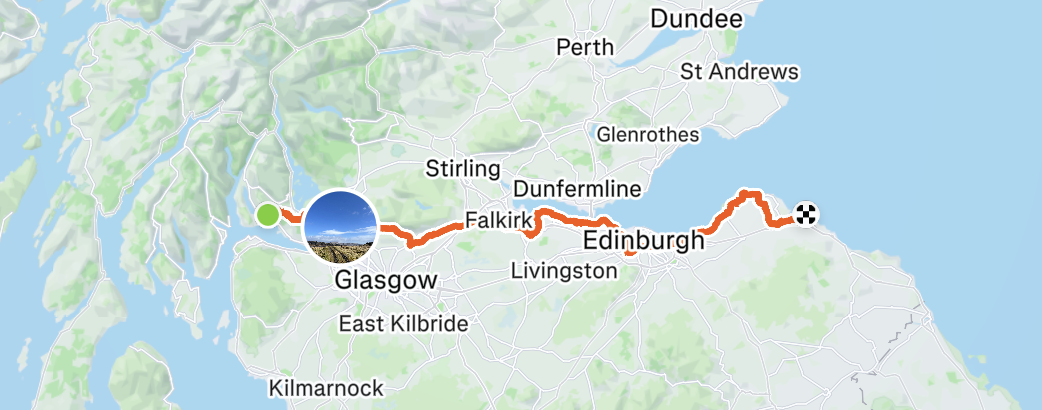
The map of Mason’s ride (Image credit: Strava / Cameron Mason)
In the end, Mason’s time of 7h 57m 51s, though over 20 minutes faster than Mackenzie’s 2023 benchmark, will not go down as an official FKT, given he planted bottles in hedges around Edinburgh the day before to pick up for feeds on the day. The FastestKnownTimes website, run by Dotwatcher, is as close to a governing body for this sort of thing as you’ll get, and their rules forbid ‘gear stashes’ as part of “the spirit of self-sufficiency and equal opportunity”.
Mason wasn’t aware of this section of the rule at the time – in fact it was only pointed out to him when we were editing this interview – but he took it gracefully and was more than happy to only have an unofficial FKT – “the ones who know will know, and the ones who wish it was pure can also wish such.”
Besides, there was rather more to the whole endeavour than the stats and the leaderboards.
“It was really good fun and it definitely like scratched an itch of doing something self powered and self planned – I think there’s something to be said for that,” Mason explained.
“And I do like that anyone can go on Strava, see what I’ve done, and then recreate it in their own way, under their own steam. They don’t even have to do the full route, or they don’t even have to do that same route – just the idea that these things are already out there for free, technically, to go and do. That’s really, really nice.
“I can use my physical ability to shoot for an FKT or whatever, but if it has the byproduct of maybe getting someone out just to go and ride their local bit of the route, or to go and get the train somewhere and ride home… I find that really, really motivating – probably more motivating than actually going fast. I think that’s important to say.”