
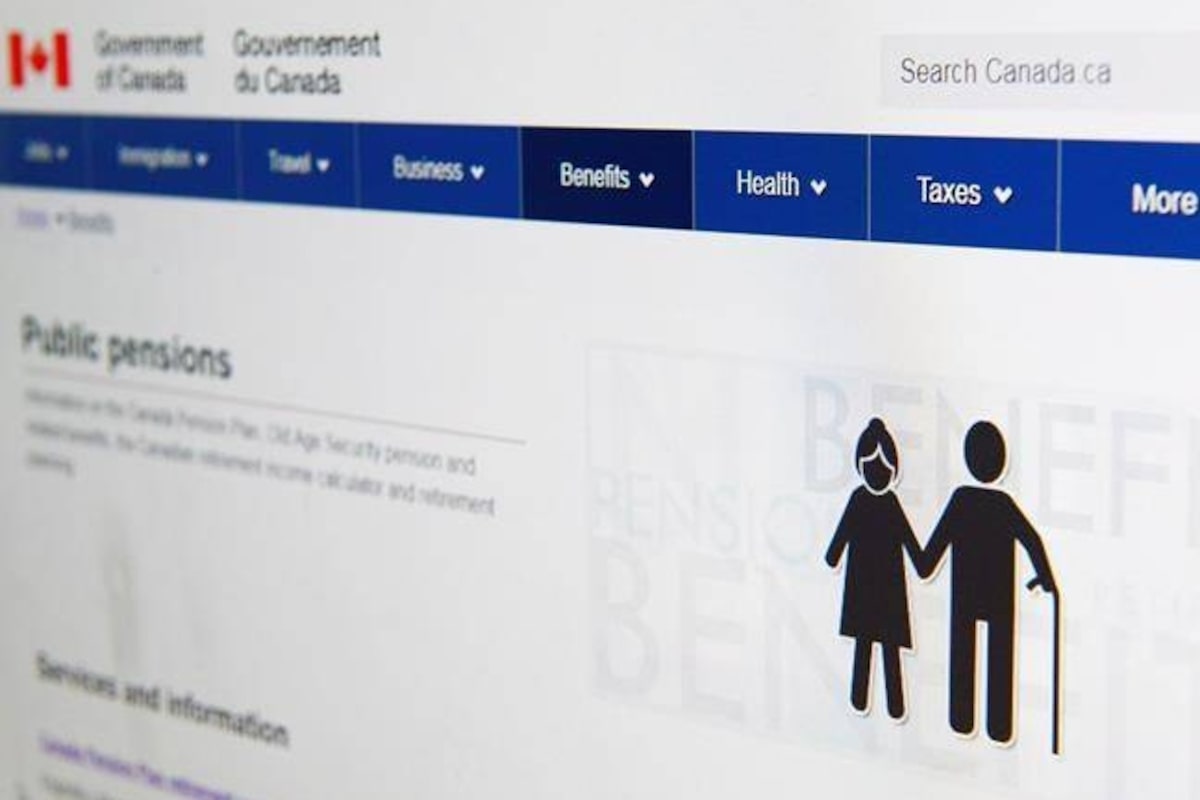
Currently, the income threshold for phasing out OAS benefits allows retired couples with household incomes of $185,000 to still receive the full $18,000 subsidy.The Canadian Press
Seniors are a powerful voting block, one that many commentators believe helped the Carney Liberals win the last election.
For that reason, some politicians are reluctant to change Canada’s most expensive cash subsidy program, Old Age Security, even as its costs are growing much faster than other federal expenditures.
But new national polling should reset how federal leaders think about OAS. Canadians are ready to reform it to deliver one of the most ambitious improvements to income security in decades – without raising taxes or increasing the deficit.
Under current rules, the income threshold for phasing out OAS benefits is so high that retired couples with household incomes of $185,000 can still receive the full $18,000 subsidy. Even when the clawback kicks in, the benefit phase-out is so gradual that couples with combined incomes of more than $300,000 still qualify to receive payments. Only 4 per cent of seniors are excluded from OAS because their incomes are too high. This generosity helps explain why OAS’s rapidly rising cost is a primary contributor to Ottawa’s $78-billion deficit.
Opinion: Boomers aren’t really hoarding wealth, but an aging population requires reforms
Polling commissioned by Generation Squeeze shows that Canadians understand the need to slow the growth of OAS spending – both to ease pressure on the federal budget and to free up funds for other national priorities. A 2024 survey conducted by Research Co. found that three-quarters of respondents supported lowering the income threshold at which OAS benefits begin be phased out for couples from the current level of roughly $185,000 down to $100,000.
Reducing the clawback threshold to that level would mean asking the top 20 per cent of OAS recipients to accept smaller benefits (on average, $3,000 less per person each year, after tax). This would free up $7-billion a year while protecting benefits for 80 per cent of OAS recipients, including seniors who live alone.
That strong support endures today. A new Research Co. poll conducted this month found that 73 per cent of Canadians support such a move if the savings are used to eliminate seniors’ poverty and reduce living costs for younger generations.
Support spans party lines, with roughly eight in 10 Liberal, Conservative and NDP voters in favour, and is consistent across regions and income groups. Notably, even among retirees who took the survey, roughly three-quarters said they supported the change. (The margin of error is plus or minus 3.1 percentage points, 19 times in 20.)
A retirees’ guide to filing your taxes in 2026
Many financially secure seniors are now speaking out publicly to bring the polling data to life. They understand that OAS was not designed to subsidize their holidays or other non-essential spending and say they are ready to take less. They agree it’s time to redefine the program’s objectives, as the federal Auditor-General recently urged.
This broad support to slow OAS spending and improve affordability comes at a critical moment, as Canada faces economic pressures at home and costs arising from geopolitical uncertainty abroad.
Six in 10 Canadians would go further, supporting a phase-out of OAS benefits beginning at or below $81,000 a year in household income, the cutoff after which the Canada Child Benefit is reduced. That lower threshold would save nearly $13-billion annually.
Support for reform doesn’t stop there. Sixty-three per cent would repurpose retirement tax breaks that do little for low-income seniors. The Age Amount and Pension Income tax credits cost about $7-billion annually to deliver up to $1,500 in yearly tax savings per person. But they exclude many of the most financially insecure seniors. A majority of survey respondents, including 69 per cent of seniors, support redirecting these funds to the OAS system to offset its rising costs driven by population aging.
Combined, these changes could free up to $20-billion a year.
That is enough to provide a further $5,000 for every low-income senior to lift them above the official poverty line, at a cost of roughly $2.5-billion annually.
Tim Cestnick: Drawing income in retirement takes proper planning for savings to last
The remaining funds – more than $17-billion – open the door to other bold, nation-building investments to improve affordability for younger generations. The money could be used to avoid planned cuts to federal spending on housing by renewing the National Housing Strategy; permanently boosting federal support for Canada Student Grants; accelerating the implementation of $10-a-day child care; introducing a youth employment supplement to help young workers get established in a difficult job market; and funding Ottawa’s recent temporary GST credit top-up for low- and moderate-income Canadians.
The potential savings are large enough to introduce some – or all – of these measures without raising tax rates, or even while reducing the deficit.
There are moments when political feasibility catches up with policy necessity. This is one of them.
Canadians have spoken – clearly and consistently. Prime Minister Mark Carney should use that support to fix and modernize the most expensive line in his budget – and deliver a once-in-a-generation improvement in affordability for young and old alike.
Dr. Paul Kershaw is a policy professor at UBC and founder of Generation Squeeze, Canada’s leading voice for generational fairness. You can follow Gen Squeeze on X, Facebook, Bluesky, and Instagram, as well as subscribe to Paul’s Hard Truths podcast.