
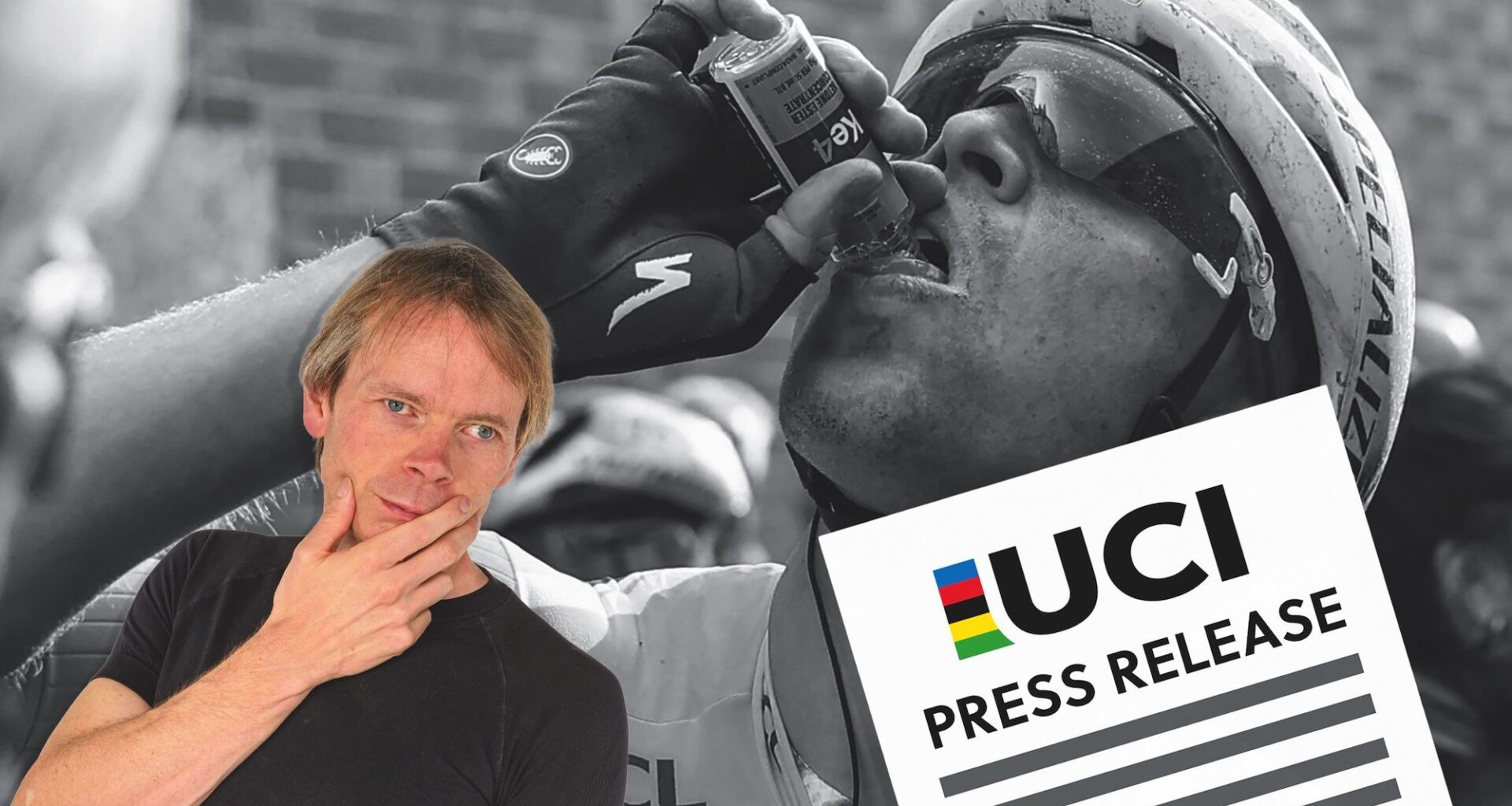
The UCI issued a press release last October that was odd even by their own standards. It was about ketones. On the off chance you haven’t been keeping up with all the latest sports biochemistry news, ketone drinks are either a supplement so incredibly effective that, left unchecked their use would destroy sport, or just a very expensive drink that tastes like a shot of anti-freeze and orange squash.
And if you think you’ve detected some sort of logical contradiction there, you’re clearly new to the supplement business.

Michael Hutchinson is a best selling author, multiple national champion and an aerodynamic consultant. His columns have been appearing in CW magazine for over 20 years
The UCI’s statement was in response to a proposed ban on ketone drinks. It found no performance enhancing effect to justify a ban. It also said: “As there is no compelling evidence that ketone supplements enhance performance or recovery, the UCI sees no reason for them to be used. Therefore, the UCI does not recommend the inclusion of such supplements in riders’ nutritional plans.”
Article continues below
You may like
It’s not really the UCI‘s business to issue vague recommendations about what riders ought to be eating or drinking. That’s more like our job at Cycling Weekly, or of that bloke in the club who paid £25 for a certificate that he thinks makes him a nutritionist. It’s more the UCI’s business to produce as clear and well-defined a set of regulations as it can manage, and in as few words as possible.
The biggest problem is that this has now been widely interpreted as creating a “grey area”, because on the one hand they don’t see a reason to ban it, and on the other they still want to tick you off officially for using it. No one really knows what that means when it comes from a global governing body.
The grey area has a long and troubled history in cycling. The idea is that there’s an ambiguity in the rules, so the honest don’t know what they should do, and the dishonest don’t quite know what they’ll get away with. It’s been used as a cover for all sorts of things. And while there are some genuine grey areas from poorly written rules, there aren’t many. No, when someone cites a grey area, usually they’re complaining about something that is legal, but which they personally think shouldn’t be.
Altitude training, perhaps. Or wearing time trial helmets in road stages. (Which will be banned in 2026, but that doesn’t make it a grey area. This year it was a white area, next year it’s a black area. At worst it’s a topic with a chequered history.)
There are things like the “sticky bottle”. But this isn’t really a grey area either, at least not in the rule book – there’s a perfectly clear rule against it. It’s just that when it happens the commissaire will look the other way, up to a point. That’s usually out of understandable sympathy for a rider who has to accelerate from the team car back to the group ahead. But as far as the actual rules are concerned, it’s a grey area in the same way as stealing bikes in the UK has become a grey area since it became something the police don’t bother to investigate.
There have even been egregious examples, like tramadol, the painkiller. For years it was legal, when it probably shouldn’t have been. It still wasn’t a grey area-it was just another rule that was wrong. Pretending there was something innate about tramadol that made it an ambiguous substance just made things harder to sort out. The whole sport would be a lot simpler if we’d all stop pretending there are ambiguities when it’s almost always just an argument about what the rules ought to be. As part of that, it would be nice if the UCI could make its mind up.
GREAT INVENTIONS OF CYCLING… FORM
Form is a pleasingly nebulous concept. At its core is the notion of a period of above-average level of performance. But it also depends who is talking about it. If one of your rivals tells you that you have “good form”, it’s essentially a veiled threat: one day this form will dissolve as easily as it came, and when it does you’re in for a bad time. For an athlete, good form is only detectable in retrospect.
What to read next
At the time you just think you’ve discovered the secret, you’ve stepped up a level, and you’ll never be beaten again. Only when you return to your average self do you realise it was just form, and you’ve no idea what you did to get it. There is also the form you have immediately before an illness or injury. As in, “I had the form of my life, then I got this cold. If that hadn’t happened, I’d have won for sure.” As a coach, when one of your athletes hits a streak of form, you have to be very careful.
You need to take as much credit as you can, while avoiding any suggestion that you might be able to recreate it. If a reporter or a commentator, says an athlete is, “in good form,” it usually means that not only did they not expect the rider in question to win, but that up till the moment they crossed the line they’d never even heard of them.
ACTS OF CYCLING STUPIDITY
I’ve heard that a local café owner banned a rider when he parked his bike in front of the building, despite a small notice asking riders not to. Draconian, but he didn’t want to argue about it. A few weeks later a friend said, “The café guy asked about you. He said, ‘Where’s your mate in the red top?'”
This made the outlaw suspect that the owner knew him not by his face, just by his jersey. So he tried going back in a different jersey, and enjoyed a peaceful coffee and the companionship of his clubmates. He passed the red jersey on to his brother-in-law, who now can’t understand why the best café in the area won’t serve him anymore.