
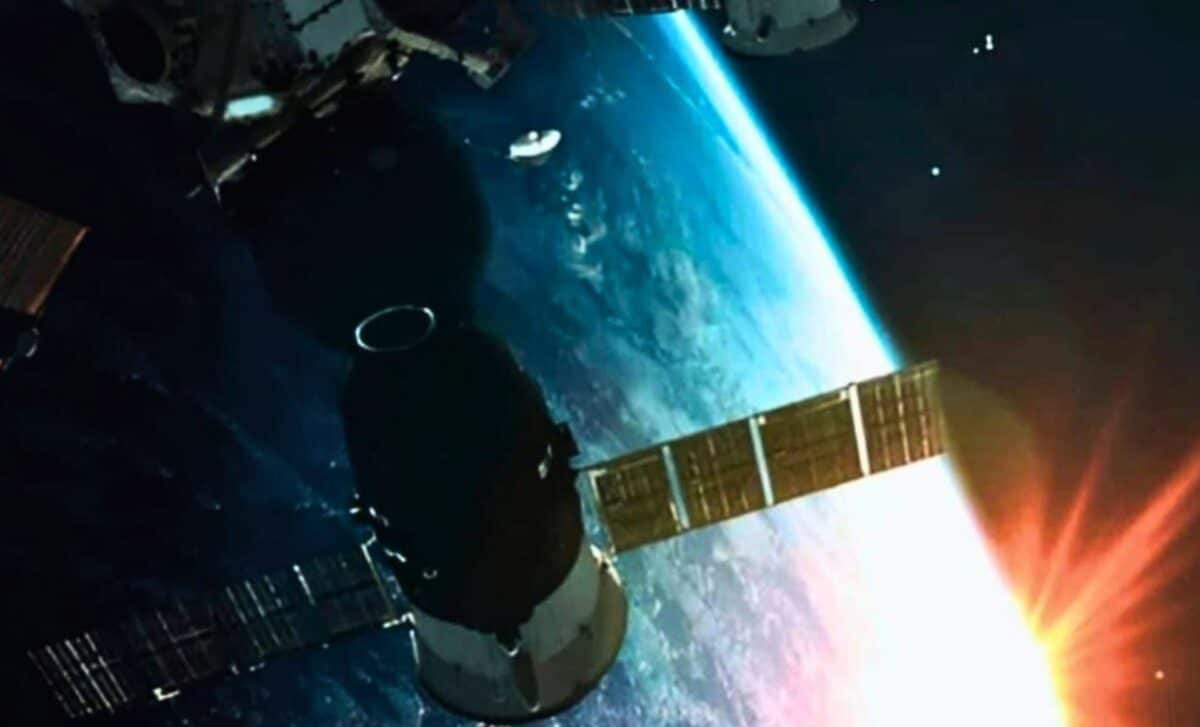
At Lijiang Observatory in southwestern China, the signal did not arrive as a neat, steady beam. It came down from a satellite parked about 36,000km above Earth in geostationary orbit, then hit the atmosphere, where shifting air could scatter and deform the light before it reached the ground. By the time it entered the receiver, the challenge was no longer simply catching a transmission from space. It was recovering clean data from a beam that had already been reshaped on the way down.
That is what made the setup at Lijiang so unusual. The ground system was built around a 1.8-metre telescope and a correction stage using 357 micro-mirrors, each adjusting in real time as the incoming signal changed. Rather than treating atmospheric distortion as a small complication at the edge of the experiment, the entire test was built around overcoming it.
The work , published in Acta Optica Sinica, was led by Wu Jian of Peking University of Posts and Telecommunications and Liu Chao of the Chinese Academy of Sciences. Their target was not just a laser link from orbit, but a stable, high-speed downlink that could survive the hardest part of the journey: the last stretch through turbulent air above the receiver.
Then Came the Number That Made the Test Stand Out
After that setup, the team reported a 1Gbps laser downlink from geostationary orbit using a 2-watt laser. The result was described as about five times faster than Starlink, even though the transmitting satellite was far higher than the low Earth orbit used by SpaceX’s network. One comparison translated the speed into simpler terms: enough to send an HD movie from Shanghai to Los Angeles in under five seconds.
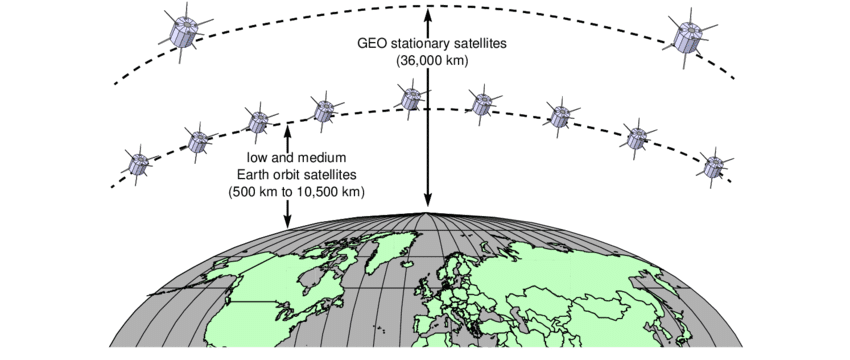 Geostationary satellites orbit the earth at 36 000 km while the emerging breed of low and medium earth orbiting satellites (LEOs and MEOs) orbit the Earth at heights ranging from 500 km to 10 500 km. Credit: Don Clarke
The contrast is what gave the demonstration its force. Starlink’s satellites operate only hundreds of kilometers above Earth. This signal came from a platform more than 60 times higher, yet still delivered a downlink speed in the gigabit range. The power level stood out as well. A 2-watt transmitter is closer to a night light than to the heavy power normally associated with long-range communications systems.
Taken together, those numbers framed the experiment as more than a narrow lab exercise. It was a working demonstration of how far a low-power optical link could be pushed when the receiving system was designed to handle the atmosphere instead of being defeated by it.
China’s Answer Was to Rebuild the Beam at the Ground
The core of the achievement lay in how the signal was handled after it reached Earth. Earlier efforts had typically leaned on one of two tools. Adaptive optics could correct distortions in the incoming wavefront, while mode diversity reception could collect and process scattered signal components. Under strong turbulence, neither method alone was enough.
The Chinese team combined both. In the first stage, adaptive optics used the 357 micro-mirrors to reshape the incoming light in real time. In the second, the signal was passed through a multi-plane light converter, which split it into eight base-mode channels. From there, the receiver selected the three strongest channels and combined them for decoding.
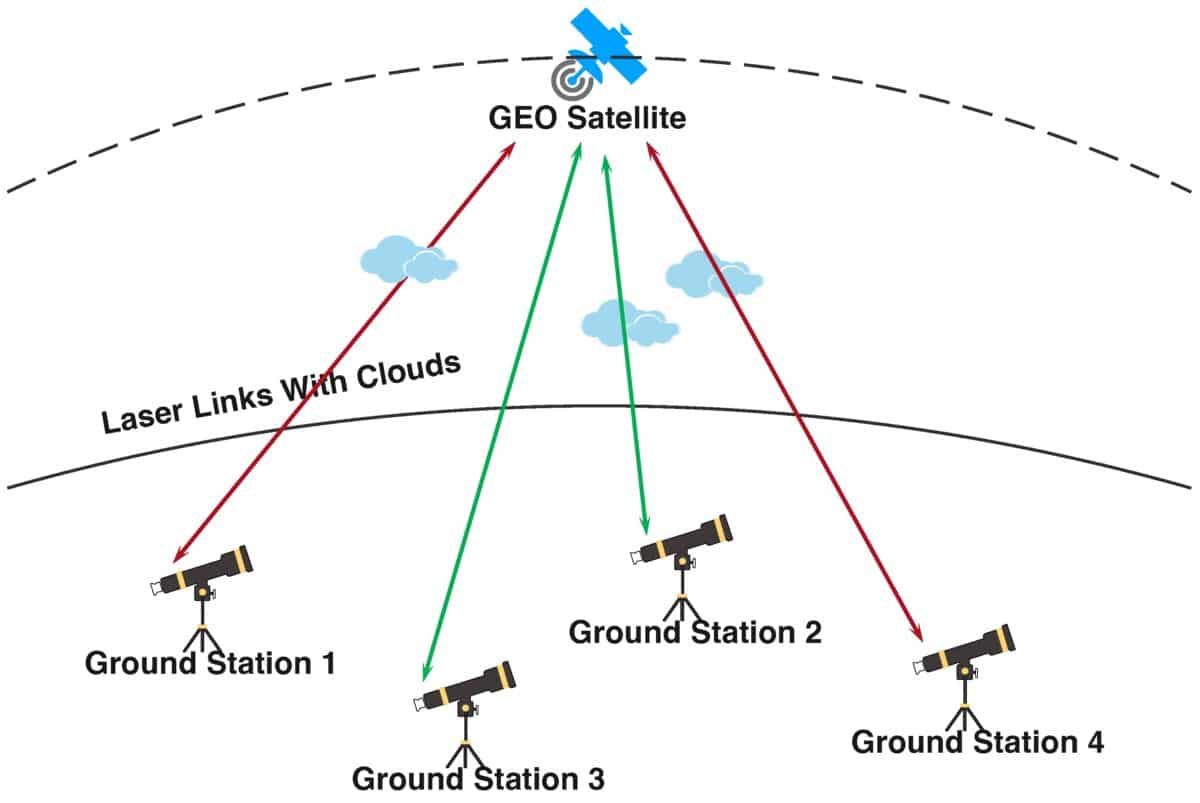 An SGLC system containing one GEO satellite and four candidate ground stations with a scheduling period of one time slot. Credit: Lyu, P., Zhao, K., & Zhao, H. (2025)
That sequence mattered because the beam was no longer being treated as one perfect stream of light. The system accepted that turbulence had already broken the signal into uneven parts, then turned that disruption into something manageable. Instead of trying to force the beam back into an ideal shape, it identified the strongest surviving paths and used them.
The combined method was described as AO-MDR synergy, and the reported improvement was not limited to raw speed. The proportion of usable signal rose from 72 per cent to 91.1 per cent, showing that the gain was also in reliability. That is what made the result read less like an isolated speed figure and more like a communications breakthrough built on signal recovery.
Why the Altitude Made the Result More Impressive
A geostationary satellite remains fixed over the same point on Earth, which gives it a very different operating profile from a low-orbit constellation. The advantage is stability of position. The difficulty is distance. A downlink from that altitude must cross far more space before it even reaches the atmosphere, then survive the optical damage caused by the air itself.
That is why the achievement drew so much attention. The signal did not come from a nearby spacecraft skimming low above the planet. It came from geostationary height, where the optical path is much longer and the final atmospheric segment becomes even more punishing. Delivering a gigabit-class downlink under those conditions made the test feel like a statement about what optical satellite communications can do when the right ground architecture is in place.
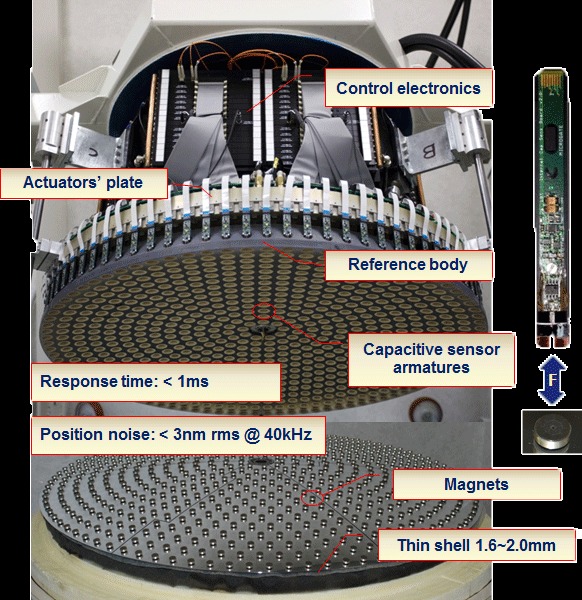 Components of an adaptive secondary mirror for a telescope, which uses actuators to control a thin mirror’s shape. Credit: Microgate
The setup also hints at where such links could matter most. This was not a consumer terminal or a home broadband dish. It was a large, specialized receiver designed to pull in and stabilize a difficult signal. That makes it better suited to high-capacity backbone or relay roles, where a powerful ground node receives large volumes of data and feeds them into terrestrial networks.
The Real Victory Happened in the Sky Above Yunnan
The hardest obstacle in the experiment was not the vacuum of space. It was the moving air above the observatory. That is where the beam lost its clean form, where light scattered, and where the downlink risked becoming unusable. The achievement was that the receiving system did not simply endure that distortion. It overcame it.
What lingers from the test is not just the 1Gbps figure or the 2-watt power level, but the image behind them: a satellite fixed 36,000km above Earth, a distorted beam dropping through turbulent sky, and a receiver in Yunnan sorting that damaged light into eight channels before choosing the three strong enough to keep the data intact.