
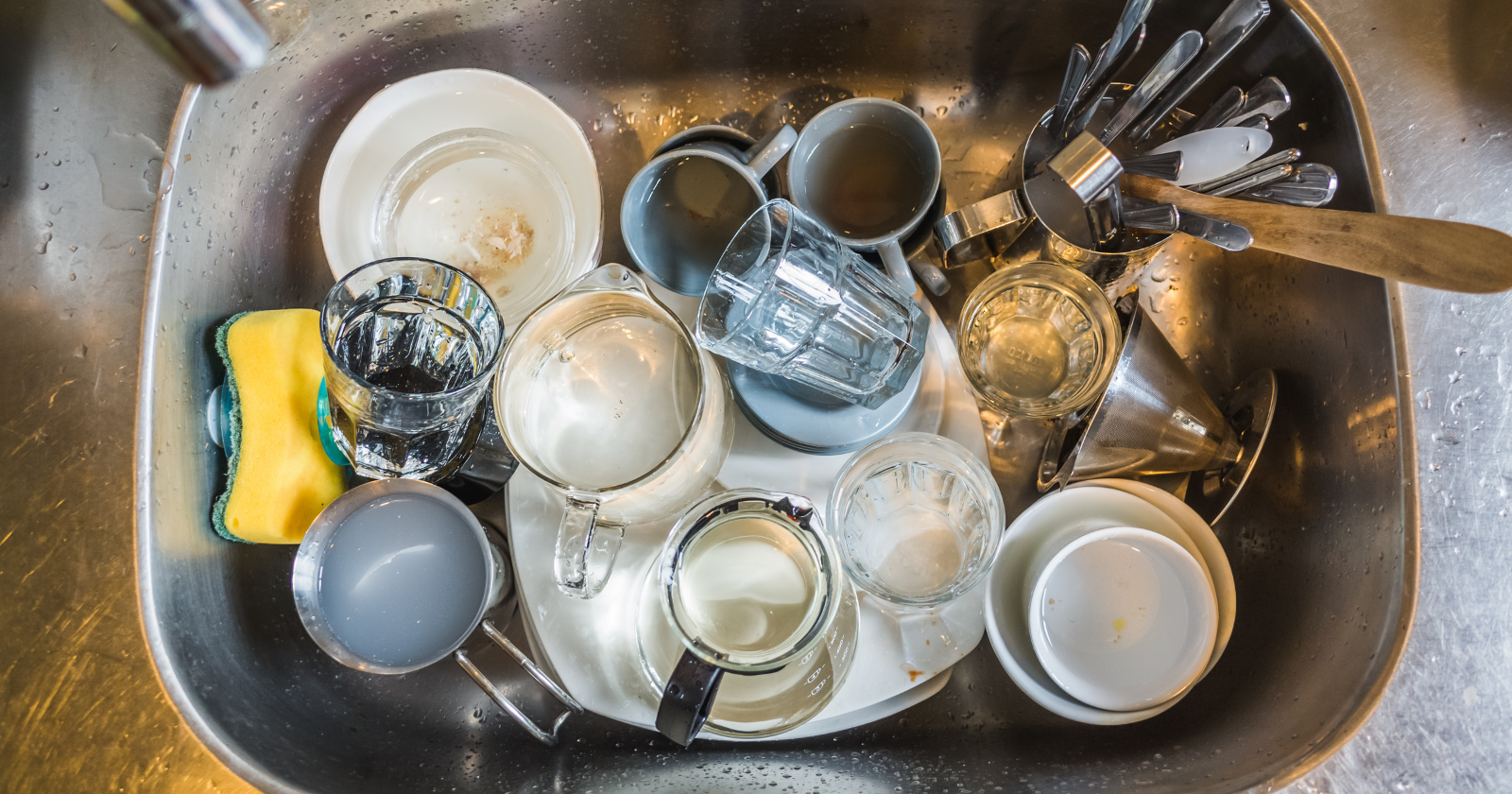
I cook for myself most nights. It’s one of those rituals I look forward to after a day of being stuck in my own head, working through ideas and staring at a screen. There’s something grounding about chopping vegetables and stirring something in a pan.
But here’s the thing. When I’m done eating, those pots and pans? They sit there. Sometimes for an hour. Sometimes until the next morning.
For a long time, I assumed this said something unflattering about me. Lazy, maybe. Undisciplined. But then I started reading what psychologists actually have to say about this kind of behaviour, and it turns out the picture is a lot more interesting than “he can’t be bothered.”
If you’re someone who lets the dishes pile up rather than scrubbing them the second you put your fork down, here are nine personality traits that might be quietly at play.
1) They prioritise rest over rigid routine
According to marriage and family therapist Anita Chlipala, people who don’t rush to wash dishes straight away often report that they simply want to relax first. They have different priorities and consider other things more important than getting chores done by a specific time.
That resonated with me.
After I finish cooking and eating, the last thing I want to do is stand at the sink with a sponge. I’d rather sit down, read something, or have a conversation with my partner. The dishes aren’t going anywhere.
And honestly? I think there’s something healthy about being able to sit with a little mess rather than feeling compelled to tidy it away immediately. It suggests a person who can separate their sense of peace from their surroundings.
2) They’re running on decision fatigue
This one really made me rethink my own habits.
Psychologists have long studied something called “decision fatigue,” which is the idea that the quality of our choices declines as we make more of them throughout the day. As psychiatrist Dr. Lisa MacLean explained in a piece for the American Medical Association, by the time we’ve navigated a full day of decisions, even small tasks can feel overwhelming.
I write best in the morning, and I protect those hours fiercely. By the time evening rolls around, my brain has already been through a lot. So when I see those dishes stacked in the sink, what I’m really experiencing isn’t laziness. My mental tank is just empty.
If that sounds like you, it might be worth paying attention to when during the day your motivation dips. It’s usually less about character and more about cognitive bandwidth.
3) They tend to think more creatively
Here’s where it gets genuinely interesting.
A well-known study led by psychologist Kathleen Vohs at the University of Minnesota found that messy environments actually promote creative thinking. In her experiments, participants in cluttered rooms came up with ideas that were rated significantly more interesting and original than those generated in tidy spaces.
Now, I’m not saying your sink full of mugs is going to spark the next great novel. But the principle holds. Orderly environments tend to encourage convention. A bit of disorder seems to encourage the opposite.
I’ve mentioned this before but some of the best writers and thinkers in history worked in spaces that would horrify a minimalist. There’s something about visual disorder that gives the brain permission to think differently.
4) They’re big-picture thinkers
Some people obsess over every small detail. Others zoom out and focus on the larger goals.
People who let dishes sit tend to fall into that second category. They haven’t ignored the washing up out of disrespect for cleanliness. They’ve mentally filed it under “minor task” compared to finishing a project, spending quality time with someone, or working through an idea.
I noticed this in myself when I left corporate life and started running my own consultancy. I had to learn which tasks truly mattered and which ones could wait. That meant accepting that not everything needed to be handled right now. Dishes included.
It’s all about prioritisation. And sometimes, in the grand scheme of things, the kitchen sink simply doesn’t crack the top five.
5) They score lower in traditional conscientiousness
Before you take offence, hear me out.
Conscientiousness is one of the Big Five personality traits used in psychology to measure things like self-discipline, orderliness, and goal-directedness. As Psychology Today notes, it’s generally considered one of the most reliable predictors of success. People who score high tend to be planners, rule-followers, and list-makers.
But here’s the nuance. Conscientiousness isn’t one-size-fits-all. The degree of conscientiousness someone brings to their job doesn’t necessarily predict how they’ll handle domestic tasks. You can be highly disciplined at work and completely relaxed about a few plates in the sink.
I’ve known plenty of sharp, driven people who could run a boardroom but whose kitchens looked like a storm had passed through. The two things aren’t as connected as we assume.
6) They might be perfectionists in disguise
This one surprised me.
For some people, leaving dishes in the sink is actually a quiet rebellion against their own perfectionist tendencies. If they can’t do it “right,” with the proper soak time, the right sponge, every surface gleaming, they’d rather not start at all.
Psychologists who study procrastination have noted that perfectionism is one of the most common drivers of avoidance behaviour. The person isn’t being careless. They care too much, in a way that creates a kind of paralysis.
Running my own business forced me to confront this exact pattern. I’d delay things not because I didn’t care, but because I wanted them to be perfect. The dishes were just another version of that same tendency showing up in a different part of my life.
7) They’re emotionally present
People who leave dishes often have a strong tendency to be fully absorbed in whatever they’re doing. When they’re working, they’re all in. When they’re with someone, they’re genuinely there. The dishes exist in the future, and these people are too busy being present to worry about them.
I noticed this about my own relationship. My partner and I are curious about the world in completely different ways, and our conversations after dinner are one of my favourite parts of the day. If the choice is between washing a pan and having one of those conversations, the pan loses every time.
Studies on present-moment awareness suggest that people who stay focused on the here and now actually cope better with daily stress. They’re not jumping to the next task before finishing the current one.
8) They value flexibility and adaptability
Not everyone operates best on a fixed schedule. Some people thrive in structure. Others do their best work when they can adapt to whatever the moment demands.
Research on adaptability suggests that people who are comfortable with a certain level of disorder tend to cope better when life throws a curveball. They’re not thrown off when things don’t go to plan because they were never that attached to the plan in the first place.
I used to think flexibility was the same as being undisciplined. It took me years to realise they’re very different things. Flexibility is a skill. Rigidity just looks productive.
9) They’re carrying a heavier mental load than you’d think
This is perhaps the most important one.
As Dr. Crystal Saidi, a licensed psychologist with Thriveworks, pointed out in Parade, our daily habits are small windows into our nervous system, stress levels, and emotional bandwidth. When someone regularly lets dishes pile up, it doesn’t necessarily mean they’re lazy. It’s often a sign of feeling overwhelmed.
During the toughest periods of my life, the dishes always piled up. Not because I stopped caring about cleanliness, but because my emotional bandwidth was being used up elsewhere. When your brain is juggling too many things, even simple tasks start to feel heavy.
If you notice the dishes stacking up more than usual, it might be worth checking in with yourself. Sometimes the mess in the kitchen is telling you something about what’s going on inside your head.
The bottom line
Look, I’m not saying you should never wash your dishes. Please wash your dishes.
But if you’ve ever felt guilty about letting them sit for a while, you can probably let yourself off the hook. The psychology behind this habit is far more layered than “tidy people have it together and messy people don’t.”
Sometimes the person with a clean sink is driven by anxiety. And sometimes the person with a stack of plates is simply someone whose brain is busy doing something else.
I’ve learned to stop judging myself for it. I’d encourage you to do the same.
As always, I hope you found some value in this post. Until next time.