
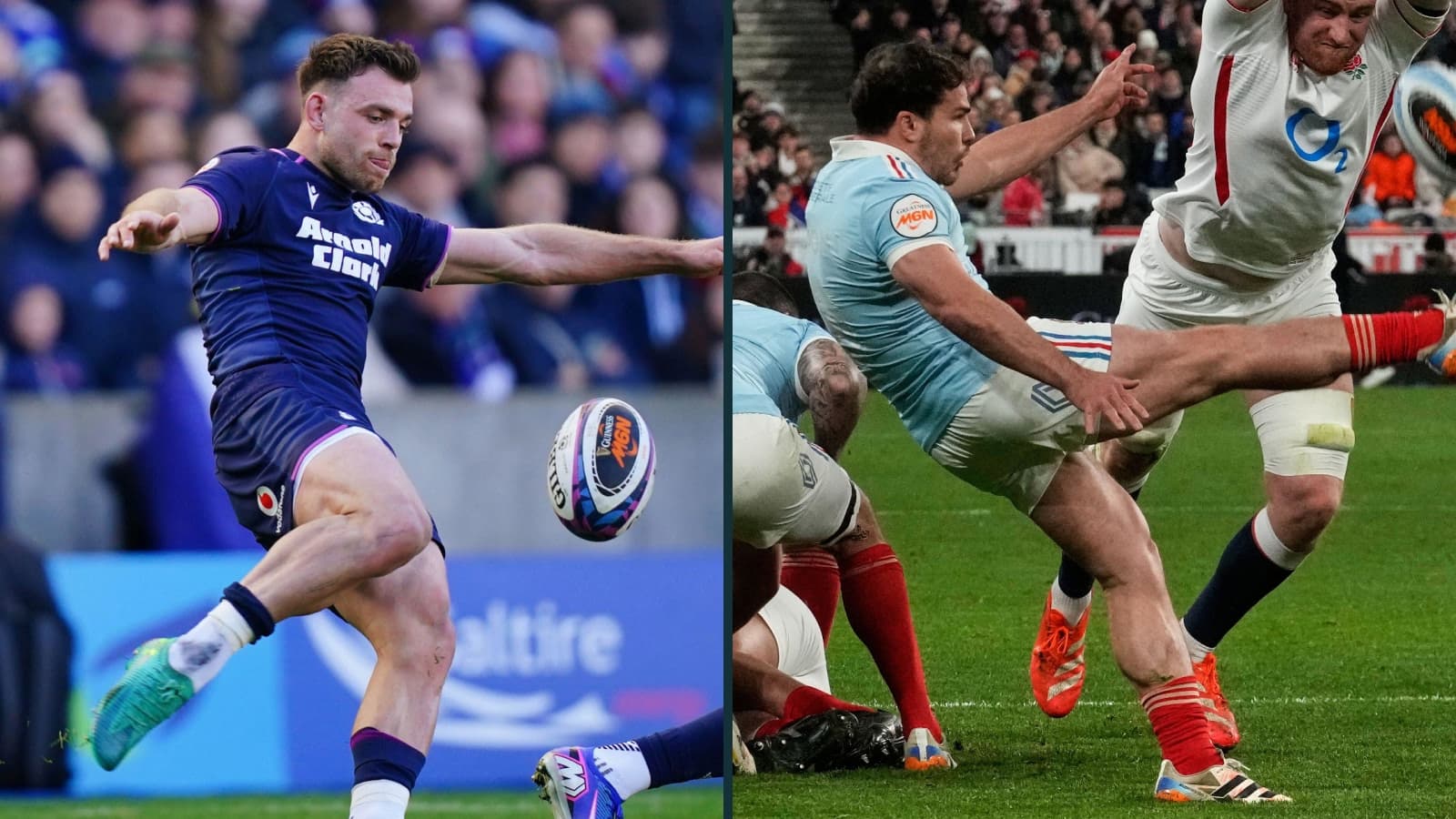
Kicking is up across the 2026 Six Nations, territorial kicks are falling while box kicks, chips and crossfields are rising. 20 percent of kicks produced a contest for possession against nine percent last season, and the 77 contestable kicks logged in the first two rounds alone came within three of the entire 2025 total.
Kicking has become the dominant attacking weapon in the modern game, and the reason is not aesthetics, not conservatism, and not accident. It is a direct and provable consequence of how elite defences have chosen to defend.
The blitz has come to define northern hemisphere rugby over the past decade. Push the defensive line up fast, crowd the ruck, compress the flat attacking space and force errors under pressure. Ireland weaponised it first, and the sides that replicated it most closely were the ones that competed at the top of the Six Nations table. For a long time it worked, because the only answer to a line advancing at pace was to run harder or carry more intelligently, and neither produced a consistent solution at Test level.
What the kicking data from 2026 reveals is that teams have found the answer, and the answer was always geometric. An advancing defensive line creates two realities simultaneously, compressed space in front of the ball and an expanding void behind it. The kick does not just exploit that void. It makes the blitz energy itself into a liability, because the faster a line advances, the further it has to travel to recover, and the more exposed the space becomes. The blitz is designed to punish teams that stay flat, but it is structurally defenceless against teams that go over the top.
The team rankings
The 2026 data, ranked by kicking sophistication and aerial ambition, tells its own story.
France accumulated 2,893 kick metres across the tournament, averaging 29.5 metres per kick, the highest of any side. That figure reflects not volume but precision, longer kicks carrying greater field position gain per attempt, fired over the top of the most aggressive blitz lines in the Championship. The design was deliberate at every level. France kicked not simply to gain territory but to engineer the conditions for transition attacks, inviting pressured returns from opponents catching under duress, then launching off those regains at a pace and width that disorganised defensive structures could not absorb. The principal architect of that system is Antoine Dupont, who kicks equally well off both feet and whose opponents will often simply not know which foot he will use. That ambidexterity allows him to pivot in either direction depending on the fringe and backfield defensive shape the opposition are offering, making him unreachable from the charging defensive line. His speed from the base of the ruck compounds it further. By the time a defender has read the play, the ball is already in the air and France are already loading the transition.
Ireland led all six teams in kicks in play with 99 and ranked second for retained kicks, reflecting a territorial system built around structure and breakdown dominance. The opening night fixture at the Stade de France told the story with unusual clarity. Of the 19 contestable kicks between France and Ireland, Ireland won five and France won 14. Volume without aerial dominance is territory ceded, not gained.
Wales led the tournament in box kicks with 43 and recorded the highest goal-kicking success rate at 93 percent. Their aerial game plan generated territory and scoreboard pressure consistently enough to threaten both Ireland and Scotland in matches they ultimately lost, which raises its own question. Wales proved the kicking system works. What they could not do was win the aerial battle consistently enough to convert territory into tries, and that gap between strategic intent and physical execution is where their campaign stalled.
Scotland shared the joint-highest contested kicks alongside Ireland at 46, with Ben White’s ability to nail contestable box kicks bringing his back three into the action repeatedly. Finn Russell added a different dimension, exposing the French backfield early with kicks into the sun, and when Scotland’s rugby was at that level of precision, their opponents had no answer.
Italy kicked the most bombs of any side and the fewest territorial kicks, an aggressive aerial game plan that troubled Ireland’s back three more consistently than anyone anticipated.
England, rather surprisingly, generated the fewest contestable kicks of any side through the opening two rounds, a striking retreat from the kick-and-contest identity that had driven their 12-match winning run into the Six Nations. Whether that tactical retrenchment contributed to four defeats across the remainder of their campaign is a question the data raises without fully answering. The Round Five match in Paris offered a different tactical logic entirely. England’s eight contestable kicks that night were deliberate and targeted, designed not to gain territory but to prevent French transition, strangling Dupont’s ability to ignite the counter. They held 57 per cent possession to France’s 43, inverting the usual dynamic entirely. It nearly worked, but it’s deeply ironic that five of those contestables came from Jack van Poortvliet when England were trying to close out, and it was one of those that cost England the result. Thomas Ramos’s last-kick penalty settled a 94-point thriller, and the tactic, in retrospect, looks less like an abandonment of principle and more like the most sophisticated reading of France that any team produced across the whole tournament, despite the Van Poortvliet howler.
The proof in the type
The proof that this is a blitz-driven phenomenon rather than a stylistic preference lies in which kicks are rising. Box kicks have risen, territorial kicks have fallen, and chip and crossfield kicks have increased, with sides prioritising regaining possession over simply gaining territory. Territorial kicks are the safety valve, the clearing mechanism, the conservative choice. The kicks that are rising are designed to recover possession in space behind a defensive structure that has already committed forward. That is not coincidence; that is cause and effect written in the data.
A single retained kick can generate around 30 metres of rapid field position, while it would take six to seven phases of possession to gain the equivalent distance from carries alone. Across a Test match, that efficiency compounds at a rate no carrying system can match. The line break remains the most spectacular mechanism for gaining territory, but line breaks have only occurred once every 15 to 25 carries across the last six editions of the Six Nations, making contestable kicking the more reliable and repeatable route forward. Reliability, at Test level, is the currency that wins Championships.
The number of attacking catches has risen to 45 per cent across the last two Six Nations campaigns, up from 38 across the previous two editions, with defensive catch success falling from 85 per cent to 79. That decline is not random. The escort rule change removed the protective pocket that receiving teams built around their catcher, giving chasers cleaner lines and earlier access to compete. The result is a generation of wingers being asked to catch under genuine physical contest for the first time in their careers, and the ones who cannot are now selection liabilities rather than positional quirks. Defences are losing the aerial battle at a rate that would have seemed implausible four years ago.
Hoisting Dupont on his own petard
The most vivid single illustration of what happens when a team turns the kicking system against its greatest exponent came at Murrayfield in Round Four. White, Dupont’s Top 14 rival at Toulon, had studied exactly how France weaponise the aerial contest and arrived with a specific counter. France simply could not cope with the width, the kick pressure or the speed of Scottish support lines. White’s box kicks were precise, high and repeatedly dropped into the sun that hung over the Murrayfield stand, turning Dupont’s own system against a French back three that found themselves catching blind.
Want more from Planet Rugby? Add us as a preferred source on Google to your favourites list for world-class coverage you can trust.
The team that had won 14 of 19 aerial contests against Ireland on the opening night of the tournament saw their talisman throw an interception that gifted Scotland a try, lost possession to White’s tackle for another, and found himself sufficiently rattled that what followed, the post-match handshake refusal and the tunnel confrontation, suggested something had genuinely got under his skin. For a player of Dupont’s temperament, that is a remarkable admission.
Scotland dominated the air through White’s box kicking and forced France into 15 turnovers lost. There is a physical dimension to this that the scoreline alone does not capture. A blitzing defensive structure burns enormous energy in the repeated sprint-and-reset cycle that high-tempo kicking forces upon it. By the time Scotland reached the final quarter at Murrayfield, France’s heavy carriers were covering ground that their conditioning had not been built to absorb at that volume. The kicking game does not just beat the blitz spatially. Given long enough, it breaks it physiologically.
France won the Championship anyway. They averaged the greatest kick distance of any team in the tournament, generated the most metres from the boot, and built their transition attack around a kicking system that only one side across five rounds found a meaningful answer to. The blitz solved the carrying game. The kicking game solved the blitz. And the team that understood that most completely, most precisely and most ruthlessly across six weeks of the finest Six Nations ever played, lifted the trophy.