

When Charlotte Clerk visited her GP in October last year while struggling with an eating disorder, she was quickly confronted with the realisation that getting help would not be an easy process.
The 25-year-old from Reading had been restricting her food intake, weighing herself daily, overexercising and counting calories in an attempt to lose weight.
Yet after she was referred for an assessment at a local specialist clinic, a doctor said that she was not thin enough to have an eating disorder and that her difficulties with food were more likely to be due to autism.
 Charlotte Clerk
Clerk said: “If I was underweight, I am sure I would have been offered help immediately.
“I had told the specialist about all of the disordered behaviours I was displaying for years, but because I wasn’t physically underweight, they said it must be because of my previous autism diagnosis.
“I had read that autism can worsen food difficulties, but for me, I knew the two problems were separate — purely because even before I was diagnosed with autism, I already struggled with my eating.”
In January, the NHS published new guidance stating that a child’s weight should not be the main focus when it comes to whether they qualify for help for an eating disorder. The guidelines state that doctors should not decide whether to admit or discharge patients from care based on their body mass index (BMI).
However, campaigners have warned that BMI is still being used to decide whether or not people should get NHS care as too many patients are being told they are “not sick enough for treatment”. Meanwhile, long NHS waiting lists mean some adults with eating disorders in England are waiting up to 700 days for care from community teams, while children and young people face waits of up to 450 days.
Dr Ashish Kumar, of the Royal College of Psychiatrists’ Eating Disorders Faculty, said: “Eating disorders can be extremely serious and life-threatening when left untreated, so it is imperative that we are bold in our efforts to innovate the support that is available.”
Zara Taylor had a similar experience of inadequate care. She had been battling anorexia for ten years and accessing NHS support for two years before she died by suicide in 2021, aged 24.
 Zara Taylor
Her mother, Debbie, said that her daughter’s struggles were “not listened to” and there was not enough funding to get her the correct support in time.
A policy group, Dump the Scales, is set to hold an annual march in Trafalgar Square in London next month, to raise awareness of eating disorders and advocate for policy change for those struggling.
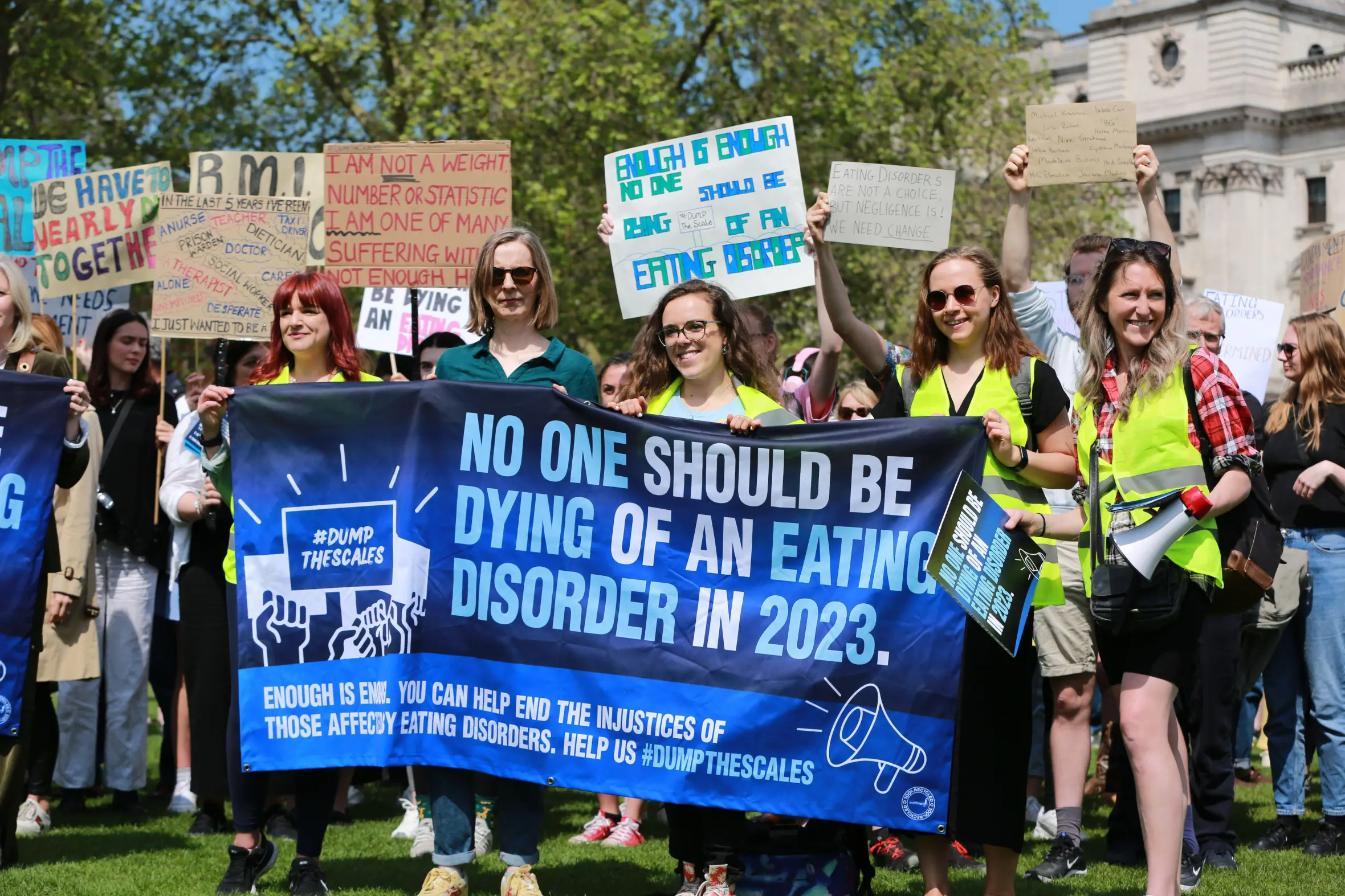 A Dump The Scales march in 2023Waldemar Sikora/Alamy
Hope Virgo, the founder of the group, said: “Every day we hear from people affected by eating disorders who are told they are not sick enough for treatment, and people who are told they are too sick for treatment based on their BMI.
“Whilst guidance says that BMI should not be used to stop people getting support, we know that on the ground, it is still happening.
“The decades of underfunding, systemic failure, and little doctor training mean many people are left without adequate support.”
Approximately 1.25 million people live with an eating disorder in Britain, the number of which is estimated to be higher for those not accessing help.