
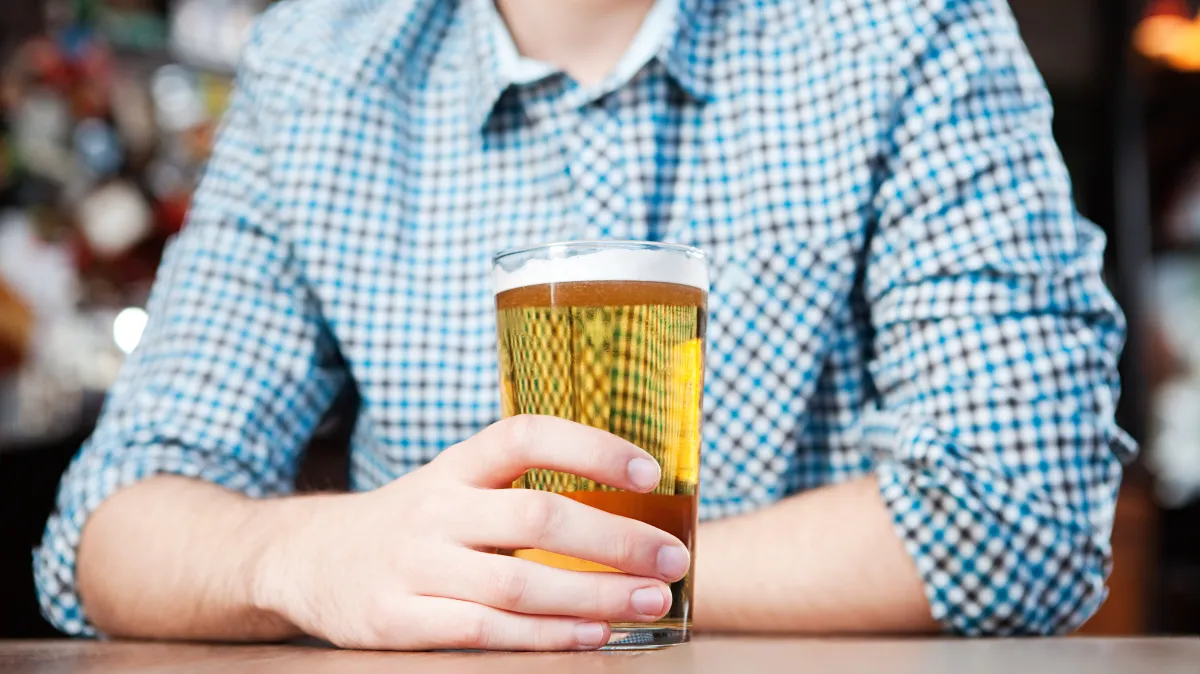
Does the beer belly really exist? This was the question posed recently by University of Oxford scientists who wanted to find out once and for all if too much beer — or any other booze for that matter — is directly linked to belly fat and a paunch.
Of course, we all know alcohol is laden with calories and it seems plausible that the more you drink the more likely you will accumulate fat around your middle, stored subcutaneously under the abdominal skin or as visceral fat surrounding our core organs.
“But what seems obvious to most people had never been proven in a solid way by scientists,” says Fredrik Karpe, professor of metabolic medicine at Oxford. “Previous studies had looked at extreme drinking or hadn’t measured fat accurately, so surprisingly ours was the first attempt to look at the connection properly.”
The idea to probe into the biology of the “beer belly” came from Joel Chesters, an Oxford medical student who was curious to find out if drinking too much in the student union bar really would lead to an unhealthy paunch.
This evolved into an investigation into the drinking habits of more than 5,000 men and women from the Oxford Biobank. The subjects answered questions about their alcohol intake and underwent a DEXA (dual-energy x-ray absorptiometry) scan to reveal how much central fat their bodies were storing.
It was the first time that such scans have been used in a study of this size to determine levels of visceral belly fat; most trials rely on more rudimentary measures such as BMI or a tape measure for waist circumference.
In the past, researchers have optimistically argued that beer isn’t to blame for laying down middle fat. In one study published in Nature, German researchers claimed that there was no proof of “a site-specific effect of beer on the abdomen”, and after reviewing 35 studies, Dutch scientists suggested that drinking a 500ml bottle of beer — which typically provides 2-3 units of alcohol — every day was unlikely to result in a beer belly (whether or not they celebrated their findings in the nearest tavern was not recorded). Karpe’s results, published in the International Journal of Obesity, poured cold water on such thinking.
 Check wine labels — the higher the alcohol, the higher the calories Getty images
“We showed there is a clear, independent relationship between alcohol intake and intra-abdominal fat in both men and women,” he says. For women who exceeded 14 units a week (equivalent to a medium glass of wine each evening) and men who drank more than 20 weekly units (a large glass of wine or a pint of beer every day), belly fat became problematic. “There is also a dose response and the link becomes obvious the more you drink,” Karpe says.
Precisely what makes alcohol a particular enemy of belly fat remains an unanswered question. “Nobody fully understands why alcohol per se affects that fat tissue more than other body fat,” he says.
He speculates that it comes down to the way our bodies metabolise the demon drink. “When you break down alcohol it happens in two steps. First ethanol is oxidised into a toxic compound called acetaldehyde and then very quickly into acetate.”
Acetate is the end product and is known to be a perfect building block for making fat in the body. “That’s the likely reason it has such a potent effect on visceral fat,” Karpe says. “And this belly fat has health consequences beyond abdominal obesity, as it is implicated in diabetes, heart disease and many other diseases.”
Alcohol also affects the body’s use of fat in other ways, suppressing fat oxidation as the body works to metabolise alcohol and remove it from the body. “As a result of complex metabolic pathways, it inhibits the breakdown of fat,” says Duane Mellor, a registered dietician and honorary associate professor of nutrition at the University of Leicester. “This means too much drink can reduce the amount of fat your body burns for energy.”
Then there’s the calories. After pure fat, which contains nine calories per gram, alcohol is the second-most calorie-dense “macronutrient’’, containing seven calories per gram. “We tend to forget that just a few drinks can provide quite a significant number of calories,” Karpe says.
Studies have shown that the calories in as little as half a glass of wine a day or a quarter of a pint of beer a day is enough to raise the risk of obesity and its related health problems by 10 per cent in men and 9 per cent in women.
A triple whammy is that hormonal factors in midlife make your waistline a magnet for storing those excess alcohol calories. “Men, with their low levels of the hormone oestrogen, typically gain weight around the middle at any age, but more so when activity levels drop in their forties,” Mellor says. “And in women entering the menopause, lower levels of oestrogen from around the mid-forties means they also move towards this android pattern of weight gain in the stomach area.”
Drinking, says Mellor, is never going to be good news for your waistline but here are some tips to help you to keep a beer belly at bay:
Avoid a pre-dinner drink — it just makes you hungrier
Mellor says that what scientists term the “aperitif effect” of drinking holds that a single drink makes food taste more appealing. “It might explain why so many of us enjoy food more after a glass of wine,” he says.
Researchers at Glasgow Caledonian University tested this theory by giving participants either 375ml of red wine 20 minutes before a two-course lunch of garlic bread and pizza or 125ml of the wine with the starter and 250ml with the main course. A considerable 25 per cent more calories were consumed when the wine was taken as an aperitif.
“The effects of wine on appetite are immediate and stimulate food intake early in the meal,” the scientists said, although the effects didn’t end there. All of the wine drinkers ate more during the next three days than a control group who had no alcohol.
Beer will give you the nibbles
Alcohol disrupts the body’s perception of hunger and satiety, which partly explains why an attack of the munchies is so common on a night out. Some researchers have suggested this might be down to the way alcohol switches your brain into starvation mode, sending signals that you are hungry even if you’ve already eaten.
Beer and cider contain carbs and will increase your blood sugar levels when you drink them, potentially raising hunger levels later in the evening. “Alcohol stimulates appetite and doesn’t make you feel full,” Mellor says. “So, it’s always likely you will eat more after a few drinks.”
Drinking wine? Avoid the highest-calorie options
“Calories in drink really do matter,” says Rhiannon Lambert, author of The Science of Nutrition, “but most of us are not aware how many our drinks contain, with a survey showing that 80 per cent of people are not aware of the calories in a glass of wine.”
Generally speaking, the higher the alcohol content of a bottle of wine (its ABV), the higher its calorie content, although wines with higher residual sugar content — such as dessert wines — are likely to contain more calories, so check the small print on the label.
Drinking out? A medium (175ml) glass of red wine is usually about 157.5 calories (and 2.3 units), while a large (250ml) one is 225 calories (3.3 units).
Or switch to spirits
A vodka, lime and soda is often dubbed the supermodel’s drinks of choice because it’s relatively low in calories and carbs when compared with beer and wine. “Spirits do tend to have the fewest calories per serving,” Lambert says. A 25ml shot of 40 per cent ABV vodka contains 55 calories.
Tequila is another spirit with a reputation as being relatively “kind” to the waistline. It does contain less sugar and slightly fewer calories — about 65 per 25ml shot — than many drinks, but not if you add sugary mixers for a tequila cocktail. It’s a similar story with gin: a double measure (50ml) provides 110 calories (2 units) but add a premium tonic water and you are looking at an extra 72 calories.
Watch out for the really sugary drinks
All alcoholic drinks contain some sugar, a notorious driver for belly fat, but some, such as fortified wines, sherries, liqueurs and cider, have sugar added and spirits are often mixed with sugary soft drinks. Ready to drink pre-mixed spirits are among the worst offenders with a report by researchers at Action on Sugar, based at Queen Mary University of London, finding many don’t even have sugar information on the packaging.
Some pre-mixed drinks — such as a passion fruit martini and a pink mojito — contained the equivalent of 12 teaspoons of sugar per pack. “Cider contains around 216 calories per pint,” says Lambert, and a lot of that is from sugar. Drinkaware says that a pint of cider can contain as many as five teaspoons of sugar — almost as much as the NHS recommended daily limit.
Opt for a low or no alcohol drink
“There are now plenty of non-alcohol alternatives, including non-alcoholic gins, wines and beers, as well as classic soft drinks,” Lambert says. Non-alcoholic drinks with an 0.5 per cent ABV or lower typically contain fewer calories than regular versions of the same drink but be aware that in some cases sugar is added to improve flavour and palatability, which bumps up the sugar content per bottle or glass.
Last year researchers from the University of California San Diego, Knappschaft Kliniken University Hospital in Germany and University of the Basque Country in Spain found that alcohol-free wheat beers and “mixed beers” — typically flavoured with soda — had “an unfavourable metabolic impact on glucose and fat”, which was “probably due to the caloric and sugar content” of the drinks.
Have at least three drink-free days a week
According to the charity Drinkaware, this simple rule — and spreading out any alcohol you do drink on other days — will help you to stick to the recommended upper limit of 14 units a week, ward off a beer belly and give your liver a chance to repair and heal itself.
“It’s a good idea to have 3-4 alcohol free days each week but not to consume all of your units in a couple of days at the weekend,” suggests the registered nutritionist Dominique Ludwig, author of No Nonsense Nutrition. “By default you are also consuming less calories than if you drink every day.”