
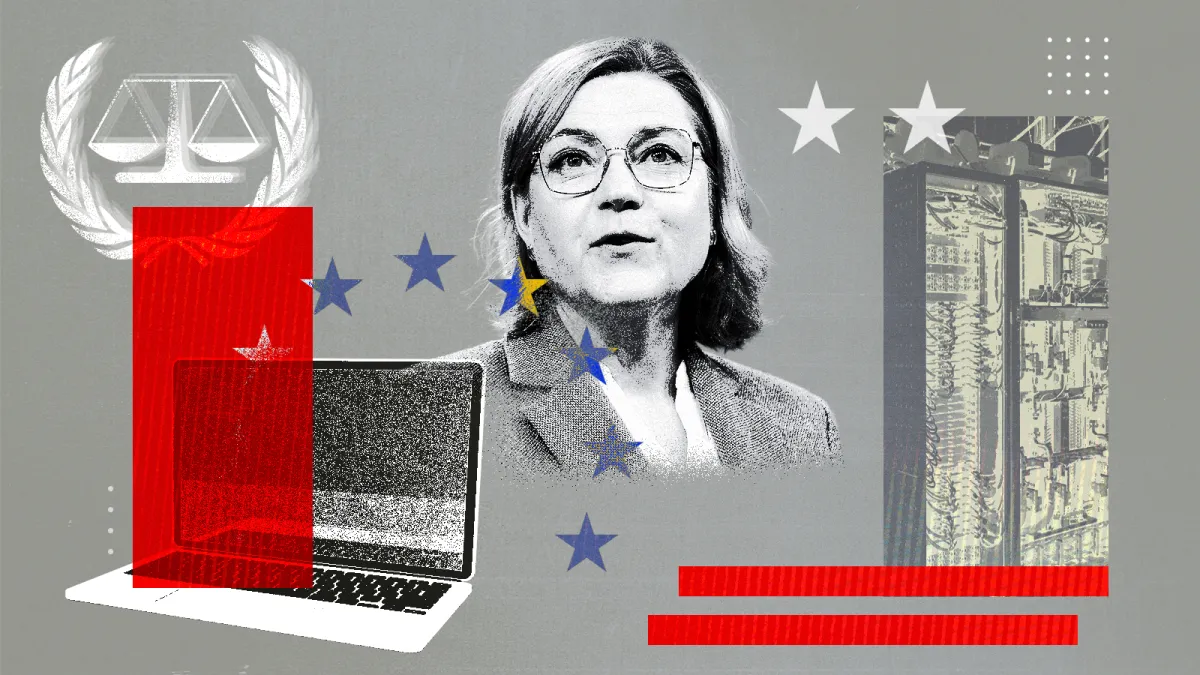
Europeans should use homegrown alternatives to American software, one of Brussels’ top officials has said as concerns mount that the United States could weaponise dependency on its systems.
The European Union is drawing up a flagship “technological sovereignty” programme to ease its reliance on the US and China for digital life, from artificial intelligence to microprocessors.
Described by some analysts as a step towards a “digital divorce” from Washington, the package is expected to be set out in May. It will include subsidies for next-generation chips, a €20 billion fund for AI “gigafactories” and a target to triple the computing power of the EU’s data centres.
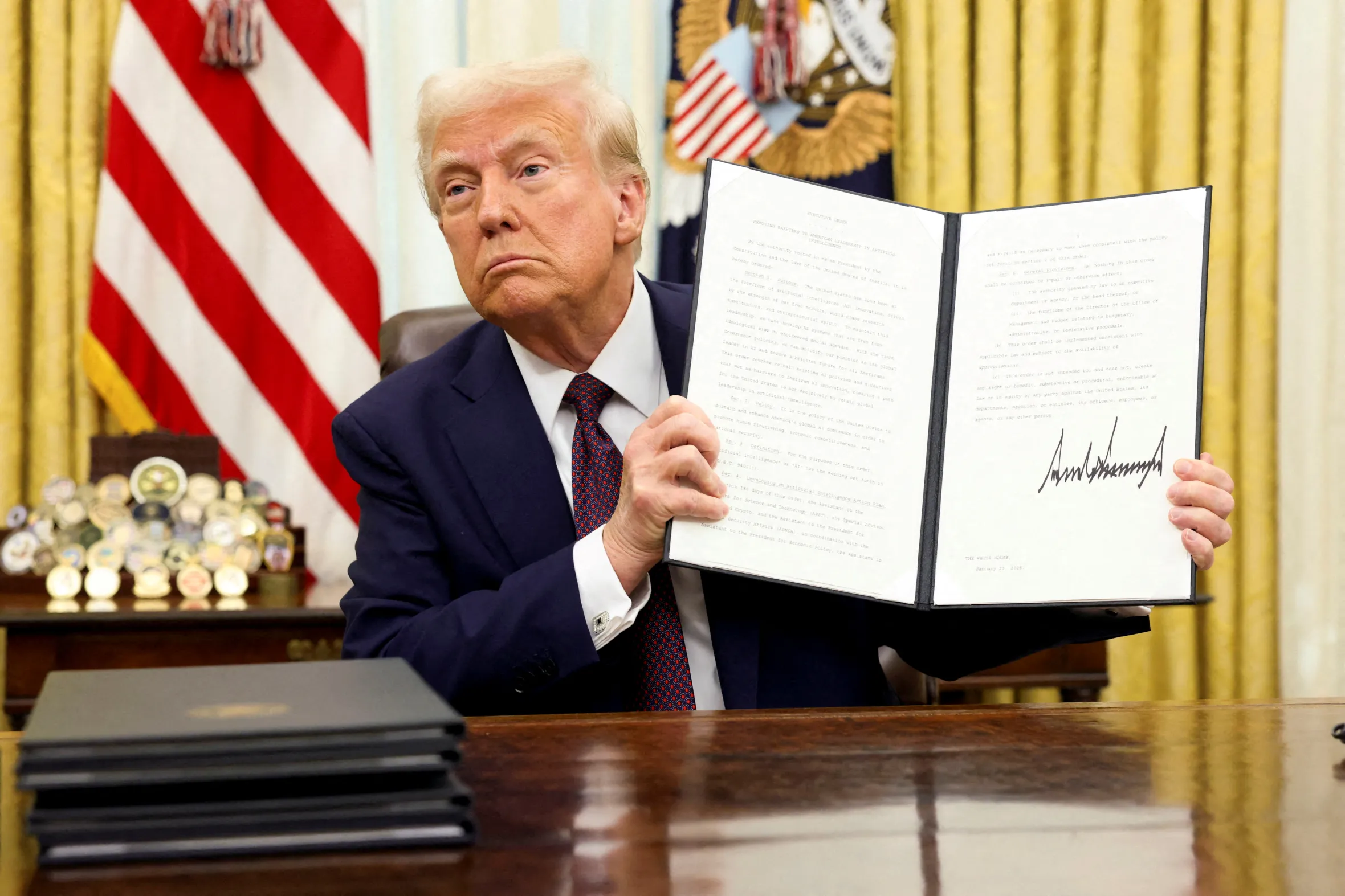 President Trump with a signed executive order on AI in the Oval Office. The US hosts several huge AI “gigafactories”Kevin Lamarque/Reuters
Given the strains in the transatlantic relationship, some European policymakers fret that the continent’s shortcomings are not just a drag on its sputtering economic growth but an outright security risk.
Henna Virkkunen, the European Commission’s executive vice-president in charge of the reforms, said ordinary people were also beginning to realise how vulnerable US dominance had made them.
“Due to the current geopolitical situation, citizens have become increasingly aware of how much Europe depends on foreign tech,” she told The Times. “We don’t need a study to see this; it is clear from conversations overheard on buses or on the street.”
Virkunnen said people often found it hard to give up US technology but Europe could often offer them superior alternatives, not least because of its stricter approach to giving individuals and companies control over their data.
She added: “When we talk about alternatives, we talk about just that: not something that we have to lower our expectations for, but something that is high quality, innovative and provides an important level of assurance. We have many great European alternatives and I encourage people to consider using them.”
Alongside obvious areas of American tech supremacy such as email, internet search, AI and social media, a particular source of anxiety is Europe’s heavy reliance on the US for cloud computing, the backbone of the digital economy.
Amazon, Microsoft and Google alone are estimated to supply about 70 per cent of the European market. Yet some governments and companies have been rattled by a series of outages, prompting warnings that these could be a taste of what might happen should the US try to flip a “kill switch” on these services in the event of a catastrophic breakdown in relations.
Others note that under the US Cloud Act, passed during the first Trump presidency in 2018, the American authorities could demand access to any data held by US companies, even if it is physically stored in Europe.
 Europeans have few alternatives if the US rescinded access Getty IMAGES
These fears were illustrated last year when the Trump administration imposed sanctions on the chief prosecutor, two of his deputies and eight judges at the International Criminal Court in the Hague because of investigations into American and Israeli personnel.
The officials not only lost access to American services such as Amazon and Uber but were also cut off by their European banks in some cases.
Virkkunen said the sanctions were a “grave violation of judicial independence” and had “severely undermined our rules-based international order”.
She said the fundamental goal of the technological sovereignty agenda was to give Europe something like the resilience and independence that her native Finland had fought to establish over half a century of attacks and political influence from the Soviet Union.
“It is exactly what we need in Europe: the ability to develop and maintain our technological capabilities in any scenario,” Virkkunen said.
“In the EU, it is clear that for some critical technologies, such as semiconductors, there are strategic dependencies where we rely on external suppliers, posing a risk to our autonomy. For example, when it comes to producing advanced AI chips, today we are completely dependent on production facilities located outside Europe.”
Politics newsletter
Get our daily insider’s guide to Westminster, plus a rundown of PMQs every Wednesday.
Sign up with one click
On Tuesday, the Finnish justice ministry announced that the country’s election data would no longer be stored with Amazon, after its main security service warned that depending on foreign providers could “undermine sovereignty”. A poll released on the same day found that only 4 per cent of Finns now trusted the US, similar to the 3 per cent who trust China.
Drawing on a €234 billion European competitiveness fund that soaks up nearly a quarter of the bloc’s seven-year budget, the package of reforms aims to turn the EU into a technological superpower in its own right, based on open-source principles, dependable and quality-tested AI systems, and sovereign digital infrastructure.
It includes a chain of five AI “gigafactories” with 100,000 graphics processing units apiece, designed to build and train rivals to large language models such as OpenAI’s GPT series and Anthropic’s Claude.
 Virkkunen said Europe needed to produce its own AI chipsJAMES ARTHUR GEKIERE/AFP/BELGA MAG
These will be about four times more powerful than the current European gold standard but still roughly an order of magnitude smaller than the biggest commercial facilities that are being built in the US.
Virkkunen argues that Europe tends to underestimate its own strengths, including basic quantum physics research and trustworthy, “human-centric” AI.
The legislation will also heavily nudge European companies to use “sovereign” cloud infrastructure and make them liable for any cybersecurity breaches in their digital “supply chain”, including parts that they do not directly control.
Virkkunen said she had been alarmed by the rapidly growing sophistication and power of AI-assisted cyberattacks, which could now identify and exploit vulnerabilities in hours, where previously it would have taken about 30 days.
“This shift changes the entire defensive equation,” she said. “Organisations no longer have the luxury of reacting over weeks. They must be able to detect, assess and remediate vulnerabilities almost immediately.”
The imminent wave of regulations has drawn considerable criticism. Many companies characterise them as costly red tape and complain that in many cases there is simply no viable alternative to US technology.
On Tuesday, Roland Busch, the chief executive of the German industrial conglomerate Siemens, told the Financial Times that prodding companies to develop their AI on European systems would be a “disaster” because it would slow down innovation.
Figures in Europe’s militaries also warned that it would not be possible to replace the American software on which a vast array of Nato weapons systems operate.
The Trump administration, which has already railed against EU regulations on US digital services, is responding with a diplomatic counteroffensive and threats of further tariffs against the bloc.
One senior MP from Germany’s ruling coalition said they were concerned that “reckless” momentum was building towards a “decoupling” from the US. However, Virkkunen insisted that Europe was not “yielding to pessimism or protectionism” and that Brussels had no intention of shutting the US out.