
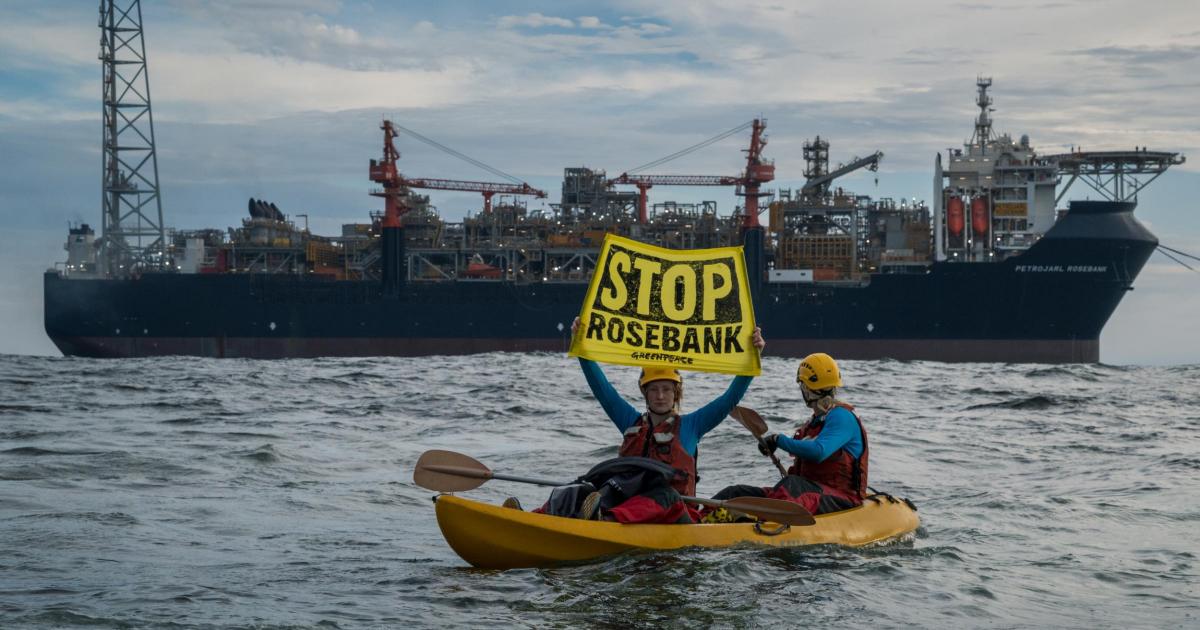
Rosebank, off the coast of Shetland, is the largest undeveloped oil field in the North Sea and has not yet been given approval by the UK Government.
Rosebank’s original approval was overturned by the Court of Session on climate grounds last year, with a court case brought by Greenpeace and campaign group Uplift forcing Equinor to resubmit its Environmental Impact Assessment to include so‑called “scope 3” emissions – the carbon released when the oil is actually burned.
READ MORE: Former Tory MP pleads guilty to drug offences involving cannabis and crystal meth
The revised figures put Rosebank’s lifetime emissions at around 249m tonnes of CO2 equivalent, more than the combined annual emissions of Ireland, Belgium and Greece.
In Namibia’s coastal waters at around 5.30pm local time on Tuesday, Greenpeace’s Rainbow Warrior III ship intercepted the PetroJarl Rosebank – a 95,000-tonne floating production, storage and offloading ship.
Greenpeace ship the Rainbow Warrior III catches up with the PetroJarl Rosebank (Image: Christian Aslund / Greenpeace)
The ship had just left Walvis Bay in Namibia after refuelling, and is currently being towed towards UK waters, to the oil field near Shetland.
Four activists left the Rainbow Warrior in small boats and reached the large vessel, before painting “They profit, we pay” down the side of the hull.
Four activists painted ‘they profit, we pay’ on the side of the ship’s hull (Image: Christian Aslund / Greenpeace)
Four activists painted ‘they profit, we pay’ on the side of the ship’s hull (Image: Christian Aslund / Greenpeace)
It marks the second time in five days activists have targeted the ship, with Greenpeace campaigners unfurling a “Stop Rosebank” banner between the vessel’s masts on Friday.
READ MORE: Workers at 11 Government-owned Scottish airports set for major pay boost
In the most recent protest, activists also held banners reading “Oil war profiteers”, “Stop Rosebank” and “Shell + Equinor profit, we pay”.
Activists with banners reading ‘oil war profiteers’, ‘stop Rosebank’ and ‘Shell + Equinor profit, we pay’ (Image: Christian Aslund / Greenpeace)
Greenpeace activists in small boats carry banners reading ‘oil war profiteering’ and ‘stop Rosebank’ (Image: Christian Aslund / Greenpeace)
The PetroJarl Rosebank, operated by Adura – a joint venture between Shell and Equinor based in Aberdeen – was recently refitted in Dubai, reflagged from the Bahamas to the UK, and renamed after the Rosebank field, despite the project not yet having final operational sign‑off from ministers.
The ship is being towed north by ocean‑going tugs to serve as the production hub for the field.
READ MORE: Scottish health board becomes first in UK to roll out ‘innovative’ miscarriage device
Greenpeace has claimed that Shell, Equinor and Ithaca – the three companies behind Rosebank – have seen their combined market value jump by billions of pounds since US‑Israeli strikes on Iran, and has accused them of cashing in on global instability while UK households see no benefit.
Angharad Hopkinson, a campaigner from Greenpeace UK who currently onboard the Rainbow Warrior, said oil companies “think they can carry on ignoring the reality of climate change and profiteering from disastrous oil wars”.
They added that “their time dominating global politics is coming to an end”.
Hopkinson said: “We have the technologies needed for real energy security and independence. Renewables are already providing far more of our electricity than fossil fuels and as the economy electrifies the role and influence of companies like Shell and Equinor will continue to shrink.”
Four activists painted ‘they profit, we pay’ on the side of the ship’s hull (Image: Christian Aslund / Greenpeace)
Hopkinson said that in order to protect bill payers and the climate, “we need to quit our oil and gas addiction as quickly as possible”.
They added: “The Government must stick to their guns on Rosebank and refuse to allow these climate vandals to bounce them into making a big, dirty and very expensive mistake.”
A spokesperson for Adura said: “While we respect the right of individuals and organisations to express their point of view, we only ask that they do so with their safety and the safety and wellbeing of others in mind. Approaching the moving FPSO in such proximity posed real risks and could have resulted in serious injury.
“New investment in the North Sea is critical to maintaining the UK and Europe’s supply of oil and gas. Rosebank is a significant project for our future energy supply and will boost the UK’s wider economy by around £25 billion over its lifetime.”