
Your support helps us to tell the story
From reproductive rights to climate change to Big Tech, The Independent is on the ground when the story is developing. Whether it’s investigating the financials of Elon Musk’s pro-Trump PAC or producing our latest documentary, ‘The A Word’, which shines a light on the American women fighting for reproductive rights, we know how important it is to parse out the facts from the messaging.
At such a critical moment in US history, we need reporters on the ground. Your donation allows us to keep sending journalists to speak to both sides of the story.
The Independent is trusted by Americans across the entire political spectrum. And unlike many other quality news outlets, we choose not to lock Americans out of our reporting and analysis with paywalls. We believe quality journalism should be available to everyone, paid for by those who can afford it.
Your support makes all the difference.Read more
The UK housing market was sluggish last year, with little growth in prices, according to official figures.
Statistics from the Office for National Statistics show the average UK house price rose just 1.3 per cent to £268,000 in the 12 months to January.
Experts say that before the Iran war, the market was heading for a boost after a sluggish period for house prices, buyers, and estate agents, with the Bank of England expected to cut interest rates.
That would have led to cheaper mortgage deals and more house activity, experts hoped, with house prices growing 0.8 per cent in March in a sign of improving sentiment.
But Tom Bill, head of UK residential research at Knight Frank, said the Middle East conflict has already hit the housing market, dashing hopes of a boost.
“House price growth slowed following the uncertainty of November’s Budget as supply recovered more quickly than demand, but momentum was building as the traditionally busier spring period got underway,” he said.
“However, the Middle East conflict has dented sentiment and curbed spending power as mortgage rates have spiked in response to an expected increase in inflation due to higher energy costs.”
On rents, the ONS reports that average UK monthly private rents increased by 3.5 per cent, to £1,374, in the 12 months to February 2026.
The ONS also revealed that average rents increased to £1,430 (3.6 per cent) in England, £828 (5.5 per cent) in Wales, and £1,022 (2.4 per cent) in Scotland, in the 12 months to February 2026.

Get a free fractional share worth up to £100.
Capital at risk.
Terms and conditions apply.
ADVERTISEMENT
Get a free fractional share worth up to £100.
Capital at risk.
Terms and conditions apply.
ADVERTISEMENT
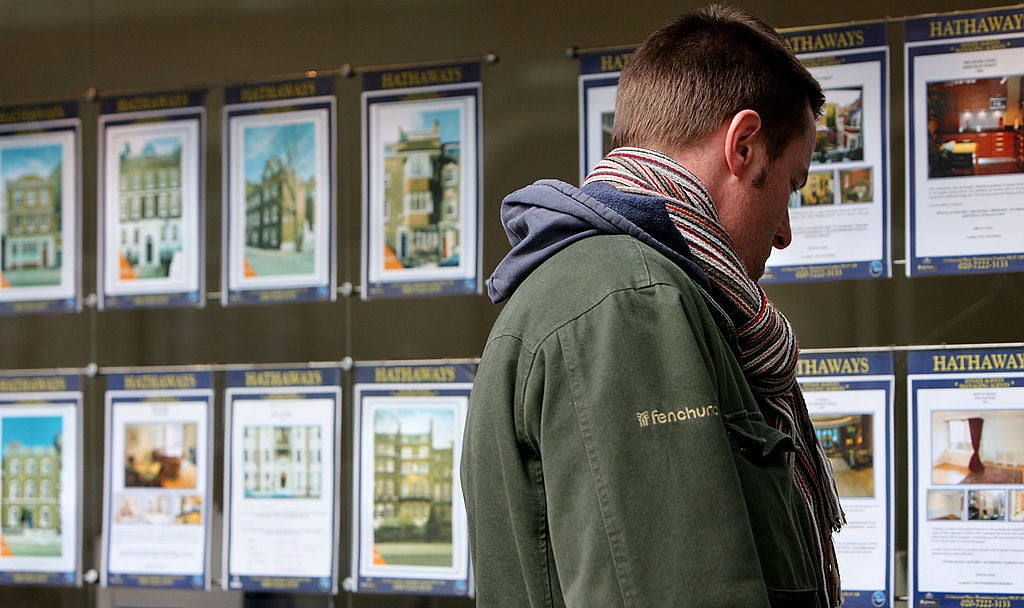 Lenders have also pulled hundreds of the best mortgage deals off the market (Getty)
Nathan Emerson, CEO of Propertymark, says: “While it is encouraging to witness growth within the housing market year on year, it is also sensible to highlight that the coming months could represent a wind of change when considering the wider global economy.
“Even with inflation remaining steady this month, the prospect of any base rate cut when the Monetary Policy Committee next meets does feel potentially slim, especially when considering reports that many households will likely face considerable pressure from rising fuel and energy costs across the forthcoming months.”
Lenders have pulled hundreds of the best mortgage deals off the market. It is presently almost impossible to get a 2-year fixed rate deal at less than 5 per cent.
Rents will probably keep rising, however.
Mr Bill added: “We expect upwards pressure on rents to intensify this year due to the arrival of the Renter’s Rights Act in May. Any extra inconvenience around setting rents or regaining possession of a property may prompt more landlords to sell and keep supply tight, which will have the unintended consequence of financially squeezing tenants.
“This has been particularly notable in the capital, where renting is traditionally more common and demand is higher.”