

Scientists in the US have uncovered a rare quantum material capable of switching between two distinct electronic states on demand, which could open the door for faster computer chips and adaptive sensors.
Led by the US Department of Energy’s (DOE) Argonne National Laboratory (ANL), the team identified the new, switchable quantum property in a new type of nickel sulfide material, known as KxNi4S2 (0 ≤ x ≤ 1).
The compound reportedly features nickel and sulfur sandwiched between layers of potassium, which can be present in varying amounts from zero to one, based on the sample.
“You can tune how much potassium comes out of the material, from full to empty and everything in between,” Mercouri Kanatzidis, PhD, a Northwestern University professor who led the research, said.
Quantum material discovery
Kanatzidis noted that the material can switch between quantum states within the same structure. “I cannot name another material that can do this – if one exists, it is not well known,” he added.
KxNi4S2 was first developed in 2021, as part of a project aimed to create more superconductors. But as the researchers studied its properties, they found that applying an electrical current can push the potassium out of the layers.
This, in turn, caused the sandwich to collapse, altering the material’s overall form. The process is reversable, so it allowed the material to host two distinct quantum features: Dirac cones and flat bands.
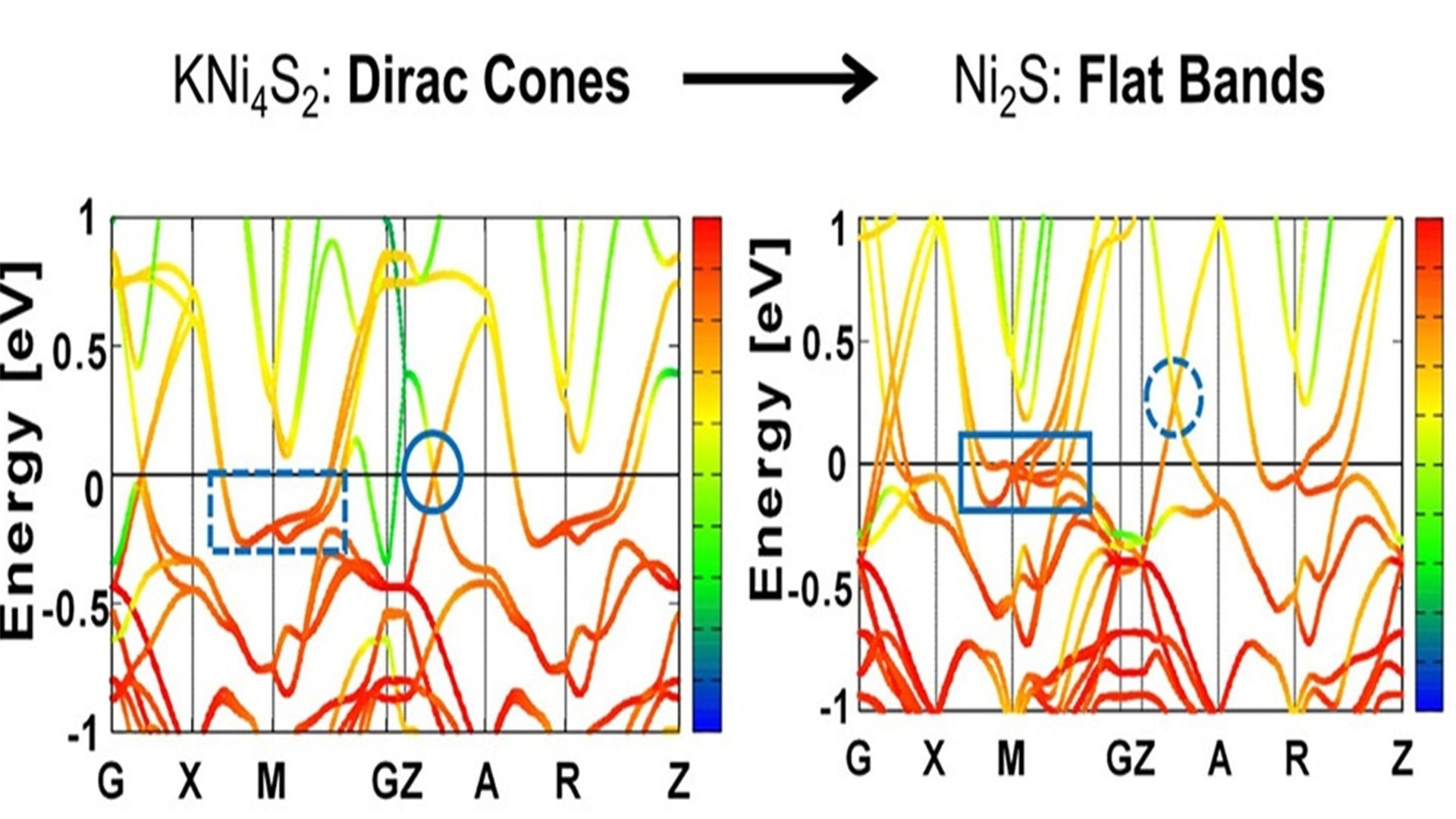 The transition between states and highlights flat bands (in squares) and Dirac cones (in circles).
Credit: Hengdi Zhao
The two states play a crucial role in controlling how electrons behave. In the Dirac state, electrons act as if they are nearly massless, and move extremely fast. In turn, flat-band states slow electrons down, making them behave as if they are heavier.
This duality effectively converts the material into an electron traffic controller and enables precise tuning of speed and flow. As per the team, such control is highly sought after in modern electronics.
Devices that can dynamically adjust electronic behavior could boost performance, efficiency, and functionality across a wide range of technologies, like high-speed processors and smart sensors.
Tunable quantum phases
For the study, the scientists created samples of the materials at Argonne’s Center for Nanoscale Materials (CNM), where they calculated its electronic structure with the Bebop high-performance computing cluster.
They confirmed the dual states in KxNi4S2 (0 ≤ x ≤ 1) using observations at the Advanced Photon Source (APS). Both CNM and APS are DOE Office of Science user facilities.
“The high amount of nickel in this material means the nickel atoms have to interact and bind to each other, and that’s what we think gives rise to its interesting properties,” Kanatzidis noted in a press release.
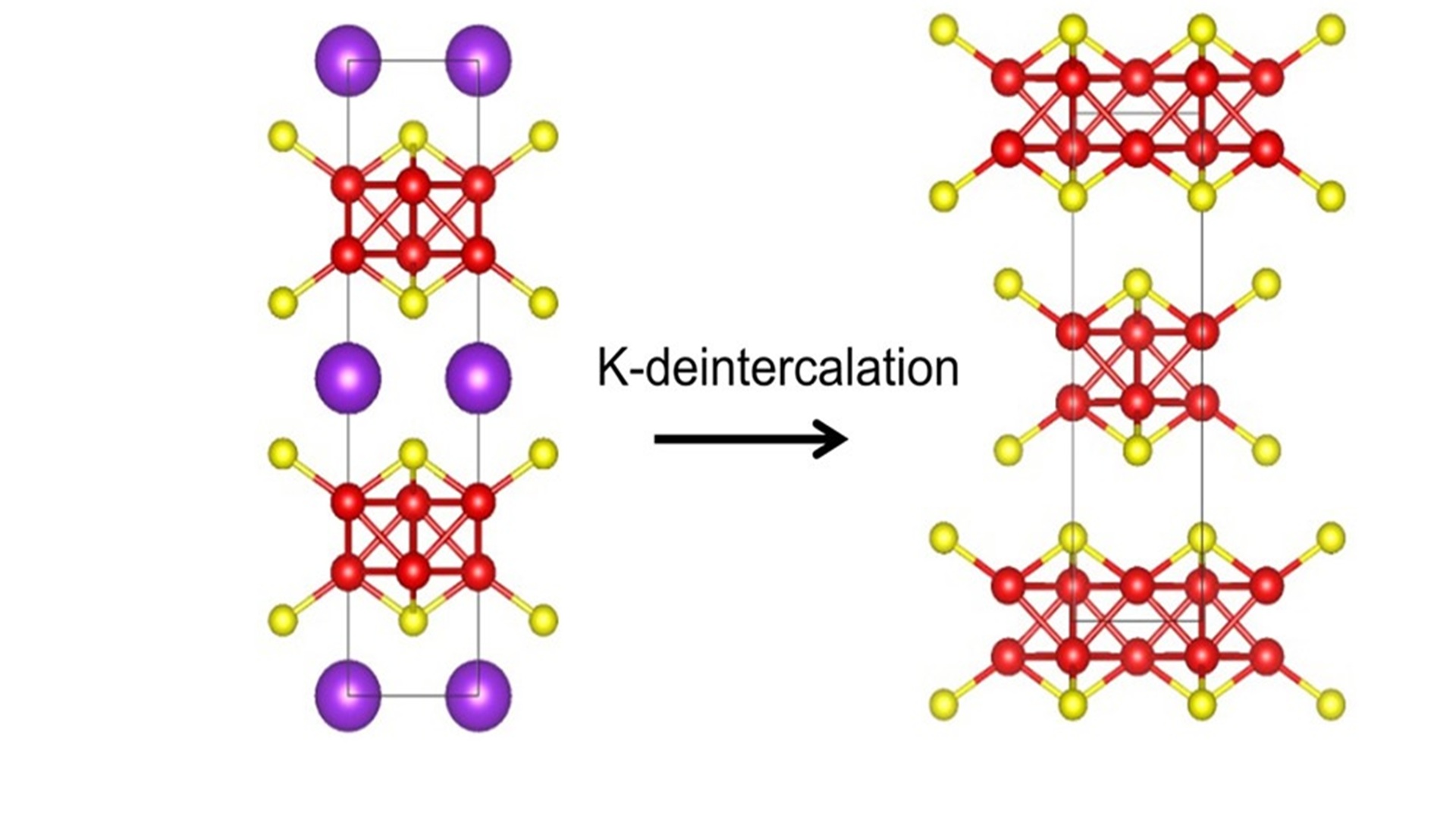 KNi4S2 structure. Left: Atoms of potassium (K), nickel (Ni) and sulfur (S) depicted in purple, red and yellow, respectively. Right: The removal of K atoms.
Credit: Hengdi Zhao
The ability to switch quantum states in one material could simplify device design. Instead of using multiple materials, engineers could rely on a single system that changes behavior in real time. In addition, the find opens the door for designing quantum materials.
“We have a much better understanding of what gives rise to this type of compound, and now we want to generalize our synthesis method to find more materials just like it,” Kanatzidis concluded.
The study has been published in the peer-reviewed journal Matter.