
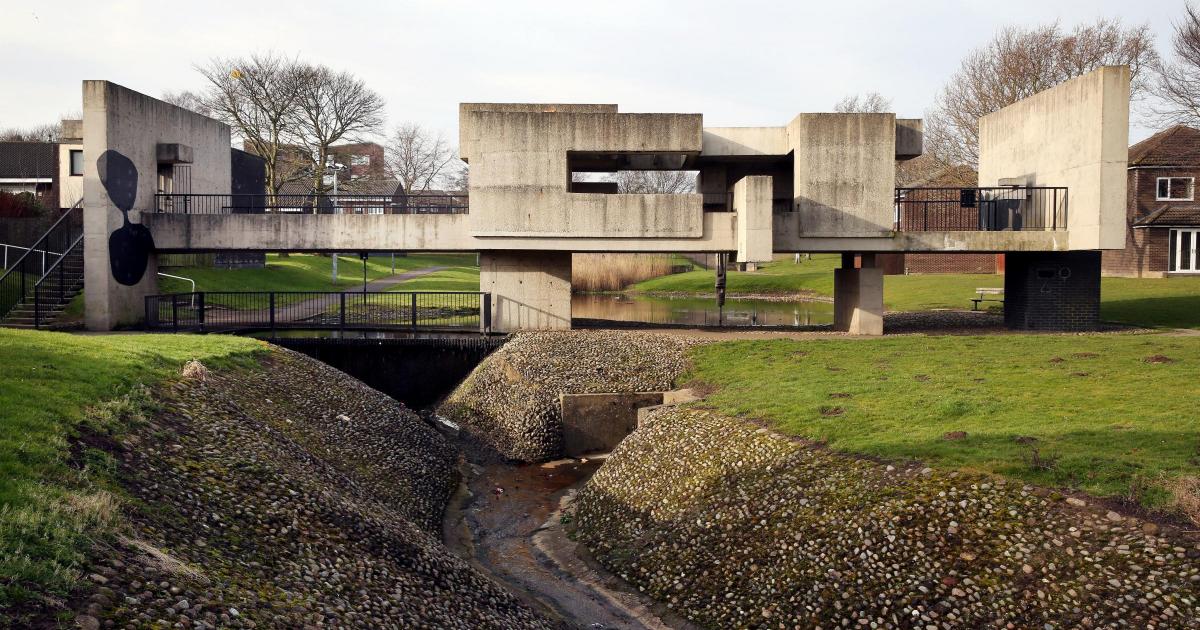
The Grade II-listed Peterlee structure, designed by artist Victor Pasmore in the late 1960s, ranked 18th on a new list of the UK’s top 20 brutalist buildings.
Durham University’s Dunelm House, a prominent example of post-war design, came in at 16th place.
The Apollo Pavilion, which fuses public art with practical use as a pedestrian walkway, was intended to represent the same spirit of hope and progress that shaped the new town of Peterlee.
Pasmore insisted it be named after the Apollo space mission, in honour of the 1969 moon landing.
However, the Peterlee Development Corporation declined to officially name the structure and opened it without ceremony on January 27, 1970.
The pavilion quickly sparked division in the community.
With little upkeep, it became a target for vandalism, and its concrete forms were seen by some as a magnet for anti-social behaviour.
By the early 1980s, calls for its demolition grew louder, with councillor Joan Maslin describing it as “a dirty lump of concrete, no more than a monstrosity and an eyesore.”
Despite the criticism, the building achieved Grade II-listed status in 2009.
The ranking was compiled by Making Moves, who used a score based on architecture awards, TripAdvisor ratings, Instagram hashtags, and Google search volume.
Durham University’s Dunelm House was also featured on the list.
London’s Barbican Estate took the top spot, followed by the Hayward Gallery and the University of East Anglia.
Long-debated brutalist landmarks including Preston Bus Station and Park Hill in Sheffield also featured in the top 10.
Sally Evans, managing director at Making Moves, said: “Brutalist buildings are increasingly being recognised as an opportunity rather than an obstacle for London’s office market.
“Instead of demolition, we’re seeing landmark 1960s structures refurbished and repositioned to meet modern occupier expectations.”
Ms Evans said the wider trend toward reusing brutalist buildings demonstrates their growing relevance in today’s property market.
She said: “The transformation of Space House in Covent Garden demonstrates how retaining the majority of an existing structure can deliver both strong sustainability credentials and distinctive, high-spec workspace – qualities that are becoming more valuable in a competitive leasing environment.”
The Apollo Pavilion continues to divide opinion, but its inclusion in the national top 20 highlights the lasting impact of Britain’s post-war architectural experiments and the ways they continue to shape public discussion and urban identity.