
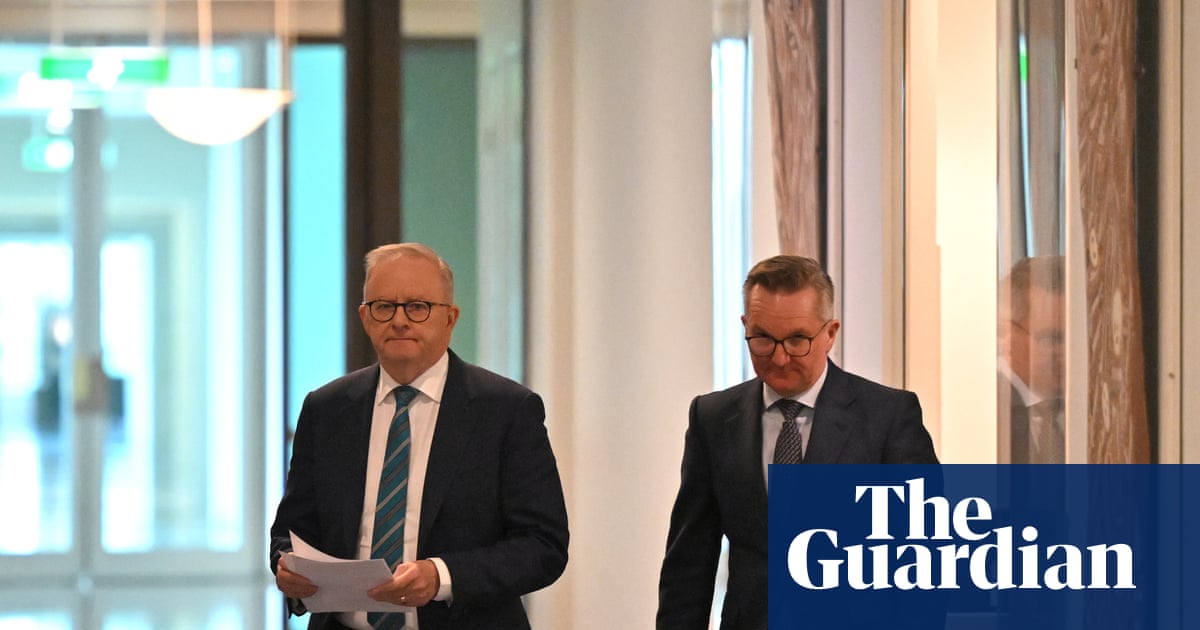
Monday’s national cabinet meeting is not likely to endorse petrol rationing across Australia – but you can see more serious government interventions on the horizon.
The Albanese government doesn’t expect this fuel crisis to suddenly resolve itself.
“Even if this conflict was to end tomorrow, there is going to be a long tail … this situation is not going to end any time soon,” the environment minister, Murray Watt, warned on Sunday.
As the federal budget nears on 12 May, businesses are calling for help and focus is turning to those vulnerable Australians hit hardest by inflation, interest rates and now ballooning fuel prices. The Albanese government will focus in parliament this week on its plan to underwrite petrol companies to secure more supply but most of the fuel problem is logistical, not legislative; so there are other levers that governments could start pulling.
Anthony Albanese will outline more of his approach in a speech to the National Press Club on Thursday. But business groups are floating the need for cashflow support, farmers’ groups need help securing diesel and fertiliser, and some state governments are announcing free public transport – something the Greens had been pushing for nearly two weeks, when the fuel price and supply crunches started really hitting.
It means Jim Chalmers’ budget will have even more demands on spending than usual. Watt on Sunday conceded budget decisions might be made later than usual “because things are so volatile”. Who knows which sectors will need emergency support by May?
There’s also an electoral question. Will the government start copping even more of the public blame and need a political boost?
Perhaps that’s why Albanese has left the door open for a cut to the fuel excise.
Sign up for the Breaking News Australia email
Despite Chalmers saying last week the government was not thinking about such a move, Albanese pointedly didn’t rule it out after the opposition leader, Angus Taylor, called for halving the 52.6c/L surcharge for three months. The government probably doesn’t want to swallow the $1.5bn cost just yet but may be keeping it as a “break glass in case of emergency” option of last resort.
Of course there’s a chance it would make no real difference. Economists and analysis have shown, including when Peter Dutton suggested it at the last election, that it would be poorly targeted and go towards richer people. Cheaper petrol could even increase demand, and put pressure on inflation.
But you could see how a government under pressure could mount an easy populist campaign by saying they’d made fuel 25c a litre cheaper.
It comes amid correlated concerns about inflation. Last week’s Guardian Essential poll found a quarter of Australians thought government spending was the biggest factor in the Reserve Bank raising interest rates. So the government faces new calls to spend money from some, while at the same time being criticised for spending too much already by others.
Don’t be surprised to see more government members calls for a windfall tax on gas profits. Political momentum is building among Labor MPs for such a move – which could help offset some of the spending they might be forced into.
The government is keen to be seen to be doing things to combat the fuel issue after being accused of being caught flat-footed in the early stages. We’ve seen a snap press conference on Friday, daily briefings of long lists of data, a flurry of task forces and new rules.
National cabinet is being urged to bed down a plan for when fuel shortages really start to hurt, with various industries clamouring to be classed as essential and given first bite at diesel supplies. The federal government sees Victoria and Tasmania announcing free public transport as examples of steps the states can be taking without Canberra needing to set a national plan, with Albanese seeing his role as more about coordinating the states to make sure they’re all working in the same direction.
Albanese on Friday drew links between the fuel crisis and Covid, saying governments had learned lessons from the pandemic about making consistent plans or having different sets of rules. But while politicians are calling for a similar moment of national cooperation now, the government cannot afford a similar economic downturn or shutdown of movement. They don’t want people sitting around anxiously waiting for the latest daily update on petrol station numbers, like the Covid case counts of recent years.
While a national dashboard of fuel outages is being demanded by Queensland, and might eventuate from Monday’s meeting, federal sources are quietly pointing out all these numbers come from the state governments anyway and that states already have their own local petrol tracker websites.
The Albanese government would also remember that Covid came with the jobkeeper wage subsidy program and other massive industry supports. Albanese talks about learning lessons from Covid mistakes – one of them may be about targeting and time-limiting industry supports to those who really need them.
Elsewhere in this three-day sitting week, we will get some long-awaited updates on the social media ban for under-16s. Murmurings inside the government are that they reckon some tech companies are not doing enough to restrict children from their platforms.
Early in the week, the communications minister, Anika Wells, is expected to give new stats on how the minimum age rules are working. Anecdotally many teenagers are still on the apps and haven’t been removed. The government wants its reforms to work, and expects tech giants to comply with the letter of the law – even if some of them are trying to cast doubt on Australia’s regime, for fear it will be replicated overseas.