
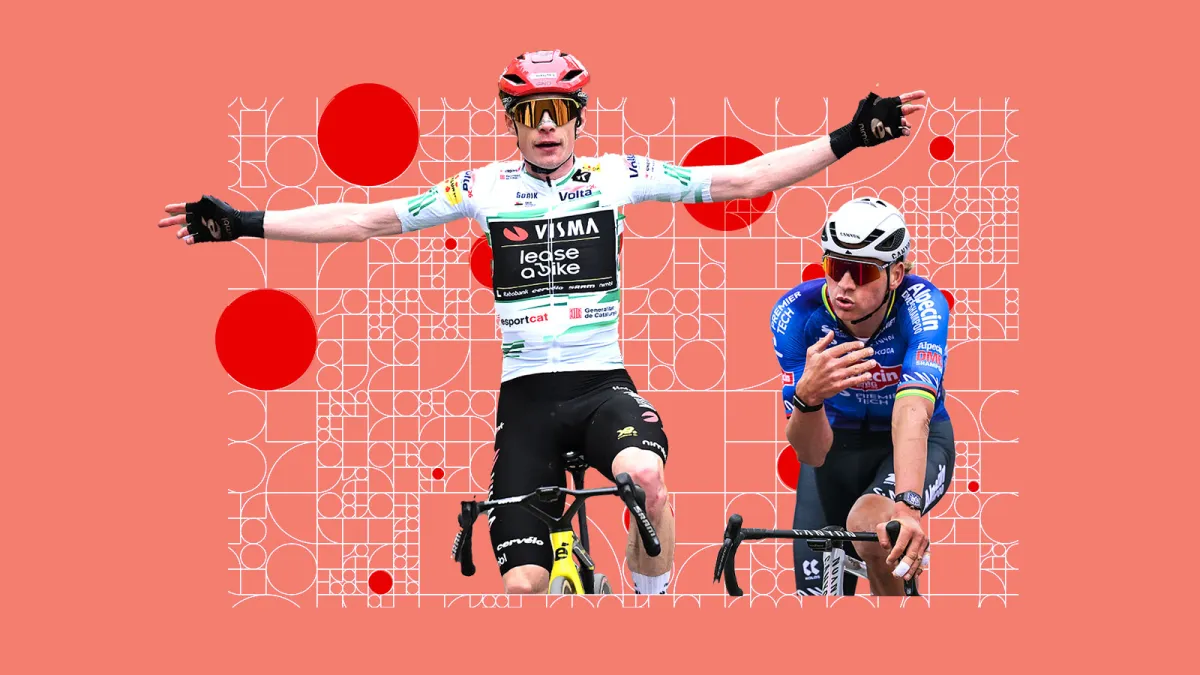
It is a peculiar sport when you only see the top two competitors go head to head once a year in July. Imagine a world in which Carlos Alcaraz and Jannik Sinner played each other only at the French Open. That is the reality of cycling. For Tadej Pogacar and Jonas Vingegaard, all we can do before the Tour de France is analyse their form and judge whether their one meeting will be a close affair.
Pogacar, of UAE Team Emirates-XRG, is clearly better than ever. After only two race days this season (both of which he won, at Strade Bianche and Milan-San Remo), the question is now: does his great Tour rival, Vingegaard, stand a chance this summer? It will be their sixth meeting at the Tour, where for the past five years the top two positions at the race have been held by either the Dane or the Slovenian. Pogacar leads the head-to-head 3-2.
There are signs that new warriors are on their way. The 19-year-old Frenchman Paul Seixas, of Decathlon CMA CGM, is living up to significant expectations. Pogacar’s team-mate Isaac del Toro looks the real deal and Giulio Pellizzari, of Red Bull Bora-Hansgrohe, continues growing into a fine rider with every race. For now — though Pogacar has comfortably beaten Vingegaard over the past two years (with gaps of 4min 24sec and 6min 17sec) — the Visma–Lease a Bike rider still appears to be the only real competition Pogacar has.
The Volta a Catalunya was vital to assess what form the Dane is in. While Pogacar was not there, the rest of the top five from last year’s Tour were: Florian Lipowitz of Red Bull, Oscar Onley of Ineos Grenadiers and Felix Gall of Decathlon. So too Britain’s Tom Pidcock, of Pinarello-Q36.5, who finished third at last year’s La Vuelta, which Vingegaard won, and Belgium’s Remco Evenepoel, a man on his own Tour de France mission, having moved to Red Bull in a headline transfer to lead them in all the major races.
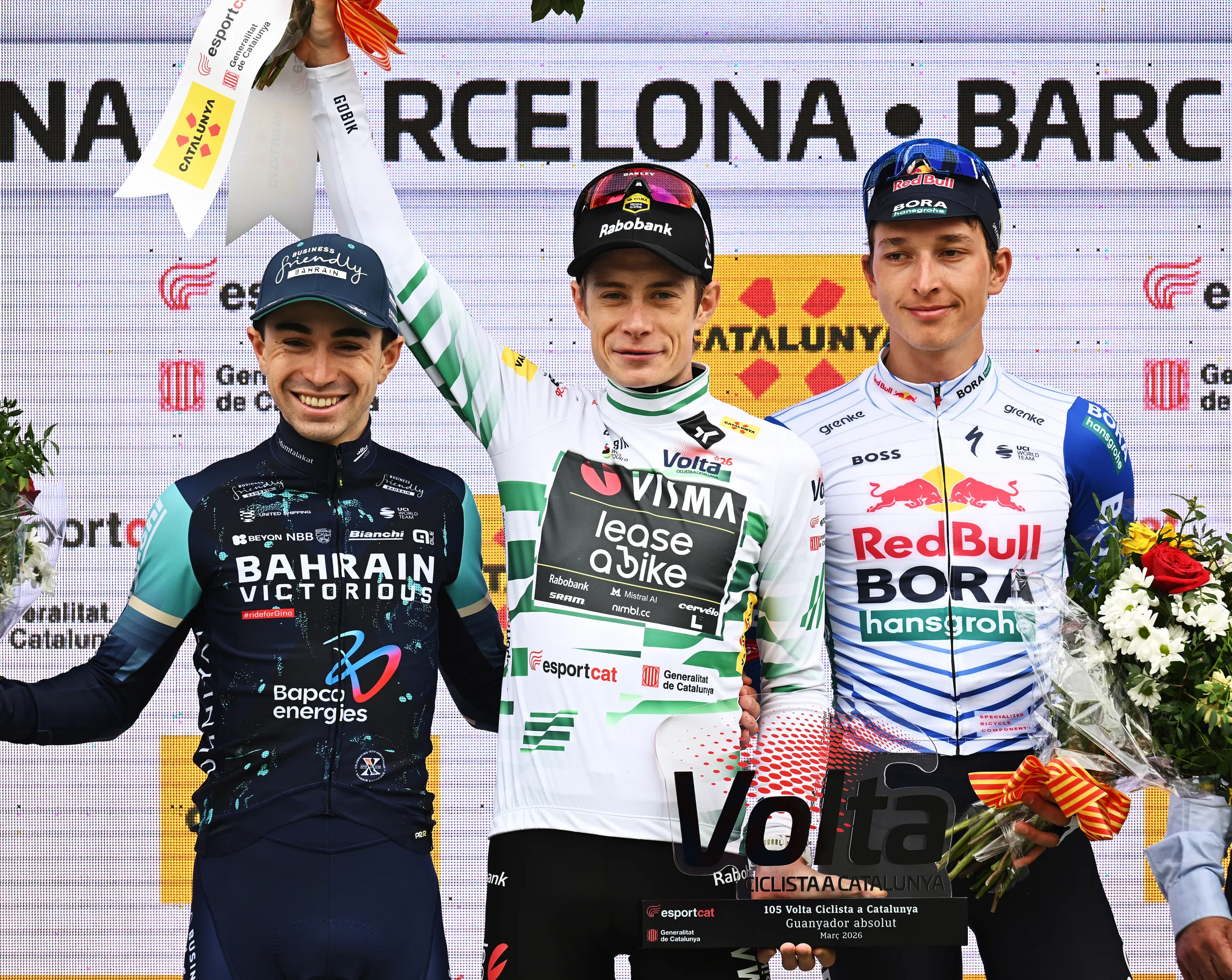 Vingegaard, centre, won the Volta ahead of second-placed Martinez, left, and Lipowitz in thirdSzymon Gruchalski/Getty Image
In seven stages, starting in Sant Feliu de Guíxols and finishing in Barcelona (where this year’s Tour will start), there was barely a flat day. Vingegaard was quite comfortable biding his time, but Evenepoel showed no such restraint, managing second on the uphill sprint behind Ineos’s Dorian Godon and ahead of Pidcock on day one. Then again, on stage four into Camprodon it was Evenepoel who attacked during a windy stage, only for Vingegaard to stick to his wheel and ultimately refuse to work with the Belgian. After the stage Evenepoel said sarcastically that the co-operation was “amazing” between the pair.
Vingegaard is known for being a defensive rider, and an intelligent one. Why would he attack on a flat finish with Evenepoel for seconds in a race that would be decided in the mountains by minutes? Evenepoel then crashed in the last kilometre on a pothole in the road, and while he managed to finish, his stage-racing instincts were missing.
Occasionally Evenepoel shows he might be better suited to the one-day races. Attacking on the flat for no real reason, and when co-operation in the group would have helped put time into his other rivals such as João Almeida, of UAE, who was caught out in the wind, would have been the sensible decision. Even his old team boss at Soudal-QuickStep has said as much: “It may well turn out that he’s a one-day rider,” Patrick Lefevere said despite Evenepoel’s obsession with stage races. He was angry with Vingegaard, but Vingegaard has won two Tours de France.
On stage five, Pidcock was caught in a crash that led to him falling down a ravine after taking a drink on a descent. He had been in second place on the general classification up until that point and was looking punchy. “It was like one of these horror crashes you see,” he said, “but I’m very lucky that I am OK. I am lucky I could talk on the radio. I was far from the road and nobody knew I was there. I’m happy I could finish the stage.” He did finish the stage, but he would not start the next day as doctors assessed his injuries.
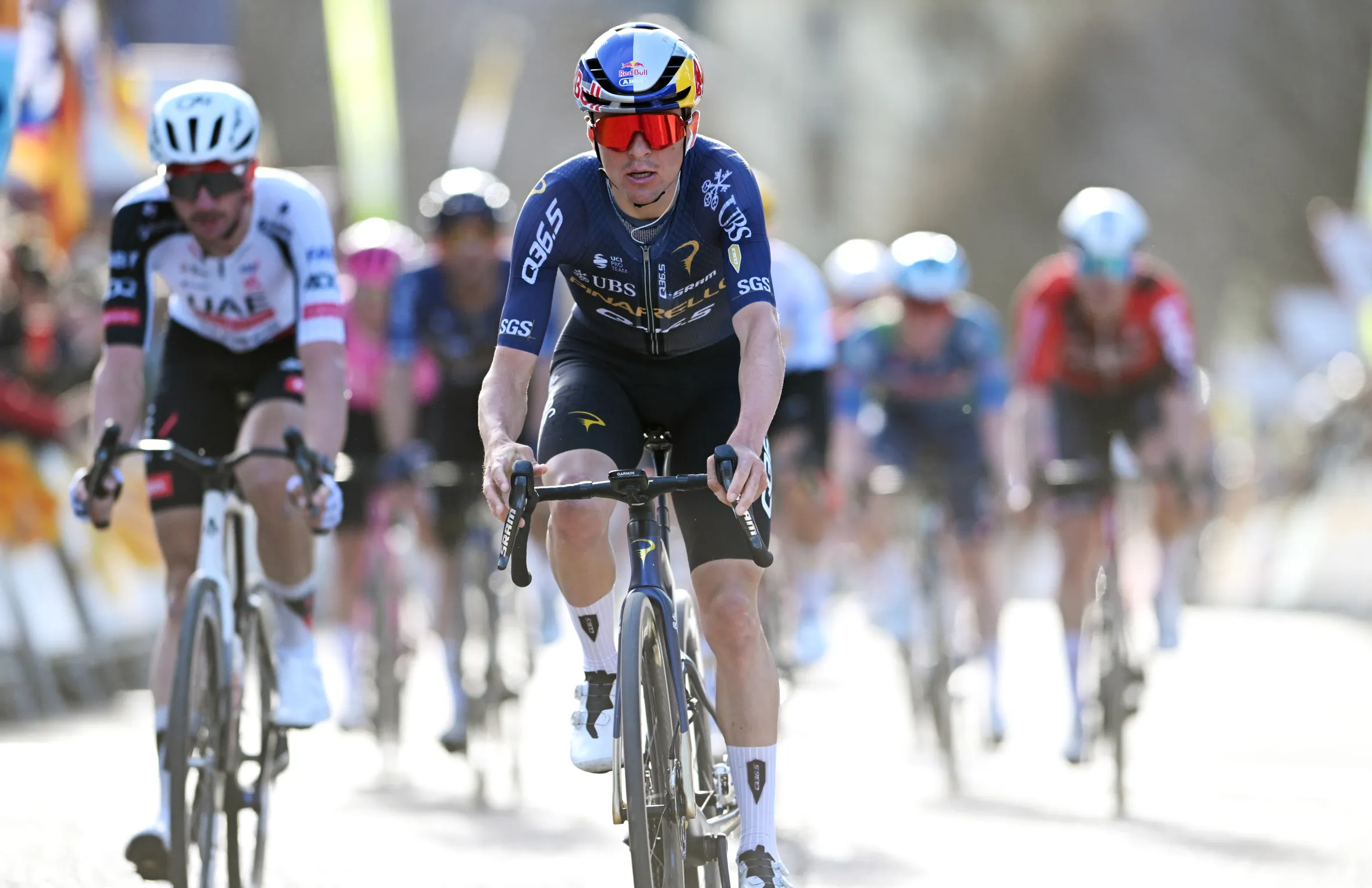 British rider Pidcock had to pull out of the race after falling down a ravine Szymon Gruchalski/Getty Images
Vingegaard, then, was in the driving seat. On stage five and six, both of which he won, the Dane simply rode away from the rest of the competition. He is rarely an explosive rider, he stays seated and pedals at a fast and relentless pace. Evenepoel had no answer, nor did Lipowitz or Onley, who still appears to be building in his first season at Ineos. Vingegaard took the general classification by 1min 22sec ahead of Lenny Martinez of Bahrain-Victorious, an unexpected contender who looked wonderful in the mountains.
The key was that Vingegaard did it while riding within himself, he never looked ruffled, he never did more than he needed. It was complete calm and ominous control. “My shape is very good [but] not the very best yet,” Vingegaard said. “We made a plan to progressively get better over the year. I’m pretty sure I still have more in me.”
The Visma rider will go to the Giro d’Italia in May searching for a victory that would complete the set of all three grand tours. But, as it stands, he may not face a test of that control until he and Pogacar at last race, at the Tour de France.
Mathieu van der Poel shows his human side
Pogacar’s principal rival in the classics, Mathieu van der Poel, of Alpecin–Premier Tech, took another victory at E3 Saxo Classic — although this one was not the slam dunk we’ve been used to. The Dutchman attacked on the Paterberg with 40km to go, but he was almost reeled in by a chasing group led by UAE’s Florian Vermeersch. In what was a stunning and somewhat petulant display, the group, within touching distance of Van der Poel, quibbled and fought among themselves and gave up the chase, refusing to work together and letting the Dutchman get away.
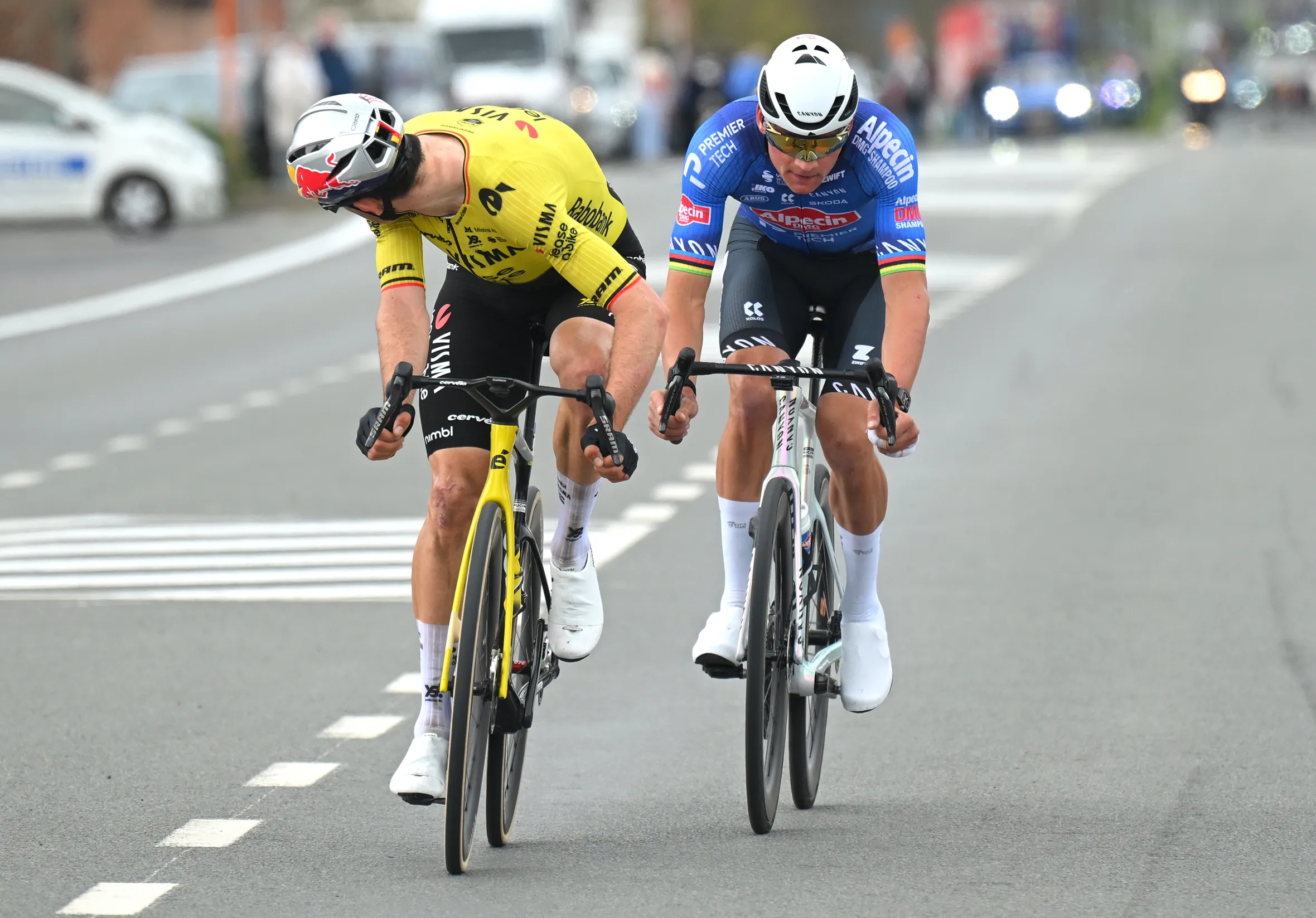 Van Aert, left, broke away with Van der Poel but the Dutchman managed to power past his rival to claim the winTim de Waele/Getty Images
Van der Poel would have been caught, a rarity in recent years. “I gave up, actually, because they were so close,” he said after the race. He cast an exhausted figure. He still won, but by only four seconds. Instead of working together until one of them could win, the chasing group decided that none of them should win.
On Sunday at In Flanders Fields — from Middelkerke to Wevelgem (formally Gent-Wevelgem) — it was a resurgent Wout van Aert of Visma who managed to break free with Van der Poel on his tail. But the Dutchman refused to give it his all as the two took turns into the wind. “The collaboration with Mathieu was good, but he had the luxury of [Jasper] Philipsen still being behind him, which allowed him to race a bit more defensively at the end,” Van Aert said. “That made the difference.” It was Van der Poel’s team-mate Philipsen who sprinted for the win.
This human side of Van der Poel, who was also dropped and beaten at Milan-San Remo by both Pogacar and Pidcock, will give Pogacar hope that he has a chance to win not just the Tour of Flanders this Sunday, but also the one of cycling’s “monuments” he is missing from his record: Paris-Roubaix, on April 12.
Lloyd enters world stage
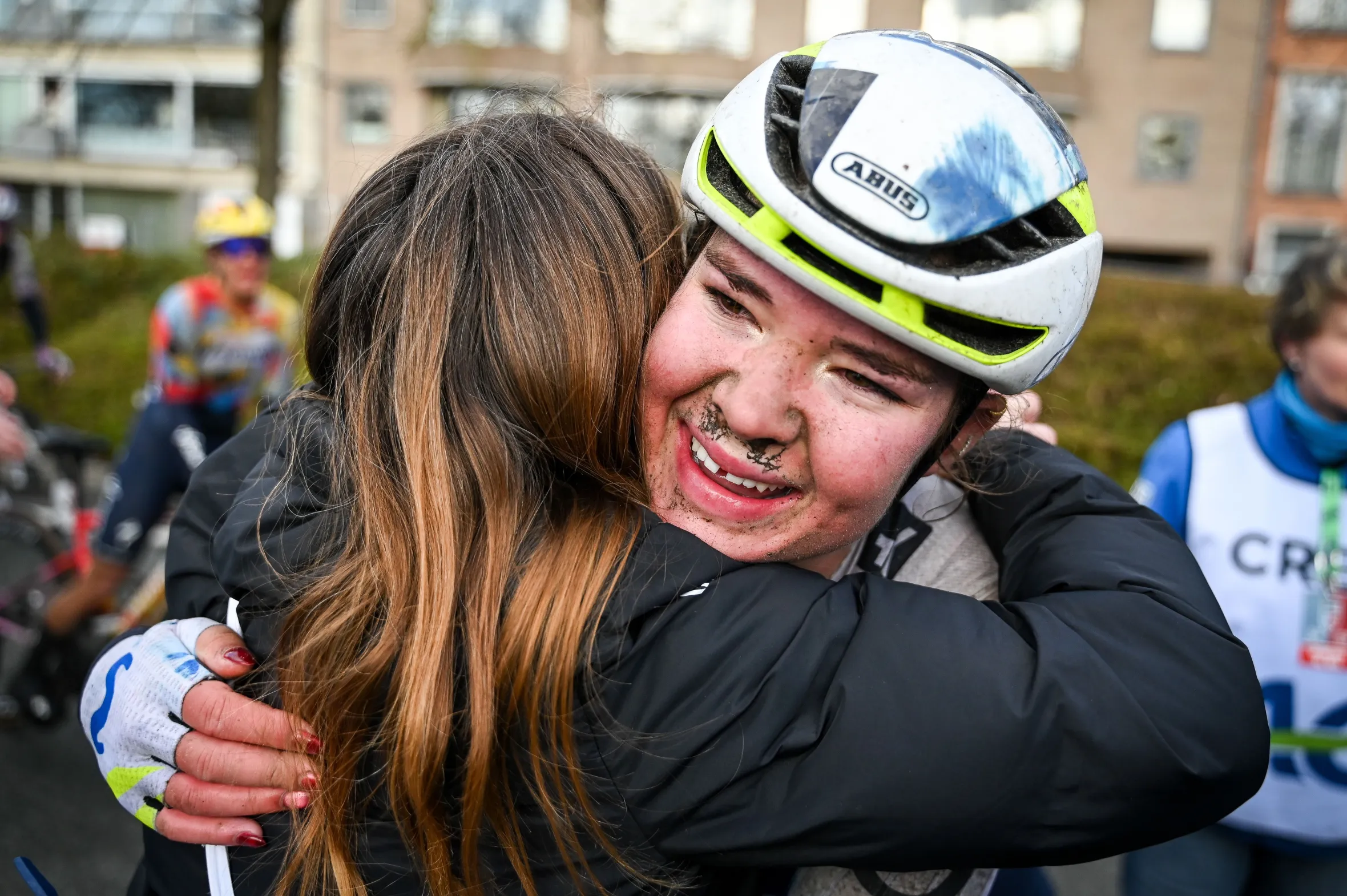 Lloyd secured her first World Tour win – the teenager’s first victory as a professional — in BelgiumElias Rom/Belga/Shutterstock
One final word for Britain’s 19-year-old Carys Lloyd, of Movistar, who managed a resounding victory in the Ronde van Brugge last week from a field that included the great Lorena Wiebes, of Team SD Worx-Protime.
The 144km race came down to a bunch sprint but with little left of the lead-out trains it was every rider for themselves. Lloyd launched with 200 metres to go and never appeared at risk of losing. She powered away, a bike’s length ahead of her nearest competitor, Elisa Balsamo, and became the youngest ever winner of that race.
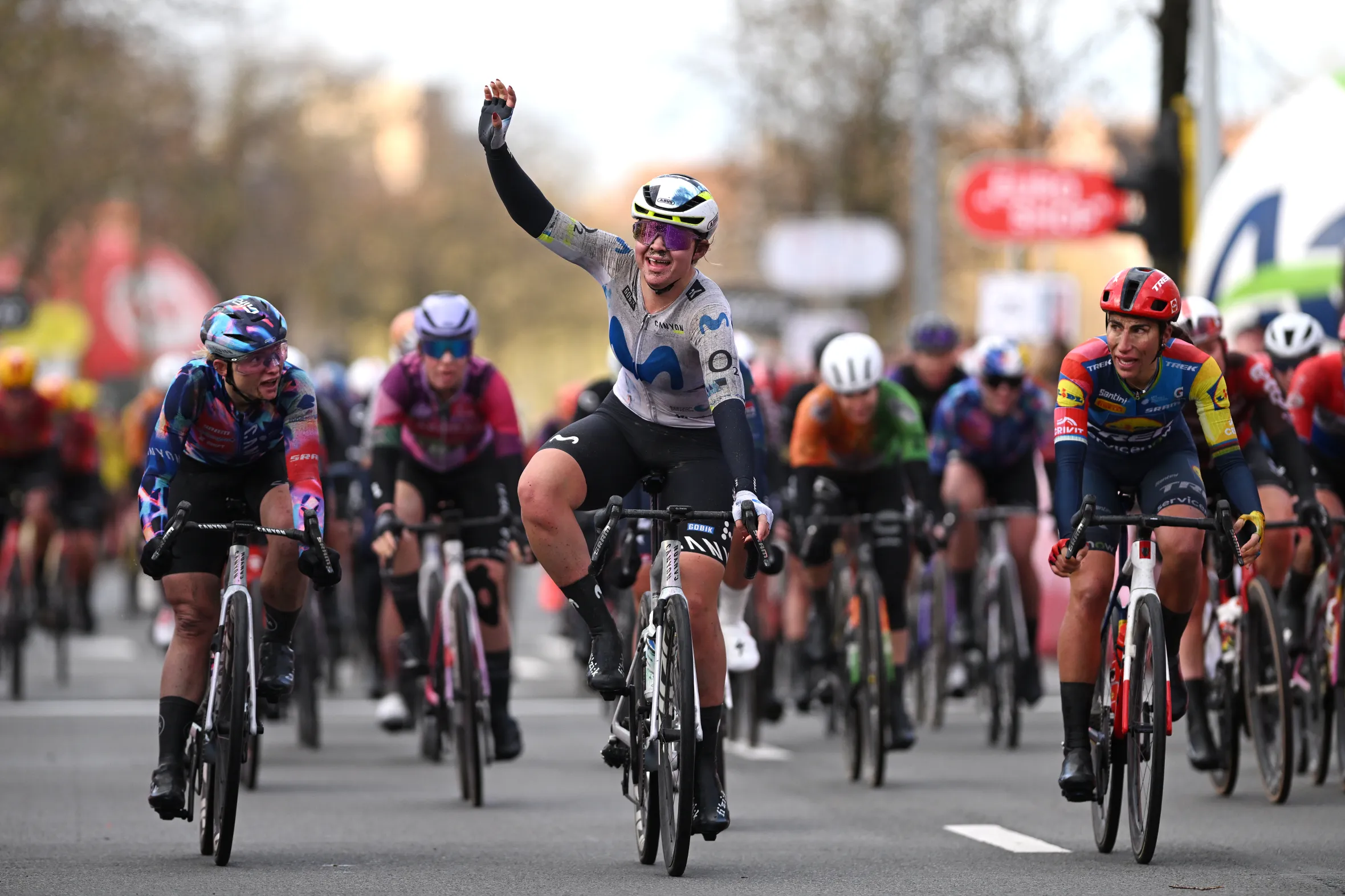 Lloyd bettered her rivals with a 200-metre sprint to victoryLuc Claessen/Getty Images
Covered in a thin film of dirt from the roads, Lloyd said after the race: “My mechanic was like, ‘I’ll take you to the Lego store and you can buy anything if you win,’ as a joke, but actually I turned around and was like, ‘Oh f***,’ sorry, ‘Oh my God, I actually won.’ ”